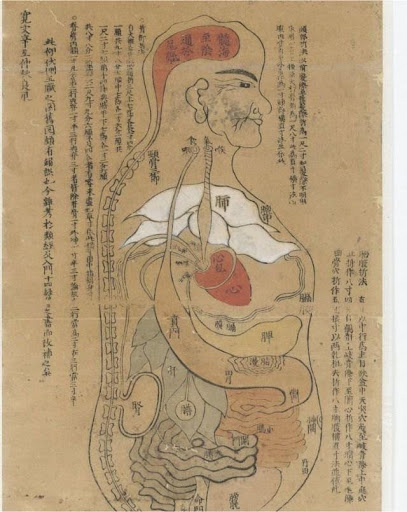
Artist, Title, Date
Jinshin gozō no zu (Illustrations of Human Internal Organs), Japan, 1661.
= Acupuncture =
The practice of acupuncture represents one of the oldest continuous medical traditions in human history. While the exact origins are debated, foundational texts like the Huangdi Neijing, or the “Yellow Emperor’s Inner Canon”, established acupuncture as a method to balance the body's "Qi," or vital energy. Unlike the Western anatomical focus on discrete structures with prescribed, rigid functions, ancient Chinese medicine viewed the body as an integrated system of functional relationships. At the time, health was defined as the harmonious flow of Qi, and illness was seen as a blockage or imbalance, much like the "ritual expelling of evil spirits" or "quelling of abnormal behaviors" seen in other forms of naturalistic medical practice. Indeed, this idea of an imbalance of energies and flow of various life-giving fluids has been pervasive throughout early medicine, including in the West in which illness was believed to arise when one’s “humours”, or the four essential fluids of the body, were imbalanced.
The attached image depicts the internal organs and their external pathways, or “meridians”, through which this energy was believed to flow throughout the body. By carefully inserting needles at various points throughout these meridians, acupuncturists aim to realign one’s Qi, balancing the flow of energy throughout the body in order to relieve stress and pain, quell inflammation, and provide a more holistic, natural remedy for certain ailments.
In ancient times, acupuncture practitioners were craftsmen who passed down techniques through guilds or family lineages, much like the barber-surgeons seen in the European Middle Ages. Such techniques and tools were then iteratively refined; for instance, acupuncture was practiced using needles which had been diligently evolved from sharpened stones to refined metal, reflecting advancements in craftsmanship similar to the transition from rudimentary Neolithic borers to the specialized tools used by Renaissance surgeons. Indeed, the transition of acupuncture from a folkloric tradition to today’s global medical modality mirrors the wider descent of modern medicine from much more naturalistic practices. For instance, in the modern era, acupuncture has undergone a process of "medicalization," where traditional concepts are reinterpreted through the lens of objective science. For example, modern Western acupuncture involves a more focused approach to musculoskeletal anatomy rather than purely symbolic meridian points, and some practitioners even use the application of a small electrical current to needles to enhance stimulation, shifting the practice of acupuncture towards a more objectively grounded science while retaining its naturalistic and humanistic origins.
Today, acupuncture is recognized for its efficacy, particularly in pain management and neurological rehabilitation. Modern neuroimaging has shown that acupuncture can modulate the central nervous system, validating the prehistoric belief that physical intervention could soothe mental or physical ailments. Specifically, acupuncture has been shown in some studies to be effective in reducing inflammation and modulating neurotransmitters, assuaging post-operative nausea, and aiding in relief of internal pressure that can enhance neurological recovery.
The history of acupuncture reminds us that the roots of human medicine lie not within pure scientific and numerical studies, but within our common cultures and beliefs. Just as Neolithic trepanation is a precursor to modern craniotomies, ancient acupuncture provides a crucial bridge between ancient healing and modern neurobiology. Further, the continued practice and successes of acupuncture remind us that modern medicine thrives when it combines both objective sciences with the foundational observations from naturalistic, folkloric craftsmen who originated the practice of medicine and an understanding of the human body.
Author (s): Michael Motoc
Citations:
* 1) Kaptchuk, T. J. (2000). The Web That Has No Weaver: Understanding Chinese Medicine. McGraw-Hill. * 2) Vickers AJ, Cronin AM, Maschino AC, et al. Acupuncture for chronic pain: individual patient data meta-analysis. Arch Intern Med. 2012;172(19):1444-1453. doi:10.1001/archinternmed.2012.3654 * 3) Smith CL, Reddy B, Wolf CM, et al. The State of 21st Century Acupuncture in the United States. J Pain Res. 2024;17:3329-3354. Published 2024 Oct 10. doi:10.2147/JPR.S469491 * 4) A. White, E. Ernst, A brief history of acupuncture, Rheumatology, Volume 43, Issue 5, May 2004, Pages 662–663, https://doi.org/10.1093/rheumatology/keg005