Artist/ Title/ Date
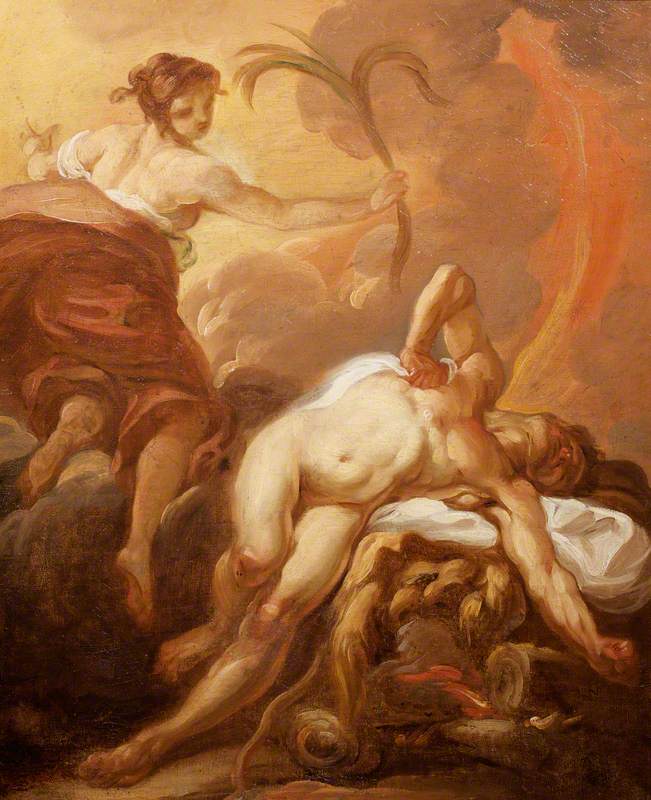
The Death of Hercules, Jean-Baptiste Deshays (French, 1729–1765)
Medium, time frame
Oil on canvas, Mid-18th century
Artist / Group / Tribe
Jean-Baptiste Deshays was a French history painter working within the late Baroque and early Neoclassical traditions. Academically trained, he specialized in mythological and biblical scenes characterized by dramatic movement, anatomical precision, and heightened emotional expression. His work reflects Enlightenment engagement with classical antiquity as a framework for moral, philosophical, and scientific inquiry.
Historical and Socio-Cultural Context
Painted during the Enlightenment, The Death of Hercules reflects renewed interest in classical myth as a means of examining human suffering, bodily vulnerability, and moral consequence. This period also witnessed expanding scientific inquiry into toxicology, pharmacology, and the physiological effects of chemical substances.
The Hercules narrative—particularly his death caused by the poisoned robe of Nessus—would have resonated with contemporary audiences attuned to the dangers of invisible agents of harm and the limits of bodily strength in the face of chemical exposure.
Symbolism and / or Iconography
The poisoned robe functions as the central symbolic device, transforming an object associated with protection and status into an agent of destruction. In myth, the robe is infused with Hydra venom, aligning the narrative with early understandings of pharmacology and toxicology, in which substances could act as both medicine and poison depending on context and dosage.
Hercules’ contorted body visualizes the internal effects of systemic poisoning. His muscular contractions, expressive agony, and loss of control externalize an otherwise invisible physiological process, rendering chemical harm legible through the language of the body.
Stylistic Significance (Elements of Art / Principles of Design)
Deshays employs dramatic chiaroscuro, dynamic diagonals, and exaggerated anatomical tension to convey acute suffering. The heroic body—traditionally emblematic of invincibility—is destabilized, its idealized musculature rendered powerless by an unseen toxic agent.
The twisted composition and heightened movement suggest neurological and systemic distress, visually articulating the collapse of bodily systems under chemical assault.
Social / Cultural Inequities
Although mythological, the image reflects Enlightenment-era anxieties about poisoning, secrecy, and unequal access to pharmacological knowledge. In the eighteenth century, understanding of toxic substances was unevenly distributed, and exposure—intentional or environmental—often disproportionately affected those without knowledge or agency.
Hercules’ helplessness despite his strength mirrors broader social realities in which bodily power offers no protection against chemical harm.
Medical Cross-References (AMDx Taxonomy)
* Primary Classification: Toxicology / Pharmacology * Suspected Condition: Systemic poisoning (toxic envenomation) * Body Systems Affected: Nervous system, muscular system, integumentary * Related Conditions: Chemical burns, neurotoxicity, systemic inflammatory response * Mechanism (Mythological): Transdermal absorption via poisoned garment * Visual Indicators: Muscle spasms, pain response, loss of motor control
AMDx Thematic Tags
Poison • Pharmacology • Toxic Exposure • Myth and Medicine • Bodily Vulnerability • Invisible Disease Agents
Selected References (APA)
Daston, L., & Park, K. (1998). Wonders and the order of nature, 1150–1750. New York, NY: Zone Books.
Louvre Museum. (n.d.). Jean-Baptiste Deshays: Mythological paintings. Paris, France.
Ovid. (2004). Metamorphoses (A. D. Melville, Trans.). Oxford, UK: Oxford University Press. (Original work published c. 8 CE)
Sneader, W. (2005). Drug discovery: A history. Chichester, UK: John Wiley & Sons.
Stafford, B. M. (1991). Body criticism: Imaging the unseen in Enlightenment art and medicine. Cambridge, MA: MIT Press.
Wellcome Collection. (2019). Poison: Fear and fascination. London, UK: Wellcome Trust.