Artist, Title, Date
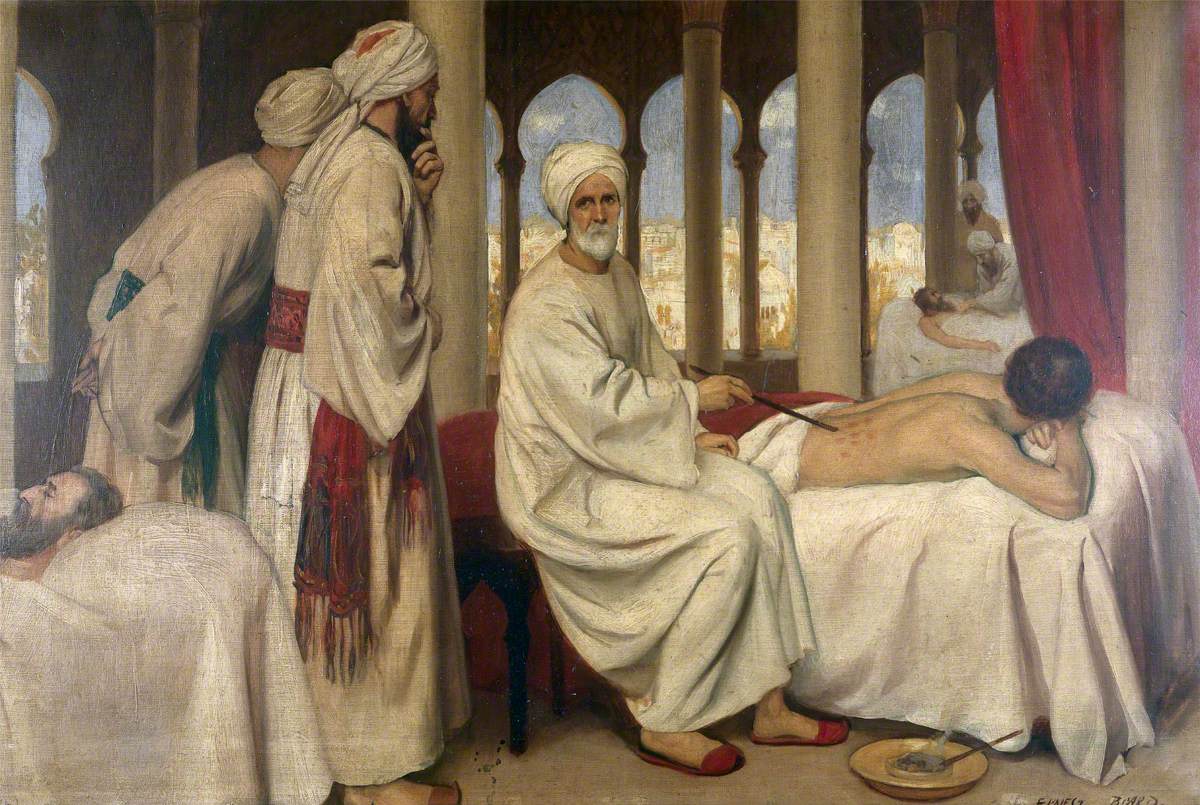
Ernest Board, Albucasis Blistering a Patient in the Hospital at Cordova, late 19th, early 20th century. Oil on canvas. Wellcome Collection, London, England.
Blistering
Blistering, also known as vesiculation or counter-irritation therapy, was a once-common medical practice of deliberately creating blisters on the skin through the use of heat, caustic substances, or irritant plasters. For centuries this process was believed to rebalance bodily humors, draw out “toxins,” or divert disease from internal organs to the surface. From the Greco-Roman period through the Islamic Golden Age and well into the 18th century, blistering was considered a legitimate and often essential therapeutic intervention for ailments such as inflammation, fever, neuralgia, and even mental illness.
The technique likely originated in folkloric or natural healing traditions but is most directly first referenced in classical medicine where it was described in the works of Hippocrates and Galen as a method to “revulse” or redirect morbid humors. This rationale rested on the humoral theory, which posited that health depended on the balance of blood, phlegm, yellow bile, and black bile, the four “humors”. Excess of one humor could be counteracted by creating a controlled lesion that drew inflammation outward. Physicians achieved this effect using mustard plasters, heated cups, or chemical agents such as cantharidin, the active compound from blister beetles (Cantharis vesicatoria) (Risse, 1987).
In the later Islamic world (8th–14th centuries), blistering was both refined and rationalized within a broader framework of empirical and theoretical medicine. Scholars such as Al-Razi (Rhazes) and Ibn Sina (Avicenna) codified its indications in works like Kitab al-Hawi and The Canon of Medicine. They described blistering as a measured form of “counter-irritation,” useful for conditions now known as chronic headache, meningitis, pleurisy, and arthritis, provided it was carefully timed and anatomically precise. Avicenna emphasized that vesicants should be applied “neither too long nor too deeply,” to avoid nerve injury or ulceration, reflecting a nuanced understanding of dose and tissue response
In the surgical tradition of al-Zahrawi (Albucasis), depicted in Ernest Board’s Albucasis Blistering a Patient in the Hospital at Cordova, blistering and cautery were considered both preventive and therapeutic. His Kitab al-Tasrif, a monumental medical encyclopedia, includes detailed illustrations of instruments used to apply heated metal to create controlled burns and blisters. These forms of external damage were used by Albucasis to treat epilepsy, sciatica, and chronic inflammation, believing that drawing humors to the surface could “liberate” internal congestion (Savage-Smith, 1995).
The procedure, having been extensively practiced and refined, endured in both Islamic and European medicine into the early modern period. Physicians of the 17th and 18th centuries, such as Thomas Sydenham, still prescribed blistering plasters for fevers and pneumonia, citing their ability to “stimulate the skin and recall nature’s powers.” Although later criticized as painful and unscientific, the principle underlying blistering—namely using controlled irritation to induce a systemic healing response—has echoes in modern therapies. Today’s counter-irritant treatments, including topical capsaicin for neuropathic pain or the use of mild inflammation to stimulate immune responses in vaccines, descend conceptually from this ancient rationale.
Ultimately, the history of blistering exemplifies how pre-modern physicians sought to manipulate the body’s surface to heal its interior. Islamic scholars transformed what was once a crude folk remedy into a disciplined therapeutic art, grounded in observation and humoral logic. Though the practice itself has faded, its intellectual legacy persists—a powerful reminder of modern medicine’s humble roots and its oft-forgotten relationship to spirituality, folk-beliefs, and natural healing.
Author (s): Michael Motoc
Citations:
* 1) Avicenna, and Laleh Bakhtiar. The Canon of Medicine. Great Books of the Islamic World, Inc, 2014. * 2) Risse, Guenter B. “The Cambridge illustrated history of medicine.” Medical History vol. 42,1 (1998): 118–119. * 3) Pormann, Peter, and Emilie Savage-Smith. Medieval Islamic Medicine. Edinburgh University Press, 2022. * 4) Nutton, Vivian. Ancient Medicine. Routledge, Taylor & Francis Group, 2024.