Artist/ Group/Tribe, etc.
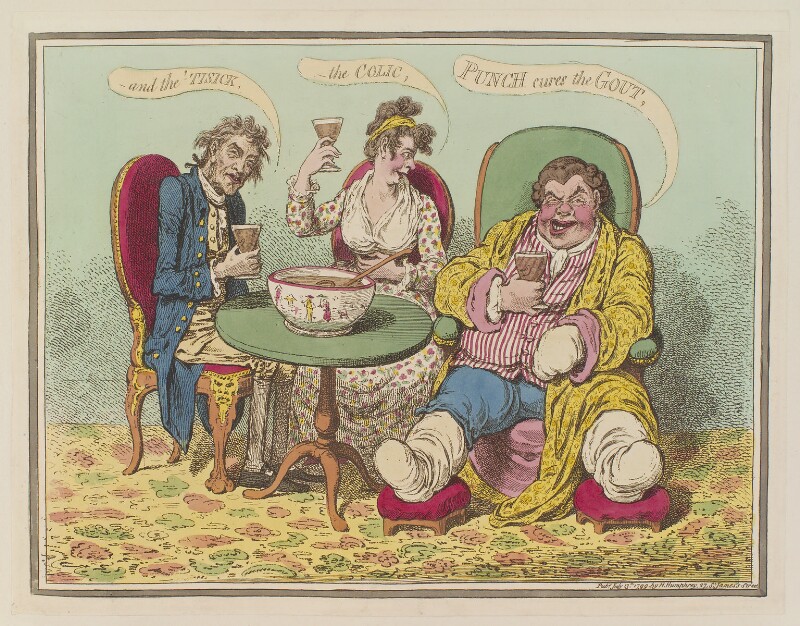
James Gillray, English. Punch Cures the Gout, the Colic, and the 'Tisick', 1799. (Wellcome Collection)
Medium, time frame
Soft-ground etching, hand coloured with watercolour. 1799
Symbolism, iconography
The print depicts three merrymaking figures crowded around a small table with a bowl of punch, filling their glasses. Speech balloons capture their exchange, starting on the far right: “Punch cures the gout,” says the fat gentleman. “The colic,” adds the woman beside him. “And the Tisic,” concludes the man on the left. Each suffers from an illness: the corpulent man’s bandaged limbs point to gout, the woman clutches her stomach, indicating colic, and the emaciated man on the left is hunched over, likely suffering from tuberculosis. Their ornate setting, fine dress, and plush chairs suggest they are people of means.
Historical context
James Gillray was well renowned for his facetious, yet intricate, representations of 18th century society. As a caricaturist, he knew his public exceptionally well, and his image is a criticism of England’s upper classes and their excesses. The image’s subject matter originates from a popular eighteenth century drinking song about punch: “Landlord Fill the Flowing Bowl” (also known as “Three Jolly Coachmen”):" Punch cures the gout, the colic and the physic, Punch cures the gout, the colic and phylitic, And is to all men, And is to all men, the very best of physic."
Punch had been brought to England from India, and the word originates from the word for ‘five’ in Hindi ( paanch ) as it was primarily composed of five ingredients: water, fruit juice, alcohol, sugar and spices such as nutmeg, amongst others. The name could also be related to puncheon, the types of barrels that stored drinks on ships.
Socio-cultural context and influences
In the eighteenth century, refinement and barbarity existed in stark juxtaposition, and Gillray’s print captures this distinction. During this time, punch consumption was on the rise, closely linked to boisterous, masculine-coded social gatherings and heavy drinking among the emerging middle and upper classes. Designed for sharing, the punchbowl was a fixture in both domestic spaces and public “punch-houses.” This image reflects the drink’s accessibility and social nature, and while punch wasn’t advertised for its medicinal benefits, the revellers may be using it to soothe their ailments.
Significance (elements of art/ principles of design)
While they drink punch to ease their symptoms, the very drink is making them worse. Gout was linked to overindulgence in rich foods and alcohol, a lifestyle reflected in the fat man’s lopsided smile, flushed cheeks, and tightly bandaged, gout-ridden limbs. His ‘medicine’ only aggravates his condition. The woman, suffering from colic, likely developed it from her drinking habit, as punch was often made with liquor distilled in lead stills, and lead poisoning was a known cause of colic. Meanwhile, the man on the left, afflicted with tuberculosis, drinks despite medical warnings against strong spirits for those with the disease. In some versions of the print, red stains his pointed teeth, his bloodied mouth suggesting a flare-up. Gillray’s work satirises the irony of self-medicating with alcohol, exposing the contradictions of eighteenth-century excess and its consequences.
Author (s): Christina Olszewski
Citations:
Harvey, Karen. "Barbarity in a Teacup? Punch, Domesticity and Gender in the Eighteenth Century."
Journal of Design History 21, no. 3 (Autumn 2008): 205-221. March February 7, 2025.[https://www.jstor.org/stable/25228589
https://www.jstor.org/stable/25228589 ].
University of Virginia. English Caricature: Excess and the Over-Consumption of Food & Alcohol,
Claude Moore Health Sciences Library, University of Virginia. Accessed March 7, 2025.[https://exhibits.hsl.virginia.edu/caricatures/en7-excess/index.html
https://exhibits.hsl.virginia.edu/caricatures/en7-excess/index.html ].
SAGE Publications. “Punch,” in ''The SAGE Encyclopedia of Alcohol: Social, Cultural, and Historical
Perspectives.'' Accessed March 7, 2025. [https://sk.sagepub.com/ency/edvol/the-sage-encyclopedia-of-alcohol-social-cultural-and-historical-perspectives/chpt/punch
https://sk.sagepub.com/ency/edvol/the-sage-encyclopedia-of-alcohol-social-cultural-and-historical-perspectives/chpt/punch ].
Sherry, Jim. James Gillray Archive. James Gillray (1756–1815) Biography. Accessed March 7,
2025. https://www.james-gillray.org/bio2.html.