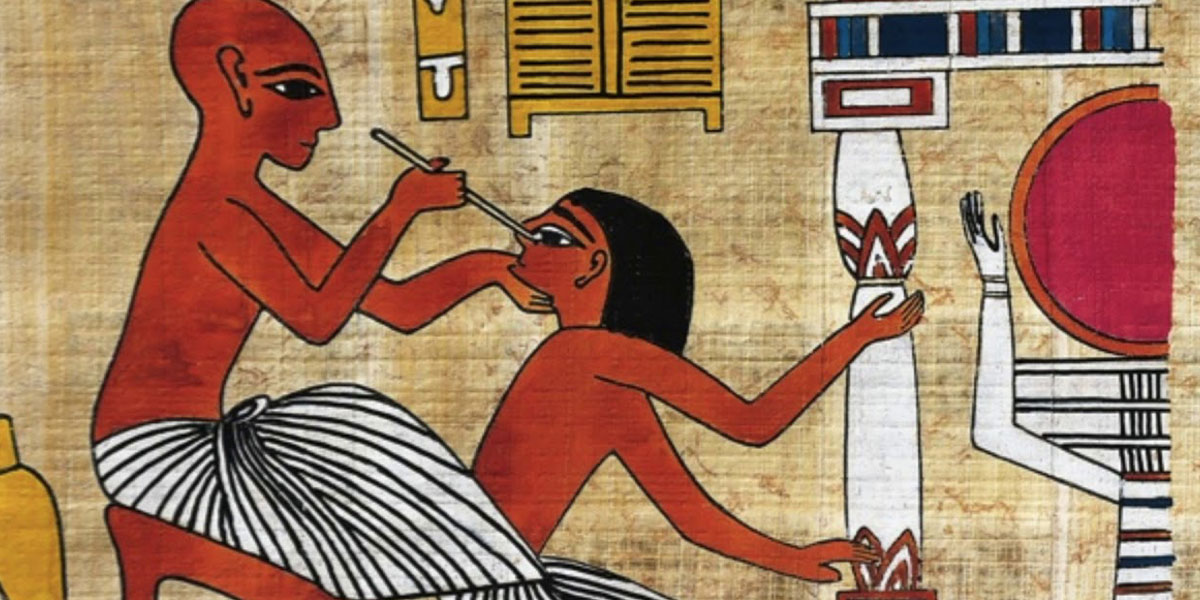
= Couching and Cataracts =
Cataracts, or the opacification of the crystalline lens in the eye, have been recognized since antiquity as a cause of disabling blindness. Among the earliest documented treatments include the practice of “couching”, a surgical maneuver aiming to displace the clouded lens out of the visual axis and thus restore partial sight. While couching eventually spread throughout the Greco-Roman, Indian, and Islamic worlds, some of the earliest evidence for its practice appears in ancient Egypt, as depicted in the image on right. Papyrus texts and archaeological depictions suggest that Egyptian physicians had not only recognized cataracts as a distinct pathology and refined a rudimentary scientific understanding of its physiology, but developed subsequent operative methods aimed at treating them. For instance, the Ebers Papyrus (c. 1550 BCE) and other Egyptian medical texts contain references to ocular diseases referred to as “ukhedu” or “white opacity”, now believed to include cataracts. Although the papyri do not reference how widespread the practice was or who first practiced it, secondary classical sources, including later Greek writers, indicate that couching had already become customary along the Nile by the first millennium BCE.
While in many societies medicine was practiced by shaman-like figures or folk-healers, Egyptian medical practice was highly stratified, and the long training of a physician or “swnw” (prounounced “sewnew”) required temple-based training, apprenticeships, and royal patronage. Indeed, given the precision required, couching was almost certainly restricted to a smaller subset of practitioners with surgical skill who received specialized training in the procedure. This group of physician-surgeons thus represents the first known “ophthalmologists” in human history.
While couching was believed to be a “simple” practice, it was also a high-risk procedure. The Egyptian surgeon used a sharp, needle-like instrument fashioned from copper or bronze, and after seating the patient upright the surgeon would steady the eye and insert the instrument through the sclera just lateral to the limbus. With controlled pressure, he depressed the opaque lens posteriorly into the vitreous cavity. If successful, the patient’s central visual axis cleared immediately. Still, with a limited understanding of infection risk, bleeding control, and post-operative care, many patients likely suffered greatly following the procedure. Indeed, postoperative care was often limited to herbal salves, honey-based ointments, and linen bandaging. While success rates are difficult to gauge or extract from limited historical texts, some ethnographic accounts suggest that only a minority achieved durable improvement.
From a modern standpoint, couching’s scientific foundation was rudimentary but not wholly misguided. Egyptian physicians lacked an anatomical understanding of the lens and retina, yet they observed correctly that moving the opaque mass away from the pupil improved sight. Despite the limited understanding of cataracts and its pathophysiology, couching quickly spread outward from Egypt into Greece, where physicians such as Celsus and Galen described the operation in detail. In the medieval Islamic world, ophthalmology underwent intense development, becoming a highly sophisticated specialty. While couching itself is no longer practiced, its conceptual legacy is substantial. It represents the first recognition that cataracts reside in an internal structure of the eye and that mechanical intervention can restore sight. Later surgeons expanded on the basic idea behind couching, namely the removal or displacement of the opacified lens, culminating in Jacques Daviel’s 18th‑century extracapsular extraction in which the opacification was fully removed. Today, phacoemulsification harnesses ultrasonic technology to remove the opacification, a markedly more precise, safe, and effective treatment, although its very practice mirrors the startling advancements made by the ancient swnws.
Author (s): Michael Motoc
Citations:
<ol style="list-style-type: decimal;"> <li> Nunn, J. F. Ancient Egyptian Medicine. British Museum Press, 2003. </li> <li> Ghalioungui, Paul. The House of Life: Magic and Medical Science in Ancient Egypt. B.M. Israël, 1973. </li> <li> Hirschberg, J., et al. The History of Ophthalmology. J.P. Wayenborgh, 1982. </li> <li> Haq, Imran, and Humayun A Khatib. “Light through the dark ages: The Arabist contribution to Western ophthalmology.” Oman journal of ophthalmology vol. 5,2 (2012): 75-8. doi:10.4103/0974-620X.99367 </li></ol>