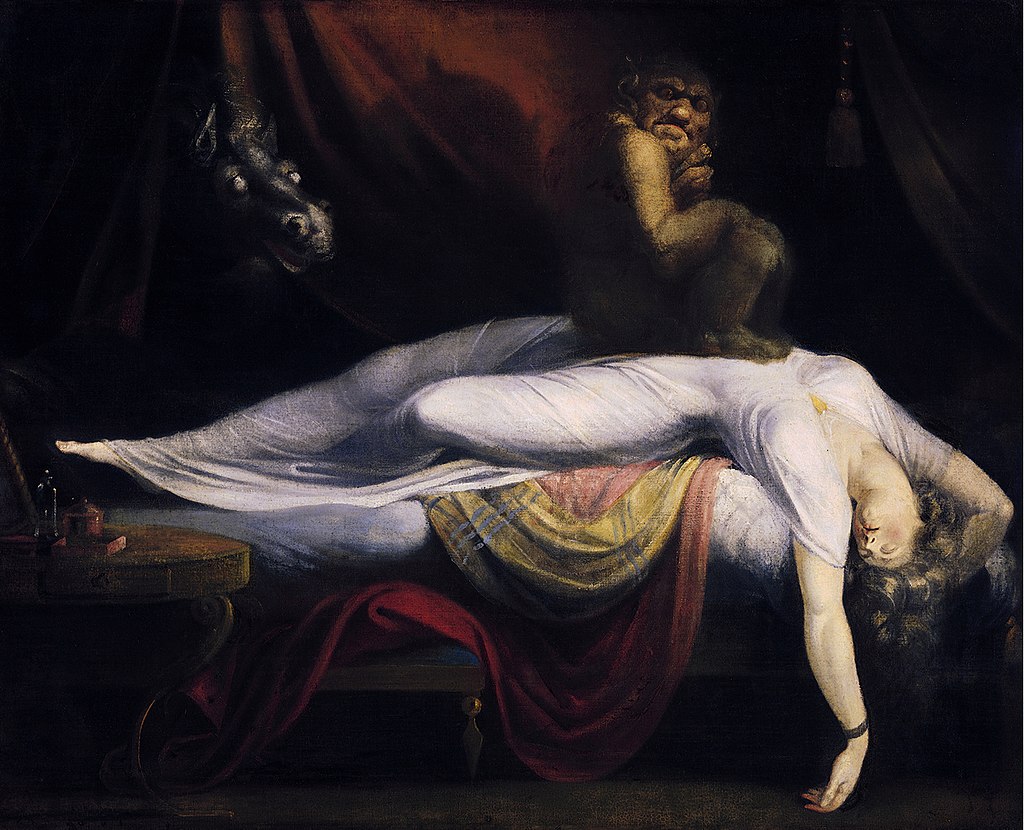
= (Sleep Paralysis) =
Artist, Title, Date
Henry Fuseli, The Nightmare, 1781. Oil on canvas. Detroit Institute of Arts, Detroit.
Description of Disease & Etiology
Sleep paralysis describes a brief, often terrifying state in which an individual finds themselves awake and conscious yet unable to move or speak during sleep. Most commonly occurring when falling asleep or waking up, sleep paralysis represents a dysregulation of REM sleep in which muscle paralysis (normally present only in REM sleep) continues into the waking state. Sleep paralysis is typically associated with visual hallucinations, often terrifying, and can occur as either an isolated phenomenon or as one aspect of narcolepsy.
Pathology
During sleep, the brain undergoes a REM (“rapid eye movement”) phase in which the brainstem, one of the most primal and oldest brain structures, inhibits motor neuron activity, leading to muscle atonia. During sleep paralysis, the cortical awakening phase of sleep, in which the brain begins to re-enter awareness and consciousness, precedes the resolution of the REM cycle’s muscle atonia, leading to the characteristic “awake but paralyzed” state. Because this phenomenon occurs as a result of a dysregulation of various brain structures involved with sleep, many people experience visual hallucinations when the visual cortex begins to activate upon awakening. These visual hallucinations are often terrifying when combined with one’s conscious experience of paralysis, and many report hallucinations of intruders, small creatures, or even “demons” in their room.
Signs/Signifiers of Illness
Sleep paralysis is most characteristically associated with a feeling of paralysis with an inability to move or speak, yet a conscious awakening state in which one is aware of their own paralysis. Hallucinations tend to be visual, but auditory (including the sound of footsteps), tactile (pressure on one’s chest or back), or even respiratory (feelings of suffocation) hallucinations have also been reported. Because sleep paralysis involves an awareness of one’s own conscious and awaking state as well as their own paralysis, this phenomenon is often very disturbing and may be accompanied by a sense of doom and intense fear.
While sleep paralysis may be seen as an isolated phenomenon, it may also be associated with narcolepsy, a condition of chronic, incessant somnolence. Signifiers of more profound illness include excessive daytime sleepiness, cataplexy, sleep attacks, and frequently recurring sleep paralysis.
Treatment
Sleep paralysis is almost always benign but reflects wider disturbances of the sleep-wake cycle. Treatment includes lifestyle modifications to bolster one’s sleep hygiene, including a regular sleep schedule, limiting caffeine and screen time, a structured bedtime routine, and improved stress management. Additionally, some suggest that avoiding supine sleep can decrease the rate of sleep paralysis, and cognitive-behavioral therapy may be used for patients experience sleep-related anxiety.
True medical treatment may only be necessary if the sleep paralysis is recurrent and/or associated with true narcolepsy. Treatment options include SSRIs or TCAs which may suppress REM sleep, as well as sodium oxybate in narcolepsy.
Social Determinants of Illness
Sleep paralysis, while benign, has cultivated a wide range of interpretations and meanings across many cultures. Specifically, the visual hallucinations associated with sleep paralysis have garnered considerable fascination, including the presence of demons, spirits, or other “beings” entering one’s room during sleep. Many patients may feel pressured against reporting their experiences or seeking treatment due to fear of external cultural forces or to avoid a public association with these “spiritual” or “demonic” creatures. Additionally, many interpret any indication of hallucinations as a sign of a deeper mental illness and thus may avoid reporting their experiences due to fear of being labeled as “crazy”.
Due to the profound influence culture plays in shaping one’s experience with sleep paralysis, some patients may normalize symptoms, ignore them, or attribute them to spiritual rather than medical causes, further delaying access to healthcare. Additionally, in societies reporting high rates of stress, shift work, or other forms of socioeconomic instability, rates of poor sleep hygiene are increased, and thus the rate of sleep paralysis is also elevated.
Author (s): Michael Motoc
Citations:
* 1) Sehgal, Amita, and Emmanuel Mignot. “Genetics of sleep and sleep disorders.” Cell vol. 146,2 (2011): 194-207. doi:10.1016/j.cell.2011.07.004 * 2) Scammell, Thomas E. “Narcolepsy.” New England Journal of Medicine, vol. 373, no. 27, 31 Dec. 2015, pp. 2654–2662, https://doi.org/10.1056/nejmra1500587. * 3) Brooks, Patricia L, and John H Peever. “Identification of the transmitter and receptor mechanisms responsible for REM sleep paralysis.” The Journal of neuroscience : the official journal of the Society for Neuroscience vol. 32,29 (2012): 9785-95. doi:10.1523/JNEUROSCI.0482-12.2012 * 4) Jalal, Baland, and Devon E Hinton. “Rates and characteristics of sleep paralysis in the general population of Denmark and Egypt.” Culture, medicine and psychiatry vol. 37,3 (2013): 534-48. doi:10.1007/s11013-013-9327-x * 5) White, Kaylin & Barber, Lauren & Shipman-Lacewell, Jelaina & Azeez, Olanike & Collop, Nancy & Johnson, Dayna. (2025). Understanding and Addressing Social Determinants to Advance Sleep Health Equity in the United States: A Blueprint for Research, Practice, and Policy. Current Sleep Medicine Reports. 11. 10.1007/s40675-025-00339-7.