Brain Scan
Artist/Group/Tribe, etc.
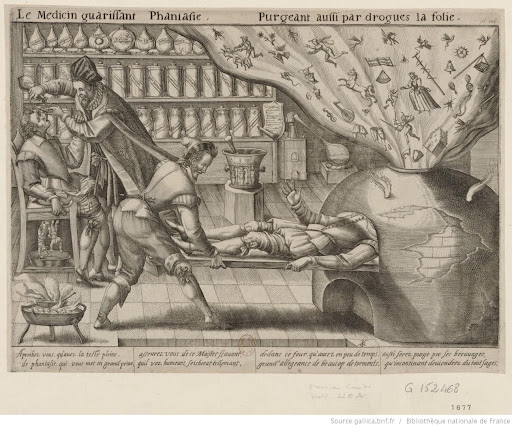
Mattheus Greuter, "Le Médecin guérissant Phantasie,", Bibliothèque nationale de France
Medium, time frame
1620, engraving.
Symbolism, iconography
This engraving vividly and quite graphically visualizes the idea of purging “phantasy” or folly from the mind. A quack-like figure, assumed to be a physician, administers a potion labeled “Sagesse”, or wisdom, to one patient in the background, prompting the expulsion of miniature jesters beneath the patient. An assistant places another patient’s head in an alchemical furnace—or distillation apparatus—where fantasies billow out as if smoke or fire, revealing the patient’s internal world as full of horses, backgammon boards, armor, women, theater masks, a monkey with a walking stick, and other imaginative vices and whimsies. The setting—a shop with jars labeled with virtues such as humility, patience, reason, memory—functions as a metaphorical apothecary for rebalancing humors and the mind.
The symbolism within this piece not only functions as a humorous reflection upon the vastness of both human foley and imagination, but also as a prescient identification of the human mind as the next realm of medical exploration. Using symbols of both pharmacology and technology as tools for revealing the mind’s inner mechanisms, this engraving symbolizes the era’s rapidly increasing interest in medicine and science more broadly by bridging alchemical iconography with more modern images of technology and pharmacology.
Historical context
Greuter, a German-born engraver active in early 17th-century Rome, was known for his scientific illustrations—most notably engraving Galileo’s sunspot observations in 1613. This piece emerges in the period’s growing interest in medical chemistry and alchemy, mirroring contemporary attempts to understand and manipulate mental processes via chemical means. The image may constitute one of the era’s earliest visual analogs to brain scans, translating internal cognitive states into visual form. Moreover, it provides a clear insight into the era’s fascination with new technology and medications and the subsequent belief in plumbing the mind and its mysteries as the next step in the progression of medical knowledge.
Socio-cultural context and influences
The engraving draws on emblematic traditions and satirical medical commentary prevalent across early modern Europe. It is part of a broader series that includes German variants like the “Narrendoktor” (Fool Doctor) by Theodor de Bry (~1596), which similarly depicts folly being distilled or exorcised by alchemical means. However, Greuter’s work expands upon prior work to also include references to new technologies, medications, and knowledge bases to suggest the era’s interest in charting new territories within the medical field, specifically in the realm of neuroscience. This engraving reflects an evolving European fascination with the mind, mental illness, and the merging of alchemy, medicine, and satire to critique folly and intellectual excess while highlighting the period’s interest in new technology and science.
Significance (elements of art/ principles of design)
Greuter’s composition employs strong contrast between dense overlay of symbols and the structured setting of the apothecary’s shop. The surreal juxtaposition of fantastical imagery emerging from a mechanical device highlights metaphor through visual exaggeration. The linear engraving technique emphasizes clarity and detail, reinforcing the allegoric narrative. The varied textures—from the bottles to the billowing cloud—create dynamic rhythm across the scene, while spatial organization directs the eye from the pouring of wisdom in the background through to the eruption of fantasies featured prominently in the foreground. Overall, the work balances order (the shop, the physician) with chaos (the fantasies), visually embodying the tension between reason and folly. Thus, the work acts as an important visual bridge between the era’s fascination with folly, alchemy, and a spiritual understanding of the world with technology, pharmacology, and the medical sciences, ultimately predicting what the next few centuries would bring by way of medicine and an understanding of the world more broadly.
Author (s): Michael Motoc
References:
<ol style="list-style-type: decimal;"> <li> Cambridge University Repository. Le médecin guérissant Phantasie, engraving by Matthaeus Greuter (1620). University of Cambridge, 2020. https://www.repository.cam.ac.uk/items/bbf40c54-09e7-40eb-862e-96d74ca769ad. </li> <li> Res Obscura. “The Alchemy of Madness.” Res Obscura, 29 Dec. 2015, https://resobscura.blogspot.com/2015/12/the-alchemy-of-madness.html. </li> <li> Cvlt Nation. “The Alchemy of Madness: Strange Renaissance Engravings of Medicine & Folly.” Cvlt Nation, 2015, https://cvltnation.com/172464-2/. </li> <li> Linda Hall Library. “Scientist of the Day: Mattheus Greuter.” Linda Hall Library, 16 Apr. 2019, https://www.lindahall.org/about/news/scientist-of-the-day/mattheus-greuter/. </li> <li> The British Museum. “Mattheus Greuter (Biographical Details).” The British Museum Collection Online, The British Museum, https://www.britishmuseum.org/collection/term/BIOG29790. </li></ol>