= Psychosis =
Artist, Title, Date
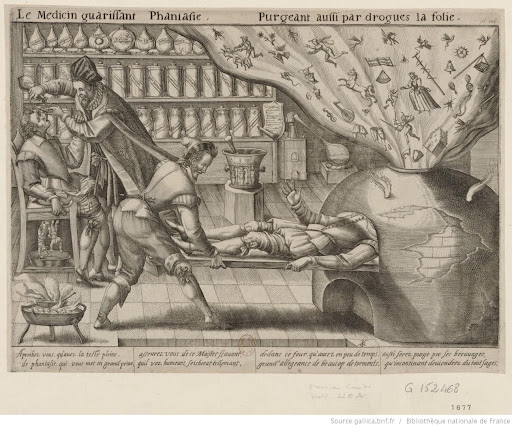
Mattheus Greuter, "Le Médecin guérissant Phantasie", 1620. Bibliothèque nationale de France. Engraving.
Description of Disease & Etiology
This engraving depicts the plumbing of a patient’s mind to expel fantastical imagery and, as embodied in the background of the scene, replace one’s folly with wisdom. Although not directly a commentary on psychosis, the engraving provides an interesting glimpse into how older society’s interpreted fantastical imagination, imagery, and even visual hallucinations.
Psychosis is a syndrome marked by a loss of contact with reality, often including hallucinations, delusions, disorganized thinking, and negative symptoms including flat affect and emotional blunting. Visual hallucinations—vivid perceptual experiences occurring without external visual stimuli—are common in psychotic disorders, with estimates of prevalence ranging from roughly 25% to over 50%, depending on population and methodology. Many of these images may be fantastical and even whimsical, as depicted in this engraving showcasing, for instance, miniature jesters and a monkey with a walking stick. Auditory hallucinations are also very common and tend to represent a true psychotic episode while visual hallucinations may be benign or stem from other, non-psychotic etiologies. Psychosis arises from a complex interplay of genetic, neurodevelopmental, and environmental factors. Neurotransmitter systems—particularly dopamine, glutamate, GABA, and acetylcholine—play key roles, and early environmental insults such as prenatal infections, malnutrition, and childhood trauma increase risk.
Pathology
Visual hallucinations in psychosis are rooted in aberrant neural processing within sensory and emotional circuits. Functional imaging reveals hyperactivity in primary and secondary sensory cortices, and misprocessing of internal perceptual signals coupled with emotion-laden circuitry (e.g., hippocampus, anterior cingulate cortex). Structural and connectivity changes in occipital and parietal regions are documented in both primary psychosis and secondary (e.g., substance-induced or neurodegenerative) psychoses featuring visual hallucinations. Together, these findings underscore a neural basis for visual hallucinations rooted in dysfunctional perception-emotion integration.
Signs / Signifiers of Illness
Individuals with psychosis experiencing visual hallucinations often endorse complex, meaningful imagery—such as people, animals, or scenes—that differ markedly from simple flashes or patterns. Visual hallucinations that tend to co-occur with auditory hallucinations (multimodal hallucinations), are associated with greater illness severity, earlier age of onset, longer inpatient stays, higher antipsychotic dosing, cognitive and social impairments, and increased suicidality. Childhood interpersonal trauma significantly increases the likelihood of psychotic visual hallucinations: survivors had three times the odds of experiencing them compared to those without such trauma.
Treatment
Treatment of psychotic disorders with visual hallucinations typically involves antipsychotic medications as frontline therapy, targeting dopamine and other neurotransmitter dysregulation. However, visual hallucinations are understudied and often resistant to standard interventions. Some evidence suggests benefit from medications that modulate cholinergic, GABAergic, serotonergic, or dopaminergic systems, alongside structured psychosocial support. Early intervention programs—especially within the first three to five years of symptom onset—are crucial, associated with better global functioning, reduced relapse, and improved long-term outcomes. These treatment options are largely new and a result of a profound re-thinking of mental illness as a complex multifactorial neurochemical dysregulation rather than a spiritual, even childish, understanding of the world as depicted by the engraving.
Social Determinants of Illness
Social and environmental contexts significantly influence both the risk of psychosis and the severity of visual hallucinations. Adverse childhood experiences—including trauma, bullying, and neglect—promote inflammatory and neurodevelopmental disruptions linked to psychotic symptoms. Urban living, social isolation, minority stress, poor housing, and economic disadvantage amplify vulnerability to psychotic disorders. Social isolation exacerbates the emotional distress associated with hallucinations and impairs engagement with treatment, whereas peer support, community engagement, and culturally informed care improve adherence and outcomes.
Author(s): Michael Motoc
References:<ol style="list-style-type: decimal;"> <li>Al-Issa I. Sociocultural Factors in Hallucinations. International Journal of Social Psychiatry. 1978;24(3):167-176. doi:10.1177/002076407802400304 </li> <li> Bailey, Thomas et al. “Childhood Trauma Is Associated With Severity of Hallucinations and Delusions in Psychotic Disorders: A Systematic Review and Meta-Analysis.” Schizophrenia bulletin vol. 44,5 (2018): 1111-1122. doi:10.1093/schbul/sbx161 </li> <li>
Cummings, J L, and B L Miller. “Visual hallucinations. Clinical occurrence and use in differential diagnosis.” The Western journal of medicine vol. 146,1 (1987): 46-51. </li> <li> Knight, W D et al. “The cultural context of visual hallucinations.” Postgraduate medical journal vol. 84,988 (2008): 103-5. doi:10.1136/pgmj.2007.063727 </li> <li> Suhail, Kausar, and Raymond Cochrane. “Effect of culture and environment on the phenomenology of delusions and hallucinations.” The International journal of social psychiatry vol. 48,2 (2002): 126-38. doi:10.1177/002076402128783181 </li></ol>