= Epilepsy =
Artist, Title, Date
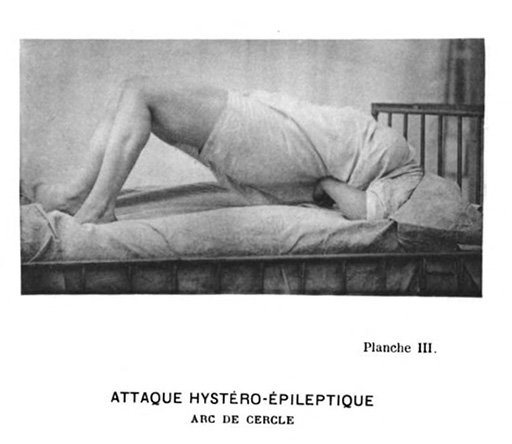
Paul Regnard, "Attaque Hystero Epileptique Arc De Cercle", 1880. Cushing John Hay Whitney Medical Library.
Description of Disease & Etiology
The term “hystero-épileptique” was used to describe dramatic seizure-like episodes observed primarily in women diagnosed with hysteria in 19th-century France. These attacks combined features of epilepsy and hysteria, including convulsions, altered consciousness, and emotional displays, and were thought to arise from psychological rather than organic causes. In modern terminology, these episodes most closely resemble psychogenic nonepileptic seizures (PNES), a functional neurologic disorder. Epilepsy, by contrast, is defined by recurrent unprovoked seizures due to abnormal cortical electrical activity in the absence of emotional or “hysterical” displays, with tonic-clonic seizures representing a classic generalized seizure type.
Pathology
Hystero-épileptique attacks lacked demonstrable structural or electrophysiologic pathology. At the time, much cultural thought barred the scientific understanding of the condition, relying instead on female hormones and mental capacities as an explanation. Jean-Martin Charcot, a famed French neurologist, proposed instead that these attacks may stem from a nervous system dysfunction without lesion, a progressive concept for the era. Modern research suggests PNES arise from altered brain network connectivity involving emotional regulation and motor control. Epilepsy involves hypersynchronous neuronal firing within epileptogenic networks, and tonic-clonic seizures are characterized by widespread cortical activation followed by rhythmic inhibition, producing tonic stiffening and clonic jerking.
Signs/Signifiers of Illness
Hystero-épileptique attacks often unfolded in stages, including emotional prodromes, dramatic motor activity, and prolonged post-event expression. Tonic-clonic seizures present with abrupt loss of consciousness, bilateral motor activity, tongue biting, incontinence, and postictal confusion. These features, alongside EEG findings, help distinguish epileptic from functional events in which the epileptic-like attacks are induced in the absence of unregulated electrical activity. Functional seizures may be characterized by a lack of tongue biting, incontinence, postictal confusion, and a tendency to try and catch oneself upon falling, all indications that the brain is still functioning and reflexes remain intact.
Treatment
Treatment in Charcot’s era included hypnosis, isolation, and moral therapy, reflecting beliefs about nervous excitability. These approaches acknowledged the mind–body connection but lacked scientific rigor. Modern PNES treatment focuses on psychotherapy and psychiatric care, while epilepsy management relies on antiseizure medications, neuromodulation, or surgery. Accurate diagnosis is essential to avoid ineffective or harmful treatment.
Social Determinants of Illness
Hystero-épileptique attacks were shaped by gender norms, socioeconomic status, and institutional power dynamics. Patients were often women with limited autonomy, subjected to public clinical demonstrations. Today, PNES and epilepsy remain stigmatized, with disparities in access to care and social support. These conditions illustrate how neurologic illness is embedded within cultural and social contexts.
Author (s): Michael Motoc
Citations:
* 1) Charcot JM. Lectures on the Diseases of the Nervous System. 1877. * 2) Richer P. Études cliniques sur la grande hystérie. 1881. * 3) Stone J et al. J Neurol Neurosurg Psychiatry. 2010. * 4) LaFrance WC, Devinsky O. Epilepsia. 2004. * 5) Fisher RS et al. Epilepsia. 2017.