MEDICAL CASE STUDY
Goiter
Artist/ Title/ Date
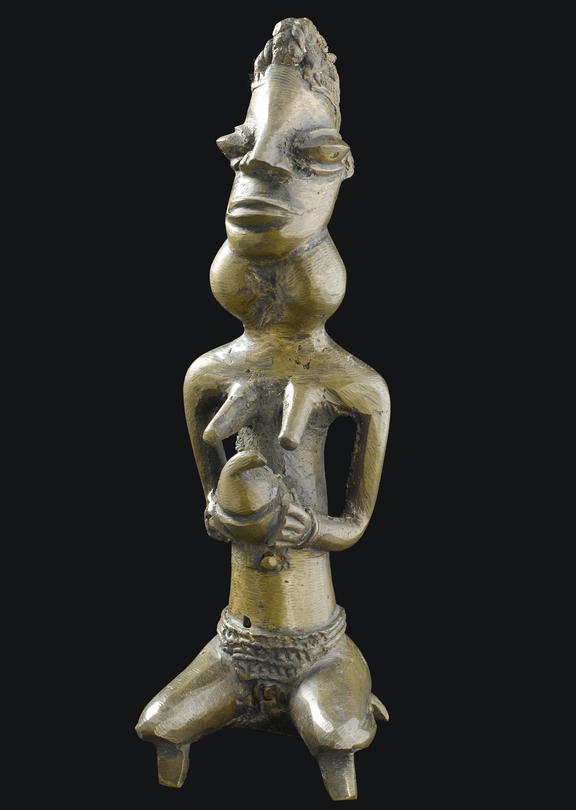
Yoruba People, Female Statue, Nigeria, 1801-1900. Bronze. Sir Henry Wellcomes Museum Collection.
Description of Disease & Etiology
An enlargement of the thyroid gland is termed as goiter. This irregularity may be a generalized enlargement of the butterfly shaped thyroid gland, or it may be the result of one or more nodules which have undergone hypertrophy. In either scenario, there will be enlargement of the thyroid gland. The size of the enlargement may be quite variable from only being identified with diagnostic imagery to a visible enlargement at the base of the neck. Goiter is classified as diffuse or nodular along with being labelled toxic or nontoxic.
Goiter can be secondary to iodine deficiency, increased TSH levels, smoking, autoimmune disorders, selenium or iron deficiency, certain medications (immunosuppressive pharmaceuticals, antiviral medications, amidarone and lithium) natural goitrogens and there can be a genetic predisposition.1
90% of the cases of goiter worldwide are cause by iodine deficiency. Goiter is most commonly found in countries that do not use iodized salt.
Signs/Signifiers of Illness
The clinical manifestation is dependent upon the inciting cause. Thyromegaly can be diffuse or nodular with subsequent normal or decreased or increased levels of the thyroid hormones (T3 and T4). Normal or decreased levels is clinically categorized as nontoxic whereas increased levels is categorized as toxic.
Hyperthyroidism has symptoms that are a result of adrenergic stimulation. This includes tachycardia, palpitations, nervousness, tremors, increased blood pressure and heat intolerance. The clinical manifestations are hypermetabolism secondary to increased levels of the thyroid hormones. This results in subsequent increases in oxygen demand, metabolic changes in protein metabolism, immunologic stimulation in diffuse goiter and exophthalmos. Conversely, clinical signs and symptoms for hypothyroidism includes coarse hair, alopecia, constipation, weight gain, sluggishness, decrease in heart rate, depression and confusion. These can progress to myxedema.2
Pathology
Goiter can be classified by the growth pattern or the size of the growth. The growth pattern can be unimodular or multinodular. These are further classified as toxic or nontoxic (inactive). If the entire thyroid gland is enlarged, then the degree of enlargement is categorized as class I which can only be identified via palpation. Class II goiter is palpable and easily visualized. While class III goiter is large and retrosternal. The pathophysiology of goiter is related to the gland’s effort to maintain euthyroidism. This comprises a complex interplay in the thyroid hormone feedback mechanism.
Uninodular goiters result from focal hyperplasia of follicular cells. TSH is the primary stimulator of thyroid growth and function. Cytokines IGF I and II, EGF, FGF and TGF can play a role in the growth of nodular goiters also. There is subpopulation of follicular cells that have a high propensity for cellular division and growth. Once these cells increase in numbers, growth will continue autonomously. There will also be a subsequent increase in iodinating capacity. The growth occurs in stages. Stage 1 is diffuse hyperplasia with uniform iodine uptake. During stage 2, there will be areas of hyperfunction and areas of normal function. Stage 3 presents with hemorrhage and necrotic areas in the hyperfunctioning nodules. Then there is a subsequent increase in the vascularity of the remaining active lobules until they become necrotic. Stage 4 occurs when the necrotic lobules coalesce. Continual repetition of the above will result in a multinodular goiter known as stage 5.3
Treatment
The identification of the clinical subtype and the thyroid function assessment will be necessary for the management of a goiter. This will allow for a highly individualized treatment plan. The goal of the treatment is to maintain euthyroidism and to relieve compression, if warrented. Likewise, cosmetic concerns and likelihood of malignancy and progression of the goiter also play a role in the treatment protocol. 4
Social Determinants of Illness
Genetic predisposition and environmental influences play a role in development of a goiter both singly and in combination. Familial occurrence is a predisposing factor to development of a goiter. There is positive correlation of goiter development with a decrease in iodine deficiency, smoking and alcohol consumption. These environmental influences often exist in the lower socioeconomic environments.5
Author(s): Donna Johnson, DVM
Citations:
1. Knobel, M. Etiopathology, clinical features, and treatment of diffuse and multinodular nontoxic goiters. ''J. Endocrinol. Invest.'' 39, 357–373 (2016).
2. Karunarathna, I. et al. Comprehensive Evaluation and Management of Goiter: Diagnosis, Treatment, and Outcomes. (2025).
3. Khatawkar, A. V. & Awati, S. M. Multi-nodular goiter: Epidemiology, Etiology, Pathogenesis and Pathology. ''Int. Arch. Integr. Med.'' 2, 152–156 (2015).
4. Medeiros-Neto, G., Camargo, R. Y. & Tomimori, E. K. Approach to and Treatment of Goiters. ''Med. Clin.'' 96, 351–368 (2012).
5. Knudsen, N. et al. Low socio-economic status and familial occurrence of goitre are associated with a high prevalence of goitre. ''Eur. J. Epidemiol.'' 18, 175–181 (2003).