Alice in Wonderland Syndrome
Artist/ Group/Tribe, etc.
John Tenniel, (English) Alice's Adventures in Wonderland
Medium, time frame
Pen-and-Ink drawing reproduced as wood engraving, 1865
Symbolism, iconography
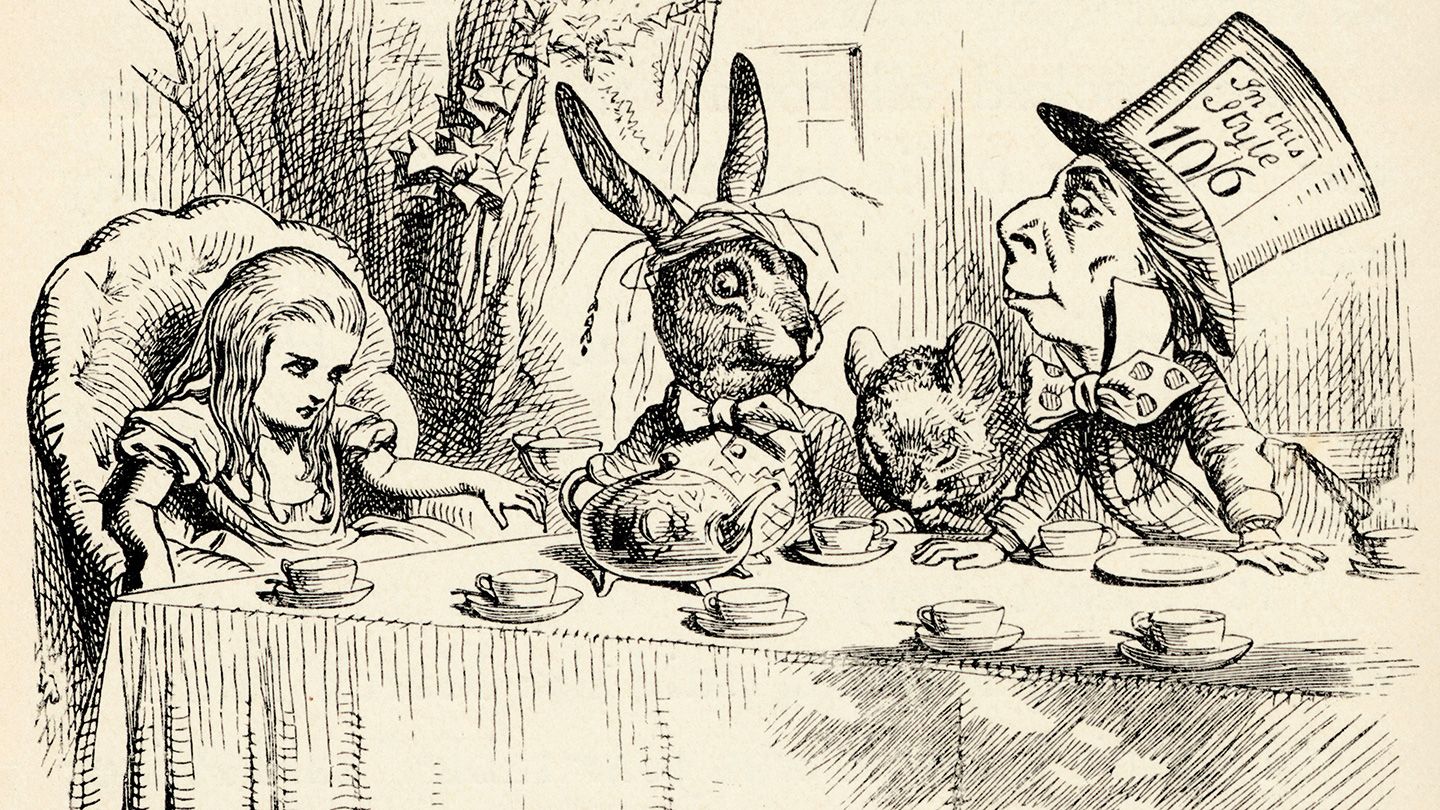
John Tenniel’s “Mad Tea Party” illustration for Lewis Carroll’s novel Alice’s Adventures in Wonderland depicts the story’s protagonist, Alice, seated at the table with the March Hare, Dormouse, and the Mad Hatter. The scene displays a Victorian tea party and social ritual satirized by caricaturized figures. The characters are seated under a tree in front of the March Hare’s house, depicted by scant lines in the background outlining the walls and a tree in the left half of the background’s composition. The table is positioned at an angle, extending beyond the frame of the scene. Alice sits at the head of the table on the left, while the other characters are squeezed together from the middle of the composition towards the right side of the illustration. The dormouse is fast asleep between the March Hare and the Mad Hatter, drawn with lines and squiggles capturing his fur, almost blending in with the background. Tenniel’s drawings anthropomorphized Wonderland’s creatures, as seen by the March Hare dressed in a mid-Victorian tailcoat and a cravat around his neck. Alice’s reclines in her chair as she takes up space in the left third of the composition. The March Hare, who sits directly in the middle of the table, sends a crazed look at the viewer with his side-eye. The Mad Hatter is drawn standing up from his chair, looking towards Alice with his nose turned up and his exaggerated facial features emphasized in a side profile view. His top hat is drawn larger than his head and torso, further exaggerating the proportion imbalance in the figures themselves.
Tenniel’s style after the 1850s gave more detail in backgrounds and figures, offering specificity to a scene. The illustration offers a delicate balance between fine detailed line-work and cross-hatching providing depth, and broken lines and negative space outlining the house in the background and table in the foreground. Cross-hatching shades in the body of the tree, captures the shadows cast by the table and other objects, depicts textures of the furniture and clothing, and provides character dimensionality. Tenniel developed an interest in human types and expressions, lending to the style of theatricality, originating in his earlier work in caricature and carried over into his Wonderland illustrations.
Historical context
John Tenniel was born in London on February 28, 1820, to John Baptist Tenniel, a fencing and dancing master, and had a long-standing career as a political cartoonist and illustrator in the 19th century Victorian era. He studied fine art at the Royal Academy of Arts in London and would often sketch from life, finding inspiration from the dramaticism of stage performers. In 1864, Tenniel became the Principal Cartoonist for the magazine Punch. His early years at the magazine were marked by his increasing interest in the uniqueness of persons and things, giving a human quality and personality to objects and environments. His caricatures in Punch and detailed illustration work is what caught Lewis Carroll’s eye. In 1864, Carroll commissioned Tenniel to draw the illustrations for his book, Alice’s Adventures in Wonderland, and for the brothers George and Edward Dalziel to engrave them on wood. Tenniel agreed to draw forty-two illustrations and thus began their tedious partnership to develop the iconic illustrations and bring Wonderland to life.
Tenniel’s creative vision saw the creatures as fanciful creations rather than real animals, and since Carroll’s text was light on description, he invented his own characterizations, drawing from fine art, natural history, heraldry, caricature, and his work in Punch. Carroll gave Tenniel specific directions for the illustrations and their shared tendency towards perfection led to a strained professional relationship in which they didn’t always see eye to eye. The artistic process involved Tenniel drafting his drawings in pencil on paper and the Dalziel brothers engraving the illustrations on wooden blocks. Once the proofs were finalized, the engraved woodblocks were electrotyped to generate metal copies for mass production. When the first edition was published in 1865, both Tenniel and Carroll disapproved of the printer’s published products, that it was recalled and reissued with improved illustrations and an 1866 title page later that year. Tenniel also illustrated Carroll’s second book Through the Looking Glass and What Alice Found There which was published in 1871. Due to his impressive career at Punch and the great success of his illustrations for Carroll, Tenniel was knighted for his services to the arts in 1893, becoming the first cartoonist to receive the honor. He retired from Punch in 1901, ending a long career in which he completed over 2,000 cartoons for the publication and left his mark in satirical commentary in the 19th century.
Socio-cultural context and influences
Tenniel’s illustrations in Alice’s Adventures in Wonderland built upon the story’s fantastical world and social commentary, creating an active dialogue between text and illustration. The story arose during a changing social current in the Victorian era. The story and illustrations operate in tandem with critiques on Victorian consumption, grappling with Darwinian theories of evolution, and the growing cultural emphasis on childhood innocence and imagination. The illustrations focus on Alice’s adventures and highlight her experience of an unstable and non-linear world. Her childhood is free from responsibility or industry, where her initial boredom and leisure contradict the historical reality of child labor. Alice’s Adventures in Wonderland also reflects the growing Victorian interest in psychology and perception, marked by a deepening fascination with identity, consciousness, and mental experiences. In the “Mad Tea Party”, unlike in prior scenes in the story, Alice is her regular size without distortion of her body proportion but is now confronted by the tea party’s madness and Wonderland’s nonsense by engaging with the characters. The scene shifts towards social absurdity and distorted reality perceived in the setting of a perpetual tea party.
Significance (elements of art/ principles of design)
Tenniel’s “grotesque” style which combined human bodies with animal heads, creating amalgamated creatures, was one of the reasons Carroll commissioned him as the illustrator for his novel. Coupled with his vigorous cross-hatching which intensified dark areas, his style emphasized Wonderland’s absurdity. His figures are highly detailed and trend towards realism, highlighting Wonderland’s inhabitants as true representations rather than total fantasies. In the tea party, Alice sits at the end of the table apart from the Wonderland characters and is faced by their strange logic gaps, dead-end riddles, and strange counter-Victorian behavior at the party. It is a test of perception in social and physical space. The characters and objects are cluttered towards the left side, creating an imbalance in the composition that adds to the story and Alice’s disorientation throughout Wonderland. The number of teacups set at the table are out of proportion to the number of guests that could be seated at the table, which further plays with the warping of quantity and size throughout the story.
Compared to the Mad Hatter, whose eye is drawn with a pinpoint pupil and bulging white space, creating a manic and crazed look, Alice seems less taut and more observant of the social chaos unfolding before her. Her chin is tucked inwards and she looks upward at the Mad Hatter, showcasing her impatience with the irrationality. All the characters are drawn with heads that are out of proportion to the size of their bodies, with that discrepancy increasingly exaggerated amongst the Wonderland inhabitants. Moving down from the table, the dense, fine crosshatching beneath the table casts the grass in shadows, grounding the scene despite the absurd interactions and caricaturist quality of the illustration. Tenniel’s manipulation of scale, proportions, and spatial arrangement produce a perceptual instability that parallels the disorienting sensory experiences central to Alice’s journey.
Author(s): Maria Burdjalov1, B.S
1Albert Einstein College of Medicine, Bronx NY
Citations:
Lim, Jessica W. H., and Lady Margaret. “And What Is the Use of a Book… without Pictures or Conversations?”: The Text- Illustration Dynamic in Alice’s Adventures in Wonderland. n.d.
Morris, Frankie. Artist of Wonderland : The Life, Political Cartoons, and Illustrations of Tenniel. University Virginia Press, 2005.
Murdoch, Lydia. “Alice and the Question of Victorian Childhood.” In The Age of Alice: Fairy Tales, Fantasy, and Nonsense in Victorian England. Vassar College Libraries, 2015.
Patkus, Ronald. “The Age of Alice: Fairy Tales, Fantasy, and Nonsense in Victorian England.” In The Age of Alice: Fairy Tales, Fantasy, and Nonsense in Victorian England. Vassar College Libraries, 2015.
Schatz, Stephanie L. “Lewis Carroll’s Dream-Child and Victorian Child Psychopathology.” Journal of the History of Ideas 76, no. 1 (2015): 93–114.
“Sir John Tenniel - Illustration History.” Accessed February 23, 2026. https://www.illustrationhistory.org/artists/sir-john-tenniel.
“The Proof Is in the Printing: John Tenniel’s Alice Illustrations | The New York Public Library.” Accessed February 23, 2026. https://www.nypl.org/blog/2020/12/29/proof-printing-john-tenniels-alice-illustrations.
Victoria and Albert Museum. “John Tenniel – an Introduction · V&A.” Accessed February 23, 2026. https://www.vam.ac.uk/articles/john-tenniel-an-introduction.