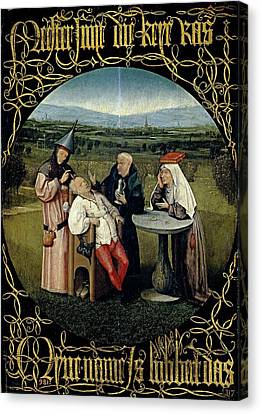
= Trepanation = Jan Sanders van Hemessen, The Surgeon, ca. 1550. Oil on panel. The Prado Museum, Madrid, Spain.
Trepanation is the deliberate cutting, drilling, or scraping of a hole in the human skull and it is the oldest known surgical procedure in the Neolithic archaeological record, appearing in Europe, Africa, Asia, and the Americas. Astonishingly, archaeologists have found skulls with deliberate cranial openings that bore evidence of healing, suggesting that patients often survived. In some Neolithic samples, 5–10% of skulls show cranial markings suggestive of trepanation, indicating that this practice was widespread and, at times, medically effective despite employing gruesome techniques without antiseptic-regiments, anesthesia, or imaging, all while using rudimentary tools such as trepans, borers, or even hand-cranked drills.
Trepanation is the deliberate cutting, drilling, or scraping of a hole in the human skull and it is the oldest known surgical procedure in the Neolithic archaeological record, appearing in Europe, Africa, Asia, and the Americas. Astonishingly, archaeologists have found skulls with deliberate cranial openings that bore evidence of healing, suggesting that patients often survived. In some Neolithic samples, 5–10% of skulls show cranial markings suggestive of trepanation, indicating that this practice was widespread and, at times, medically effective despite employing gruesome techniques without antiseptic-regiments, anesthesia, or imaging, all while using rudimentary tools such as trepans, borers, or even hand-cranked drills.
Motives for prehistoric trepanation can only be assumed but may include a relief of head trauma or intracranial pressure, a ritual expelling of evil spirits, an attempt to quell abnormal behaviors, or the initiation of ceremonial rites. Early classical authors like Hippocrates and Galen have written about the practice, describing trepanation for depressed skull fractures or head injuries, recognizing that opening the skull could relieve pressure or allow for the removal of bone fragments. However, given the diversity of techniques seen across the archeological record and the surprising rates of survival, it is possible that both medical and symbolic reasons coexisted.
From the Middle Ages through the Renaissance, barbers, who we know today as craftsmen of hair, had much wider scopes of practice and were frequently extracting teeth or even performing minor surgery. They organized into guilds to hone their skills and share techniques and subsequently learned to managed battlefield injuries, abscesses, and amputations, often in public settings. The historical record indicates that many barbers were also the main practitioners of trepanation. Jan Sanders van Hemessen’s painting The Surgeon (c.1550–1555, Museo del Prado) portrays one such barber-surgeon operating on a patient’s skull while onlookers observe. The “stone of madness”, here lodged within the central figure’s forehead, was a folk concept representing the physical seat of folly or insanity, believed removable by incision. Hemessen’s image is both satirical and historical, critiquing early medical practices which often contained elements of superstition, entertainment, and quackery while reflecting upon the real practices of barber-surgeons. The painting thus juxtaposes modern medicine’s current neurosurgical operations (based upon profound advancements in objective science) with an ancient procedure practiced by superstitious and folkloric craftsmen.
Still, Hemessen’s scene finds a link between modern and prehistoric medicine, namely a common belief in opening the skull to cure mental or physical disorders. While Neolithic trepanation may be a far cry from modern craniotomies, Hemessen’s work bridges ancient healing, early surgery, and modern neurosurgery, depicting medicine as both a scientific and social endeavor shaped by centuries of culture, belief, and craftsmanship. Indeed, it is evident that modern neurosurgery descends from trepanation. Procedures such as craniotomy and craniectomy, which rely upon the prehistoric belief in relieving intracranial pressure to soothe mental or physical ailments, remain vital procedures for many patients. The history of trepanation reminds us of the need for evidence-based practice, ethical oversight, and institutional regulation—principles at the core of modern public health systems—yet urge us to remember the roots of human medicine within our common cultures and beliefs.
Author (s): Michael Motoc
Citations:
* 1) Ghannaee Arani M, Fakharian E, Sarbandi F. Ancient legacy of cranial surgery. Arch Trauma Res. 2012;1(2):72-74. doi:10.5812/atr.6556 * 2) Verano JW. Differential diagnosis: Trepanation. Int J Paleopathol. 2016;14:1-9. doi:10.1016/j.ijpp.2016.04.001 * 3) Missios S. Hippocrates, Galen, and the uses of trepanation in the ancient classical world. Neurosurg Focus. 2007;23(1):E11. doi:10.3171/foc.2007.23.1.11