PHRENOLOGY
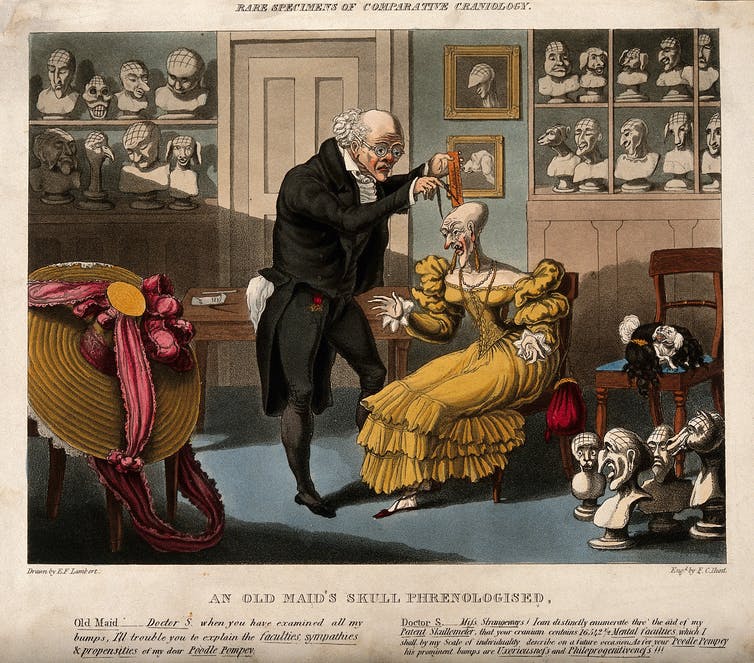
Print. Rare specimens of comparative craniology. An old maid's skull phrenologised. / Drawn by F.C. Hunt, engraved by E. F. Lambert. (London) [1805-1830?]. Aquatint, col., 27x32cm.
History
The above image represents an older woman who is dressed eccentrically in a ruffled dress and cinched corset. Her expression, mouth open mid speech, draws attention to her angular, bony features. She sits on a chair, her skull measured by a doctor who stands over her, bespectacled and dressed in black. On another chair nearby, a fluffy yet ferocious little poodle snarls at the doctor. In the background, statues of varied busts populate the shelves, the faces differing drastically with some features animalic. On the floor in the right hand corner, the busts assembled seem to contain that of a cat and a goat amongst humans. The woman’s expansive hat takes up the left-hand corner of the image, while the portraits of a humanoid figure and a dog hang above the doctor and his patient. The text below the print reads:
“Old Maid – Doctor S. When you have examined all my bumps, I’ll trouble you to explain the faculties, sympathies and propensities of my dear ''Poodle Pompey.
Doctor S – Miss Strangeways! I can distinctly enumerate thro’ the aid of my Patent Skullometer, that your cranium contains 16342 ½ Mental faculties'' which I shall by my Scale of individuality describe on a future occasion. As for your Poodle Pompey, his prominent bumps are Uxoriousness and Philoprogenitiveness!!!” F.C Hunt’s drawing, engraved in print by E.F Lambert, makes a spectacle of the now obsolete practice of phrenology through his caricature (Bynum, 1968).
Phrenology emerged in the late 18th and early 19th centuries as a purportedly scientific study of the relationship between the shape of the skull and mental faculties. It was founded by the German physician Franz Joseph Gall (1758–1828) a physician who contributed extensively to the fields of anthropology, physiology, neuro-anatomy and comparative anatomy. Phrenology was based upon the notion that the brain and its mental faculties—such as behavior, intelligence, or even violence—were localized in specific regions of the cerebral cortex, thereby creating an immediate connection between the shape of the cranium and the disposition of an individual. Phrenology initially held appeal within medical and scientific circles. At the time, neurology and psychiatry were in their infancy, and phrenology appeared to offer a rigorous, methodical approach to understanding the mind-body connection. The discipline’s emphasis on brain localization contributed, in a limited way, to the later development of neuroscience, as it encouraged researchers to consider that specific brain areas might serve distinct functions (Finger, 1994). Moreover, its understanding of the brain as a “geometric” organ, in the sense that both its arrangement and size could impact function or the lack-thereof, also served as a useful precursor to the basis of neurology and psychiatry.
Limitations
Phrenology’s methods—including palpating skulls to infer psychological traits—were based on faulty premises without concrete medical evidence for its validity. The assumption that cranial contours reflected underlying brain structure was anatomically incorrect; skull thickness and shape bear little consistent relationship to cortical topography. Gall and his followers, particularly Johann Spurzheim, derived increasingly flawed relationships between the size and contour of these brain regions. For instance they believed that the measurement of the skull’s surface would enable scientists and physicians to make wider conclusions and assessments of a person’s character, intelligence, and moral tendencies (Gall, 1835).
By the late 19th century, advances in experimental psychology and neuroanatomy had discredited phrenology as a science. Researchers such as Pierre Flourens demonstrated through lesion studies that while different regions of the brain contributed to different functions, complex behaviors themselves could not be localized to discrete brain “organs” as Gall proposed (Flourens, 1842). Yet the legacy of phrenology persisted—its emphasis on quantifying human worth through biological traits influenced later pseudosciences like craniometry and physiognomy, both of which underpinned eugenic movements in the early 20th century. These movements were used to justify racial discrimination, sterilization, and restrictive immigration laws under the guise of biological improvement (Gould, 1981), and became important underpinnings of numerous global conflicts and atrocities, subsequently shaping the development of the modern world.
The print itself is remarkable for the way it satirises this pseudoscience. The busts, a format of sculpture typically regarded as reverential and ennobling, feature not only human beings but also animals. This side by side display of man and beast demonstrates their shared characteristics, with hybrid creatures sometimes displayed. This draws attention to those monstrous people who walk amongst us, discernible by their skulls. Mathematical grids are etched across their craniums, resembling in some ways an atlas which explores the dark continents of the mind. The doctor’s appraisal of the poodle as having affection for its owner (uxoriousness) and ‘loving children’ (philoprogenitiveness) contrasts with its draconic appearance, teeth bared and body bristling. This irony encapsulates the scepticism felt at the time for phrenology, summarised by Dr. John Gordon (1786-1818) as a “field for quacks to fatten in.” He writes: “We look upon those whole doctrines [sic] taught by these two modern peripatetics … as a piece of thorough quackery from beginning to end… and we are persuaded that every intelligent person … will view them precisely in the same light.” (Hughes, 2022.)
Impact
Despite its scientific shortcomings, phrenology gained immense popularity in Europe and the United States during the 19th century. Its appeal lay partly in its promise of self-knowledge and social order—it suggested that moral and intellectual capacity could be objectively measured. Although spurious and substantially critiqued by the contemporary British press, it had appeal to medical dilettantes as well as professional practitioners of medicine. Spurzheim, so keen to transmit his ideas, even allowed women to attend some of his lectures for a third less of the price of a gentleman (Hughes, 2022.) However, the objectivity of the practice was illusory and arrived during a period of increasing scientific progress in which societal excitement allowed many sensational-yet-flawed scientific ideas to disseminate without proper scrutiny. Practitioners used phrenological charts to “prove” the intellectual superiority of Europeans and the inferiority of other races, providing a seemingly rigorous, legitimate, and objective veneer to racism, colonialism, and eugenic ideologies (Stepan, 1982). Therefore, it can be said that phrenology was deeply rooted in racist, classist and religious ideologies. At times, people were often compared to animals through their skull shape, for instance “manifest[ing] less mind than many of the lower animals,” while a cold-blooded murderer was described as having “somewhat the forehead of a dog” (Eadon, 1846.) The “scientific” ranking of skulls and faculties mirrored and reinforced existing social biases, promoting the idea that moral virtue and intelligence were biologically predetermined and unequally distributed among populations.
Modern Understanding
Phrenology thus occupies a paradoxical place in medical and scientific history. While it encouraged the anatomical study of the brain and contributed an important geometric and geographic study of the brain, it also exemplified the dangers of conflating empirical observation with social prejudice. Its history underscores a crucial lesson for modern medical science: that claims of biological determinism, when uncritically accepted or socially motivated, can lead to the misuse of medicine and science to rationalize inequality.
References
Bynum, W. (1968), 'An Old Maid’s Skull Phrenologised', Journal of the History of Medicine and Allied Sciences, XXIII(4)
Eadon, S. (1846) Descriptive Catalogue of the Busts, Masks and Skulls of the Sheffield Phrenological Society. Robert Leader, Sheffield.
Finger, S. (1994). Origins of Neuroscience: A History of Explorations into Brain Function. Oxford University Press.
Flourens, P. (1842). Recherches Expérimentales sur les Propriétés et les Fonctions du Système Nerveux. Paris: Baillière.
Gall, F. J. (1835). On the Functions of the Brain and of Each of Its Parts. Boston: Marsh, Capen & Lyon.
Hughes, W. (2022), The Dome of Thought, Manchester University Press, Manchester.
Stepan, N. L. (1982). The Idea of Race in Science: Great Britain 1800–1960. Macmillan.
Gould, S. J. (1981). The Mismeasure of Man. W. W. Norton & Company.
Authors: Christina Olszewski & Michael Motoc