= Alzheimer’s Disease =
Artist, Title, Date
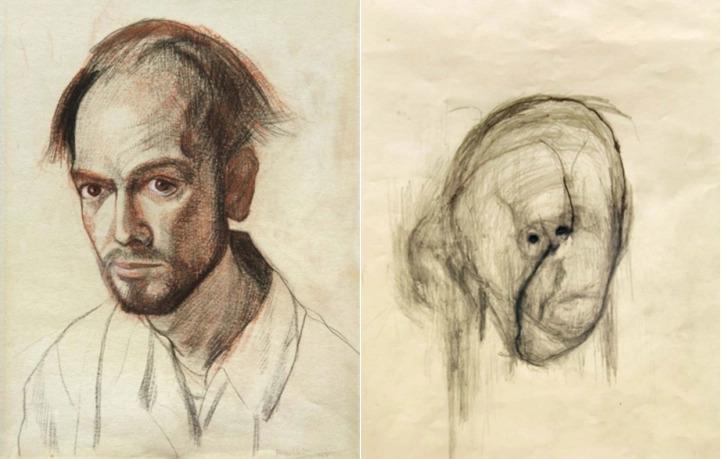
William Utermohlen, Head, Dementia. Pencil. 2000.
Description of Disease & Etiology
Alzheimer’s disease (AD) is a progressive neurodegenerative disorder and the most common and perhaps recognizable cause of dementia worldwide. It is clinically characterized by gradual decline in episodic memory, executive dysfunction, visuospatial impairment, and eventual loss of functional independence. The disease typically presents after age 65 (late-onset AD), although early-onset familial forms exist and are associated with autosomal dominant mutations in APP, PSEN1, and PSEN2. Late-onset AD is multifactorial, with the APOE ε4 allele serving as the strongest known genetic risk factor. Age, vascular risk factors, inflammation, and metabolic dysfunction contribute to disease susceptibility, however there remains a lack of clinical and neurobiological clarity around definitive disease pathology. Utermohlen’s self-portrait captures the lived phenomenology of neurodegeneration, including a fragmentation of self-perception, loss of spatial coherence, and emotional isolation, reflecting the progressive cortical dysfunction central to AD.
Pathology
The neuropathological hallmarks of Alzheimer’s disease are extracellular β-amyloid plaques and intracellular neurofibrillary tangles composed of hyperphosphorylated tau protein. According to the “Amyloid Cascade Hypothesis”, abnormal cleavage of amyloid precursor protein results in accumulation of toxic Aβ42 peptides, initiating synaptic dysfunction and neuroinflammation. Tau pathology spreads in a stereotyped pattern beginning in the medial temporal lobe, particularly the hippocampus, before extending to associative neocortex. Progressive synaptic loss correlates more closely with cognitive decline than plaque burden alone. Neurodegeneration is accompanied by microglial activation, astrocytosis, mitochondrial dysfunction, and cholinergic neuronal loss, particularly within the nucleus basalis of Meynert. These pathological processes culminate in cortical atrophy, especially in temporal and parietal lobes, visible on neuroimaging. Importantly, it is not entirely understood what causes the original development of Tau pathology, and increasing research indicates a plethora of underlying changes within the brain, including from single-neuron changes up to entire neuronal network dysregulation.
Signs/Signifiers of Illness
Clinically, Alzheimer’s disease initially presents with impaired short-term memory and difficulty forming new memories. As disease progresses, patients exhibit aphasia, apraxia, agnosia, executive dysfunction, and behavioral changes such as apathy, irritability, or paranoia. Utermohlen’s Head, Dementia visually reflects cortical disintegration: the asymmetry, blurred facial boundaries, and spatial distortion symbolize visuospatial decline and fragmented self-recognition. The hollowed eyes and muted palette evoke emotional withdrawal, while diminished facial definition parallels the erosion of identity often described by patients and caregivers. In this sense, the distortion within the piece serves as a metaphorical biomarker of the artist’s cortical degeneration.
Treatment
Current treatments for Alzheimer’s disease are largely symptomatic. Cholinesterase inhibitors (donepezil, rivastigmine, galantamine) improve cholinergic transmission and provide modest cognitive benefit. Memantine, an NMDA receptor antagonist, may reduce excitotoxicity in moderate-to-severe disease. Recently approved anti-amyloid monoclonal antibodies such as aducanumab and lecanemab aim to reduce amyloid plaque burden, though their clinical benefit remains under ongoing evaluation. Non-pharmacologic strategies, including cognitive stimulation, exercise, vascular risk management, and caregiver support, remain foundational. Despite advances, no definitive cure exists, and therapeutic goals focus on slowing progression and preserving quality of life.
Social Determinants of Illness
Alzheimer’s disease disproportionately affects aging populations and is influenced by education, socioeconomic status, cardiovascular health, and access to healthcare. Lower educational attainment is associated with reduced cognitive reserve, potentially accelerating symptomatic expression. Social isolation and caregiver burden further compound morbidity. Globally, disparities in diagnostic access and long-term care infrastructure shape outcomes. Utermohlen’s work underscores the psychosocial dimension of dementia: the illness is not solely neuropathological but existential, altering identity, relationships, and autonomy. Understanding AD thus requires integration of biological mechanisms with social context.
Author (s): Michael Motoc
Citations:
1. Hardy J, Selkoe DJ. The amyloid hypothesis of Alzheimer's disease: progress and problems on the road to therapeutics. Science. 2002;297(5580):353-356. doi:10.1126/science.1072994
2. Braak H, Braak E. Neuropathological stageing of Alzheimer-related changes. Acta Neuropathol. 1991;82(4):239-259. doi:10.1007/BF00308809
3. Jack CR Jr, Bennett DA, Blennow K, et al. NIA-AA Research Framework: Toward a biological definition of Alzheimer's disease. Alzheimers Dement. 2018;14(4):535-562. doi:10.1016/j.jalz.2018.02.018
Selkoe DJ. Alzheimer's disease is a synaptic failure. Science. 2002;298(5594):789-791. doi:10.1126/science.1074069
5. Cummings J, Lee G, Nahed P, et al. Alzheimer's disease drug development pipeline: 2022. Alzheimers Dement (N Y). 2022;8(1):e12295. Published 2022 May 4. doi:10.1002/trc2.12295