= Development of Neuroscience =
Artist, Title, Date
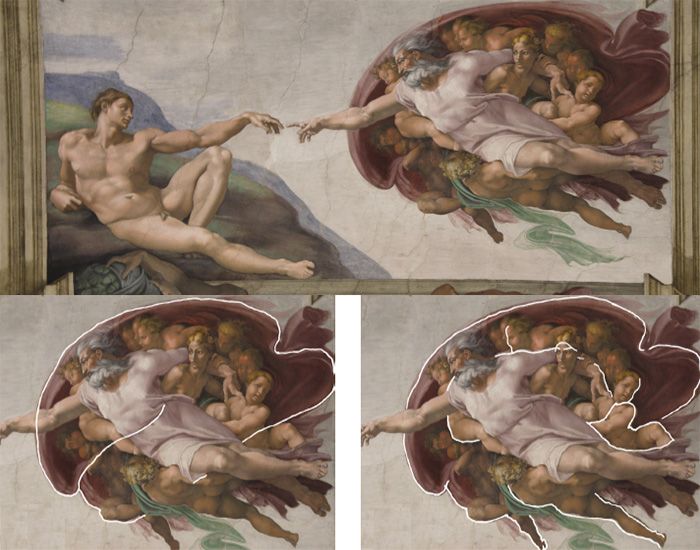
“The Creation of Adam”, Michelangelo Buonarroti. 1508-1512. Fresco. Sistine Chapel (ceiling), Vatican City.
Description
Michelangelo’s Creation of Adam has long been one of the most controversial and most discussed artworks ever created, occupying the intersection of art, theology, and early anatomical science. Painted during the Renaissance period, the fresco depicts God extending his hand towards Adam, imparting the “spark of life” that creates Adam, and by extension the human species, as described in the Bible. While traditionally interpreted as a purely theological image of divine creation, scholarship has increasingly explored the possibility that the composition encodes early ideas about the brain and human consciousness. Most famously, the billowing maroon mantle and attendant figures surrounding God have been argued to resemble a sagittal section of the human brain, with identifiable structures such as the frontal lobes, brainstem, and cerebellum subtly embedded within the form.
This interpretation gains plausibility when considered within the historical context of Renaissance anatomy. The fifteenth and sixteenth centuries marked a profound shift in the study of the human body, driven in large part by renewed interest in classical texts and increasingly systematic human dissection. Artists such as Michelangelo were not passive observers of these developments; rather, they were active participants. Famously, artists such as Leonardo da Vinci would study numerous anatomical structures including cow fetuses and deceased human remains to better understand how the human body operated. Michelangelo, too, is known to have dissected human cadavers, gaining intimate knowledge of musculature, skeletal form, and internal anatomy. Although neuroscience as a formal discipline would not emerge until centuries later, early anatomical investigations laid the groundwork for understanding the brain as the seat of sensation, intellect, and identity. Importantly, many of these studies countered the central dogma of the Roman Catholic Church, which makes Michelangelo’s seeming tongue-in-cheek depiction of God as a brain a scientific challenge to the era’s religious dominance of thought.
Early Interpretations of the Brain and Its Function
Historically, conceptions of the brain were shaped by a blend of empirical observation and philosophical speculation. Ancient thinkers such as Hippocrates and Galen recognized the brain’s role in sensation and cognition, yet their theories coexisted with beliefs that placed the soul or intellect in the heart or ventricles. During the medieval period, a new theory of cognition dominated European thought, proposing that imagination, reason, and memory were housed in discrete brain cavities.
By Michelangelo’s time, this framework was beginning to erode. Renaissance anatomists, most notably Andreas Vesalius, challenged inherited dogma through direct observation, revealing the brain’s complex structure and undermining simplistic ventricular models. Although the functional significance of neural tissue remained poorly understood, the brain increasingly emerged as the anatomical substrate of thought, putting a physical object at the forefront of human behavior and thought rather than a spiritual being.
Controversies Surrounding Neuroscience: Church and Science
The development of anatomical science during the Renaissance unfolded within a delicate tension between religious doctrine and empirical inquiry. The Church was both patron and gatekeeper: it commissioned works such as the Sistine Chapel ceiling while simultaneously imposing theological boundaries on acceptable knowledge. Dissection, though increasingly practiced, remained morally and culturally fraught.
Within this climate, art offered a unique space for intellectual negotiation. Symbolism allowed artists to explore controversial ideas without overtly challenging doctrine. Rather than depicting science and faith as oppositional, the fresco may potentially suggest a synthesis in which divine creation and human cognition are inseparable. Some other interpretations insist that Michelangelo’s depiction of God as the brain is a disavowal of religious thought, positing science and rigorous enquiry as the “maker” of man.
Modern Understanding of the Brain and the Self
From a modern neuroscientific perspective, the questions implicitly raised by The Creation of Adam—what gives rise to consciousness, identity, and selfhood—remain among the field’s most profound challenges. Contemporary neuroscience understands the brain as a highly interconnected network of neurons, with cognition emerging from dynamic patterns of electrical and chemical signaling. While modern experiments highlight individual brain regions as possessing specialized function, increasing knowledge of the brain only further elucidates the complexities of its function and structure, revealing a vast, impossibly complex web of connections between billions of neurons.
Modern technologies such as functional MRI, diffusion tensor imaging, and electroencephalography allow researchers to observe brain activity in vivo and can shed light on how certain human behaviors originate and change over time. While many questions about how the brain creates a “self” remain unanswered, theories including the global workspace model and predictive processing frameworks conceptualize consciousness as an emergent property of large-scale neural integration.
The Creation of Adam stands not only as a masterpiece of Renaissance art but also as a visual case study in the evolving understanding of the brain and the development of neuroscience. Michelangelo’s image anticipates a central question that continues to animate scientific inquiry: how does the brain give rise to thought, identity, and the experience of being human? Moreover, it sits at the very center of a long debate between science and religion, making it a contentious, everlasting reminder of man’s origins, his purpose, and the questions that remain.
Author (s): Michael Motoc
Citations:
* 1) Meshberger FL. An interpretation of Michelangelo's Creation of Adam based on neuroanatomy. JAMA. 1990;264(14):1837-1841.Finger S. Origins of Neuroscience. Oxford University Press. * 2) Damasio, Antonio R. The Feeling of What Happens Body and Emotion in the Making of Consciousness Antonio Damasio. Harcourt, 2000. * 3) Dehaene, Stanislas. Consciousness and the Brain: Deciphering How the Brain Codes Our Thoughts. Viking, 2014. * 4) Vesalius, Andreas, et al. De Humani Corporis Fabrica. Department of Classics, Northwestern University, 2003.