= Parkinson’s Disease =
Artist, Title, Date
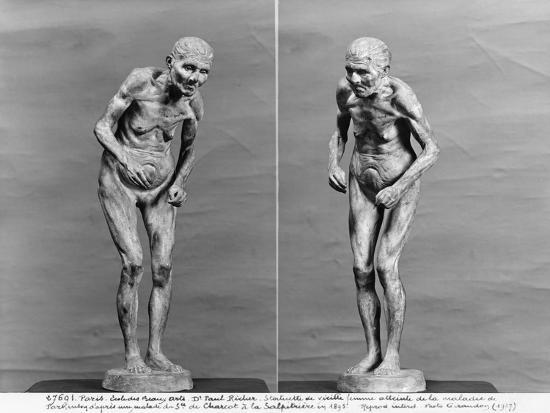
Paul Marie Louis Pierre Richer, Statuette of an Old Woman with Parkinson’s Disease, 1895. Bronze. Académie de Médecine, Paris.
Description of Disease & Etiology
Parkinson’s disease (PD) is a chronic, progressive neurodegenerative disorder primarily involving the loss of dopaminergic neurons in the substantia nigra pars compacta of the midbrain leading to declining motor capabilities. First systematically described by James Parkinson in 1817, the disease is characterized by the classical tetrad of resting tremor (often with pill-rolling motions), rigidity, bradykinesia, and postural instability. Although most cases are idiopathic and much research remains to be done, PD is thought to arise from a complex interaction between genetic susceptibility, environmental toxins, aging-related mitochondrial dysfunction, and abnormal misfolded α-synuclein protein aggregation forming Lewy bodies within neurons. Richer, a neuroanatomist, artist, and professor of anatomy, created the statuette to document and visually teach the characteristic features of PD. His sculpture captures the lived experience of patients at a time when no effective therapy existed and serves as an early example of how medical visualization shaped diagnostic understanding before modern neuroimaging.
Pathology
The central pathology of PD is the degeneration of dopaminergic neurons in the substantia nigra leading to reduced dopamine input into the striatum. This results in dysfunction of the basal ganglia motor circuits, producing dis-coordinated, impoverished motor abilities leading to difficulty initiating motion and abnormal muscle tone. Microscopically, Parkinson’s is characterized by neurons containing Lewy bodies, intracytoplasmic aggregates composed largely of α-synuclein, marking a failure of cellular protein clearance mechanisms. As the disease progresses, widespread involvement of limbic and cortical structures contributes to mood disorders, cognitive decline, sleep disturbances, and autonomic dysfunction. While there exist variations of PD, including Atypical Parkinsonian Disorders such as Progressive Supranuclear Palsy (PSP) and Multiple System Atrophy (MSA), Richer’s representation illustrates the most characteristic and common presentation of PD, namely rigidity, postural instability, and bradykinesia. The forward-flexed spine, shuffling posture, and reduced arm swing implied by the statuette reflect dysfunction in the basal ganglia’s output pathways and impaired postural reflexes.
Signs/Signifiers of Illness
Richer’s sculpture meticulously captures clinical markers recognizable to modern neurologists. The statuette shows the woman bent forward at the waist with rounded shoulders, typical of PD’s axial rigidity and postural instability. This “camptocormic” posture arises from increased muscle tone in flexor muscles and impaired extensor activation. Her arms hang stiffly and close to the torso. The implied paucity of movement, even in still form, reflects bradykinesia, or the slowing and decrement of voluntary movement. Richer sculpted a face with diminished emotional expressivity, open-mouthed stiffness, and fixed gaze. Hypomimia, or the loss of facial movement, is a well-known sign of PD. While not shown explicitly in the statuette, her left hand appears subtly cupped inward, perhaps suggestive of the classical “pill-rolling” tremor described historically. Marked thinness in the limbs and torso mirrors disuse atrophy and the progressive reduction in physical activity experienced by patients.
Treatment
When Richer created the sculpture in 1895, no disease-modifying therapy existed. At the time, treatment relied on rudimentary physical therapy, massage, hydrotherapy, and occasionally sedatives or anticholinergic plant extracts. Patients often experienced progressive disability with limited medical intervention. Today, however, treatment is multifaceted, including dopamine-based therapeutics such Levodopa–carbidopa, the current gold-standard treatment, which helps to restore striatal dopamine levels. Dopamine agonists, MAO-B inhibitors, and COMT inhibitors provide additional symptom control, although may have side effects related to the inundation of dopamine, including visual hallucinations or even disinhibition of self-control (some patients report increased desire for gambling). Surgical interventions remain under investigation but show increasing promise, including placement of Deep brain stimulation (DBS) devices into the subthalamic nucleus or globus pallidus internus to improve tremor, rigidity, and bradykinesia. Regular exercise, balance training, occupational therapy, and speech therapy may also be utilized to improve functional outcomes. Much research remains to be done to produce therapeutics that treat or even cure Parkinson’s Disease as current therapeutics have only been shown to slow progression and treat symptoms. Emerging therapies include gene therapy, the creation of neuroprotective molecules, and trials that target α-synuclein aggregation or reverse mitochondrial dysfunction.
Social Determinants of Illness
Parkinson’s disease disproportionately affects older adults, and Richer’s selection of an elderly woman highlights the intersection of aging, gender, poverty, and disability in France. Older adults historically had limited mobility, few social supports, and minimal access to medical care. Importantly, at the time chronic neurological illnesses were often dismissed as “senility,” and late 19th-century urban Paris had high rates of poverty among elderly women. Socioeconomic instability limited access to nutrition, safe working conditions, and medical attention, all of which are associated with accelerated neurodegeneration and more pronounced, visible symptoms. Motor disorders carried social stigma; patients were often perceived as feeble, mentally impaired, or morally weakened. Many elderly women relied on charity hospitals such as the Salpêtrière, where Richer worked and where the model for this statuette was almost certainly observed. Richer’s anatomical realism thus highlights how disability was observed not only medically but also socially in late 19th century France.
Author (s): Michael Motoc
Citations:
1. Poewe, W., Seppi, K., Tanner, C. et al. Parkinson disease. Nat Rev Dis Primers 3, 17013 (2017). https://doi.org/10.1038/nrdp.2017.13
2. DeMaagd G, Philip A. Parkinson's Disease and Its Management: Part 1: Disease Entity, Risk Factors, Pathophysiology, Clinical Presentation, and Diagnosis. P T. 2015;40(8):504-532.
3. Jankovic J. Parkinson's disease: clinical features and diagnosis. J Neurol Neurosurg Psychiatry. 2008;79(4):368-376. doi:10.1136/jnnp.2007.131045
4. Surmeier DJ, Obeso JA, Halliday GM. Selective neuronal vulnerability in Parkinson disease. Nat Rev Neurosci. 2017;18(2):101-113. doi:10.1038/nrn.2016.178
5. Goetz CG. The history of Parkinson's disease: early clinical descriptions and neurological therapies. Cold Spring Harb Perspect Med. 2011;1(1):a008862. doi:10.1101/cshperspect.a008862