Artist/ Group/Tribe, etc.
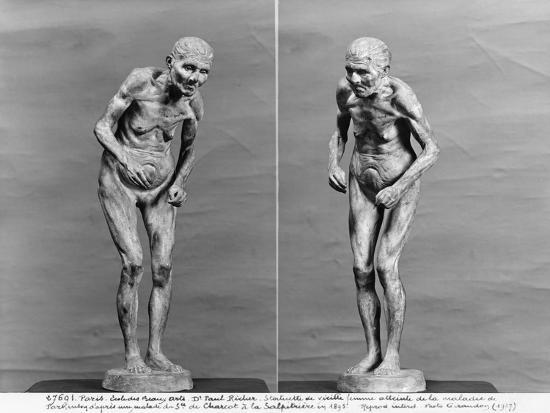
“Statuette of an old woman with Parkinson's disease. ” Paul Marie Louis Pierre Richer (French) also called Paul Richet
Medium, time frame
Plaster, h. 47cm, after 1895. Musée d' Histoire de la Médecine et de la Pharmacie, Lyon.
Symbolism, iconography
This statuette depicts an elderly woman afflicted with what was historically called “Shaking Palsy,” also known as Parkinsons’ disease. The figure is represented in the nude, and her posture is inclined forward, her limbs flexed and her body emaciated and sunken. The veins in her body are finely rendered, and her body is anatomically proportionate. Particular attention is drawn to her facial expression, with deep lines furrowing her brow and a downturned mouth.''' '''
Historical context
Paul Richer was a prominent figure in 19th century French medicine and neurology. In 1849, he was born in Chartres, not far from Paris, to a humble working class family. As a child, he demonstrated a keen interest in art, particularly inspired by the intricate gothic facade of the magnificent Cathédrale Notre-Dame de Chartres. Despite his profuse talent, Richer had no formal artistic training and was colourblind. For this reason his work is predominantly in black and white or sculpture. His journey into medicine followed his participation as a medical assistant in the Prussian War, and after continuing studies in medicine, he eventually interned in the Salpetrière Hospital, where he produced some of his most famous work as an artist and as a doctor. He sculpted many figurines such as these throughout his career as a doctor to be used didactically as visual representations of illness.''' '''
Socio-cultural context and influences
Paul Richer was the protégé of the renowned Jean Martin Charcot (1825-1893), who was a significant mentor and supporter of Richer. Charcot claimed that from Richer’s work, a medical viewer would be able to diagnose the illness directly, and described it as “a photograph in three dimensions,” indicating the high level of accuracy in his work. Charcot was interested in reviving the crossover of medical and artistic practice in the tradition of 16th and 17th century Dutch anatomists such as Andreas Vesalius, Adriann von Spiegel and Thomas Bartholin, and was dedicated to establishing the Salpêtrière hospital as a centre for medical imagery. It’s significant to note that in the second half of the 19th century, there was a strong preference for “mechanical objectivity,” such as images captured through photographic media, however in this instance Richer’s work is significant for the dialogue it produces between science and art, which he strongly believed issued from the same source.
Significance (elements of art/ principles of design)
The convention of nudity was traditionally used to illustrate mythological, academic or allegorical figures, their proportions often exaggerated or beautified for artistic merit. Richer’s portrait of the patient simply known as “Gell,” is represented differently to tradition, deeply rooted in reality. Although static, the sculpture’s bent posture suggests movement and the minute gesture of her hands, one of which displays the coin-counting tremor that was associated with Parkinson’s disease. Moreover, the medium of plaster captures the rigidity of the sufferer’s limbs. Through the sculpture, the viewer is given a clue into the interiority and livelihood of the woman who has been ravaged by this disease, exemplified by a mournful expression. Details of her life have not been spared, such as the trilobate appearance of the stomach under the navel, attesting to the fact that this woman, at 58 years of age, had lived a long life, bearing 11 children. This leads the viewer to speculate on the patient’s personhood, her portrait at once educational and evocative of pathos.
Author(s): Christina Olszewski
Citations:
Kullmann, Benoit. Building a Bridge Between Neurology and Art. Neuroland Art, 24th September 2011. URL:
http://bkneuroland.fr/mobile/articles.php?lng=fr&pg=1306
Maranhão-Filho, Péricles. “A arte e a neurologia de Paul Richer.” Arquivos de Neuro-Psiquiatria, 75, no. 7
(2017): DOI : 10.1590/0004-282X20170067.
Ponomariov, V. The story of a statuette “A woman with Parkinson’s disease”. ''International Neurological
Journal, 16'', no. 3 (2021). 84–87. https://doi.org/10.22141/2224-0713.16.3.2020.203453
Ruiz-Gomez, Natasha. “The ‘scientific artworks’ of Doctor Paul Richer.” Journal of ''Medical Humanities Online
First'' (2013). DOI: 10.1136/medhum-2012- 010279.