Chronic Pellagra
Artist/ Title/ Date
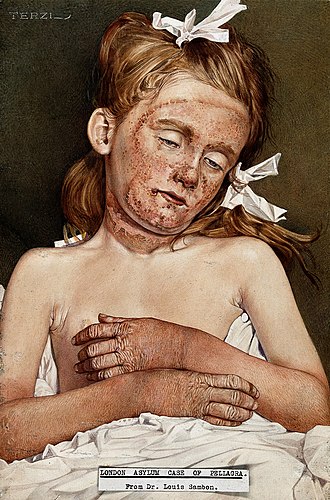
A.J.E. Terzi, A Girl in the London Asylum Suffering from Chronic Pellagra, 1925. Watercolor. Wellcome Collection, London.
Description of Disease & Etiology
Pellagra results from a deficiency in niacin (vitamin B3) or its precursor, the amino acid tryptophan. Although humans can synthesize niacin from tryptophan, this conversion depends on adequate levels of iron, vitamin B2 (riboflavin) and vitamin B6 (pyridoxine). Historically, pellagra has been associated with malnutrition, particularly in populations relying on untreated maize (corn) as a dietary staple. Without nixtamalization, a traditional processing method, the niacin and tryptophan in corn remain largely unavailable for absorption. In the absence of sufficient niacin, the body cannot produce NAD+ and NADP+, essential coenzymes for energy metabolism and cellular repair processes.1-3
Signs/Signifiers of Illness
The “Four D’s of Pellagra”, Dermatitis, Diarrhea, Dementia, and Death, summarize the hallmark effects of niacin deficiency on the body. Pellagra’s skin involvement is typically symmetrical and appears on sun-exposed areas, including the hands, forearms, lower legs, and neck, the last of which is known as Casal’s necklace. The rash may initially resemble sunburn, but progresses to hyperpigmented, scaly plaques, often followed by desquamation and cracking.
Because rapidly dividing epithelial cells in the gastrointestinal tract are highly dependent on niacin, diarrhea, nausea, and vomiting are common symptoms. Pellagra also induces neuropsychiatric changes, including irritability, fatigue, insomnia, and memory impairment. In advanced stages, patients may develop hallucinations, delusions, dementia, or depression. Without treatment, pellagra may lead to severe systemic deterioration and death.1-2
Pathology
NAD+ is essential for oxidative metabolism, ATP production, and DNA repair. Its deficiency impairs energy production and cellular maintenance, particularly in tissues with high metabolic demands, such as the epidermis, gastrointestinal epithelium, and neurons. This contributes to the characteristic skin lesions, digestive dysfunction, and neuropsychiatric signs and symptoms seen in pellagra.
NADP+ plays a key role in maintaining redox balance and in the regeneration of glutathione, the body’s primary intracellular antioxidant. In the absence of adequate niacin, cells become more vulnerable to oxidative damage, especially in the skin and mucosa, where environmental stressors are high.
Additionally, niacin deficiency affects neurotransmitter synthesis, including that of serotonin, since its precursor tryptophan is diverted toward compensatory NAD+ production. Combined with the impaired neuronal metabolism, this contributes to the cognitive decline associated with advanced pellagra.1-3
Treatment
The primary treatment for pellagra is oral or intramuscular nicotinamide, a form of niacin that doesn’t cause flushing, a side effect characterized by warmth, redness, burning, itching, or tingling that can occur within minutes of taking high-dose nicotinic acid. With treatment, neurological and dermatological symptoms typically improve within a few days, although gastrointestinal symptoms may take longer to resolve. A balanced diet rich in niacin, tryptophan, and protein is essential for long-term recovery and to prevent relapse. Multivitamin supplementation may also be recommended if other nutrient deficiencies are suspected.1-2
Social Determinants of Illness
Pellagra is often described as a disease of poverty, arising where people lack access to niacin-rich foods such as meat, legumes, and dairy. Many historical pellagra outbreaks occurred in asylums, prisons, and orphanages, where diets were nutritionally inadequate and lacked variety. These settings magnified risk due to overcrowding, poor oversight, and lack of public health infrastructure. Pellagra has been most prevalent in regions where untreated maize is a dietary staple. In more recent cases, it has been linked to alcoholism, HIV/AIDS, and anti-tubercular drugs like isoniazid, which can interfere with niacin metabolism or absorption.1-2
Author (s): Victoria Rhodes
Citations:
* 1) Prabhu, D., Dawe, R. S., & Mponda, K. (2021). Pellagra a review exploring causes and mechanisms, including isoniazid-induced pellagra. Photodermatology, Photoimmunology & Photomedicine, 37(2), 99–104. https://doi.org/10.1111/phpp.12659 * 2) Viljoen, M., Bipath, P., & Tosh, C. (2021). Pellagra in South Africa from 1897 to 2019: A scoping review. Public Health Nutrition, 24(8), 2062–2076. https://doi.org/10.1017/S1368980021001336 * 3) Williams, A. C., & Hill, L. J. (2020). The 4 D’s of Pellagra and Progress. International Journal of Tryptophan Research, 13, 1178646920910159. https://doi.org/10.1177/1178646920910159