Artist/ Group/Tribe, etc.
Michelangelo Buonarotti (1475-1564) Italian Renaissance''' '''
Medium, time frame
1512, Fresco (Sistine Chapel, Vatican City)
Symbolism, iconography
Michelangelo’s Separation of Light from Darkness (1512) crowns the Sistine Chapel ceiling above the altar and depicts the first moment of Creation from Genesis. Within an architectural frame, God’s arms sweep upwards, physically pushing light and darkness apart. The background is stark and minimal, and God’s form is surrounded by four muscular, decorative male figures, ignudi, who sit on the frame. Michelangelo uses extreme foreshortening so the viewer looks up at God from below whose posture twists, and robes swirl with intense movement and effort. Stripped of landscape and narrative detail, the fresco visualises divine power, placed sacredly above the altar to connect the beginning of the world with themes of salvation and spiritual renewal.
Historical context
At the age of 15, Michelangelo was taken in by the most powerful leader of Florence’s home, Lorenzo de’Medici. This exposed him to Neoplatonic philosophy through Marsilio Ficino (1433-1499) and painting through Sandro Botticelli, and Luca Signorelli, amongst other notable individuals. During the high Renaissance, a developing interest in science was used to understand and explain the human mind, in addition to the pervasion of Christian values, Neoplatonism and Galen’s philosophy of the body. Michelangelo grew into the well known painter, sculptor, and architect and also mastered the art of anatomy. He practiced dissection of cadavers, usually independently, an interest that began between 17 and 19 years old. He also developed a close acquaintance with one of the foremost anatomists of his time, Matteo Realdo Colombo (1516-1559). As dissection was viewed somewhat negatively by the church during Michelangelo’s lifetime, it is likely that he destroyed many of his anatomical sketches and did not publish them to preserve his public image and to remain in favour with the Pope, one of his primary patrons. Only a few sketches remain, depicting topographical and musculoskeletal anatomy. As an artist, he was a master in painting and sculpture. He is noted for his skill in fresco painting, which involved depositing coloured pigments onto wet plaster, which dried to preserve the painting on its surface.
Socio-cultural context and influences
Pope Julius II commissioned Michelangelo to paint the ceiling from the entrance to the altar in the Sistine Chapel in addition to other commissioned pieces in 1508. The Separation of Light from Darkness, the final panel in the series, was probably completed the following year, four months before the Sistine Chapel reopened to public entry on All Saint’s Day (November 1st). The prevalence of Neoplatonic thought at the time have led researchers such as Suk and Tamargo to argue that Michelangelo’s Separation is neoplatonically symbolic. They propose that the fresco reflects Plato’s ‘Allegory of the Cave,’ in which prisoners trapped within a cave mistake shadows for reality until they glimpse the light of truth that emerges from beyond their imprisonment. In this reading, Michelangelo’s God embodies the pursuit of enlightenment, an image placed deliberately above the altar to unite Christian theology with Neoplatonic philosophy and the pursuit of divine truth.
Significance (elements of art/ principles of design)
Varied interpretations exist in relation to the understanding of this bay. For instance, Bondeson and Bondeson (2011) contend that the image of God is in fact a self portrait of Michelangelo himself, maintaining that “a self esteem of the degree reflected by painting God in his own image… is in line with his personality in those days.” They claim that several autobiographical details support this notion, such as the illustration of what they interpret to be a multinodular goiter and gynecomastia in God’s figure, reportedly features of Michelangelo’s own earthly form.
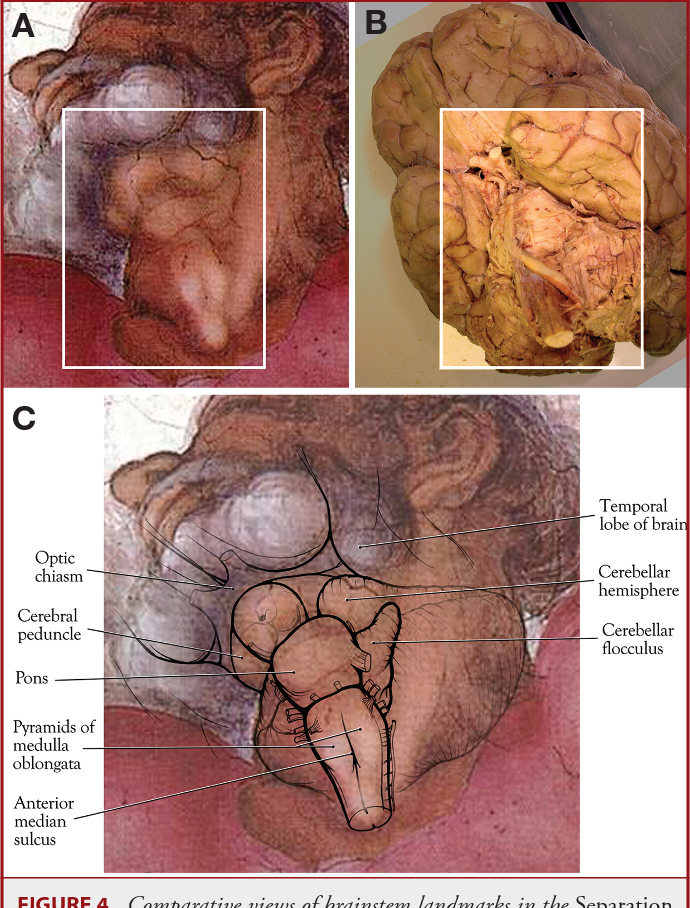
In contrast, Suk and Tamargo (2010) assert that since the neck shows four unusual midline prominences and lacks the anatomically precise suprasternal hollow, it is possible that a ventral view of the brain is concealed in God’s throat, reflecting Michelangelo’s expertise and fascination with human anatomy. The rolled beard, with its central depression and rounded bulges, is said to correspond to frontal brain regions. Together, these forms have been interpreted as the spinal cord, medulla, pons, cerebellum, and frontal lobes. Additional folds of drapery below the waist have been interpreted as the cervicothoracic spinal cord and even the optic chiasm and optic nerves. A representation of the brain in this way aligns closely with neoplatonic values, which privileges the non-tangible qualities of knowledge, ideas and truth and being the closest to divinity. This is reflected in Michelangelo’s poetry, where he writes:
'' The soul, the intellect complete and sound,
more free and unfettered, can rise through the eyes
up to your lofty beauty;
and,
Whatever beauty here on earth is seen,
To meet the longing and perceptive eye,
Is semblance of that source divine,
From whence we all are come.
In this alone we catch a glimpse of Heaven. '' Author(s): Christina Olszewski
Citations: Bondeson, Lennart, and Anne-Greth Bondeson. “On the Anatomy in Michelangelo’s Separation of Light from Darkness.” Neurosurgery 69, no. 2 (August 2011): E503–E505. https://doi.org/10.1227/NEU.0b013e31821787cc.
Suk, Iljun, and Rafael J. Tamargo. “Concealed Neuroanatomy in Michelangelo’s Separation of Light from Darkness in the Sistine Chapel.” Journal of Biocommunication 40, no. 2 (2016). https://pmc.ncbi.nlm.nih.gov/articles/PMC9138627/
Suk, Iljun, Rafael J. Tamargo, and colleagues. “Neoplatonic Symbolism by Michelangelo in the Sistine Chapel’s Separation of Light from Darkness.” World Neurosurgery (2018). https://pubmed.ncbi.nlm.nih.gov/20404688/