Artist/ Group/Tribe, etc.
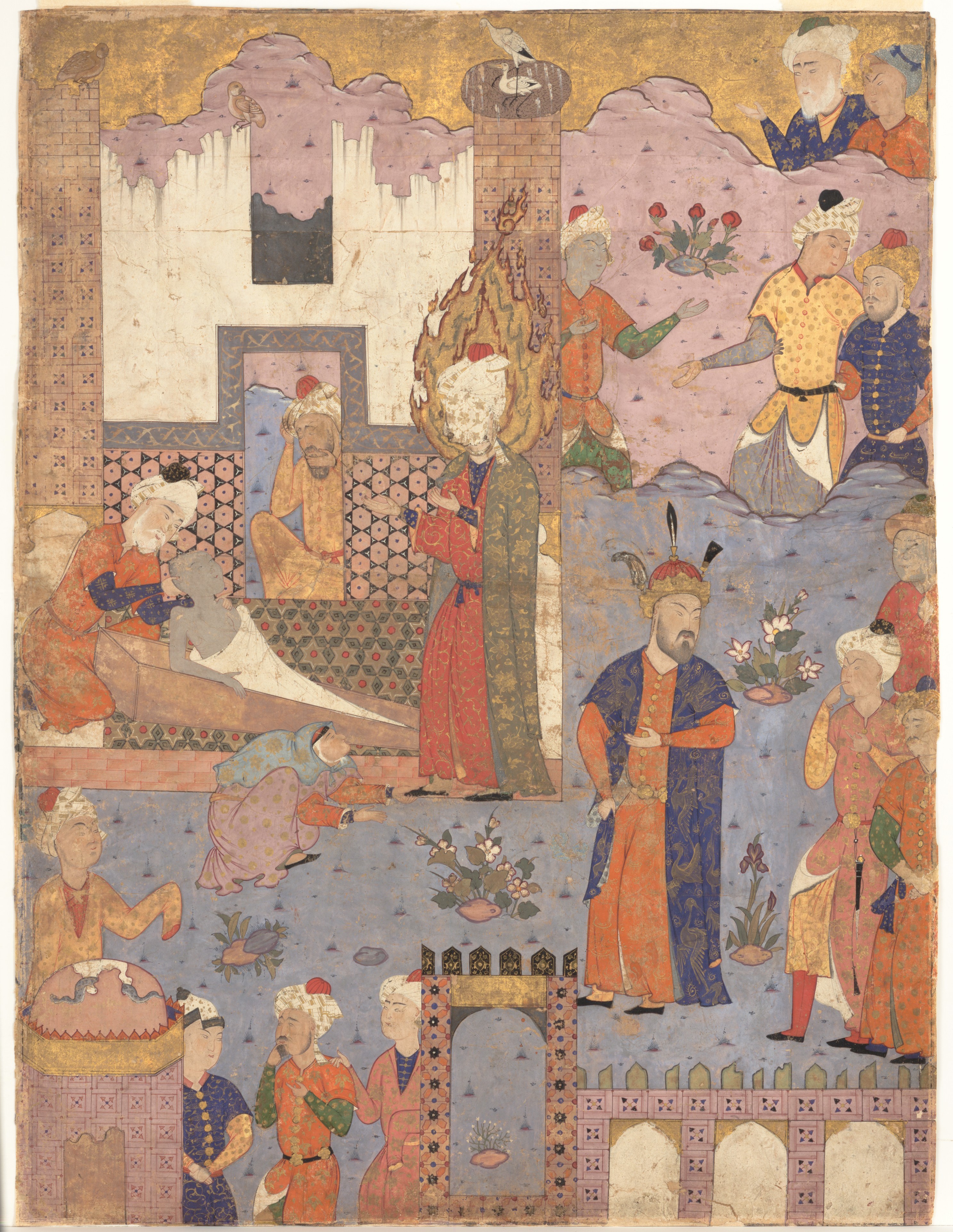
Artist unidentified, attributed to Iran, Qazvin. "Muhammad Revives the Sick Boy", Folio from a Falnama (Book of Omens) of Ja'far al-Sadiq
Medium, time frame
Ink, opaque watercolor, and gold on paper, 1550s.
Symbolism, iconography
This folio from a falnama (book of omens) depicts a miraculous event from the life of the Prophet Mohammad. He is represented veiled in the centre of the composition crowned by a flame-like halo. A woman crouches before him, begging him to heal her sick son. The son is clothed in a sheet, his complexion sallow and head uncovered. Around him, male onlookers watch from all parts of the composition with differing expressions of shock, wonder and curiosity. The landscape is punctuated with geometric, architectural forms, and alternating views of a level garden with various plants, flowers and animals populating the composition.
Historical context
A falnama was not meant to be read cover to cover, but rather aided in the answering of prayers through the revelation of omens through bibliomancy. Bibliomancy describes a practice where the answers to a prayer or a question are divined through the pages of a book. The enquirer utters their prayer, then opens the book at random to find the answer they seek through interpreting the book’s pages, richly illustrated and accompanied by text. A book of augury like the falnama highlighted the moral dimension of sickness and health, the physician being “the one who cures in each man the soul of its sins and the body of its sickness.” In Safavid Persia (1501-1756) medicine drew from the Galenic tradition, and that of Rhazes (al-Rāzī, 865–925) and Avicenna (Ibn Sīnā, 980–1037) which treated the body as composed of four humours: blood, phlegm, black bile (spleen) and yellow bile. Sickness was a result of the imbalance of any one of these humours, with individuals having different humoral dispositions.
Socio-cultural context and influences
A falnama was typically consulted by elite society, composed of nobles, Şūfī mystics, astrologers and scholars. Some falnamas were over a foot and half tall, large enough to be examined and interpreted by a small crowd. Both text and image borrowed symbolism drawn from historical, folkloric and religious contexts. The folios were encoded with spiritual messages based on a sophisticated word-and-image relationship to a highly literary audience.
Despite exposure to Western visual culture during the 16th-18th centuries with some discernible pictorial influence (such as in the representation of flowers) Persian miniature painting in the Safavid period adhered to tradition through the use of geometric design. In architecture, as in miniature painting, the use of geometry signalled a displacement from the mundane, earthly world, provoking conscious introspection and reverence.
Significance (elements of art/ principles of design)
The composition suggests the book’s mystery, as figures and faces are simultaneously revealed and concealed. The viewer visually crosses the thresholds of walls, windows, bricks and rock formations at a glance. Above Mohammed, two cranes, one standing over the other in a small body of water, suggest the aspiration of the soul for higher knowledge and transcendence. To the upper left side of the composition, the artist has illustrated a pair of partridges. As ground-dwelling birds, they are connected to the earthly realm, although here they are seen perched on the height of the structure that houses the sick boy, suggesting the mystery of the miracle healing taking place. Flowers, such as the red tulips to the upper left of the composition, reinforce the spiritual nature of the image, suggesting sacrifice and martyrdom, and the soul’s intense yearning for the divine.
Beyond what can actually be seen, Şūfīs accorded that illustrations such as this folio depict a world that exists beyond the physical one (mulk), transforming the page into a portal of the malakūt, the world of the imagination, or that of ‘hanging forms,’ (şuwar al-mu‘allaqah) signalling suspended potential. While symbolism animates the falnama, it is sight which leads to insight, the knowledge that is found within. It is as the Safavid court calligrapher, Dust Mohammed, writes: “When the desired form is manifested from the invisible world, like a mirror, the surface of a pure heart is the best.”
Author(s): Christina Olszewski
Citations: Cammann, Schuyler. “The Interplay of Art, Literature, and Religion in Safavid Symbolism.” Journal of the Royal Asiatic Society 110, no. 2 (April 1978): 124–36. JSTOR: https://www.jstor.org/stable/25210954
Gignoux, Philippe. “Health in Persia. I. Pre-Islamic Period.” Encyclopaedia Iranica, December 15, 2000. https://iranicaonline.org/articles/health-i.
Hosseinabadi, Zahra, and Hossein Ahmadi. “The Impact of the West and Modernism on the Persian Paintings of Flowers and Birds.” The Social Sciences 11, no. 29 (2016): 6178–6184. DOI: https://doi.org/10.36478/sscience.2016.6178.6184
Nasr, Seyyed Hossein and Kuroda, Toshio. “ ‘The World of Imagination’ and the Concept of Space in the Persian Miniature.” The Islamic Quarterly 13 (1969): 129-134. DOI: https://doi.org/10.5356/jorient.12.119
Necipoğlu, Gülru. “The Scrutinizing Gaze in the Aesthetics of Islamic Visual Cultures: Sight, Insight, and Desire.” Muqarnas 32 (2015): 23–61. JSTOR https://www.jstor.org/stable/pdf/44657311.pdf Savari, Mohammad, and Alireza Sheikhi. “A Study of the Flower and Bird Painting of Isfahan School in the Safavid Era and the Factors of Its Formation.” Journal of Visual and Applied Arts 17, no. 46 (January 2025) DOI: https://doi.org/10.30480/vaa.2022.3934.1670.