Schistosomiasis
Artist/ Title/ Date
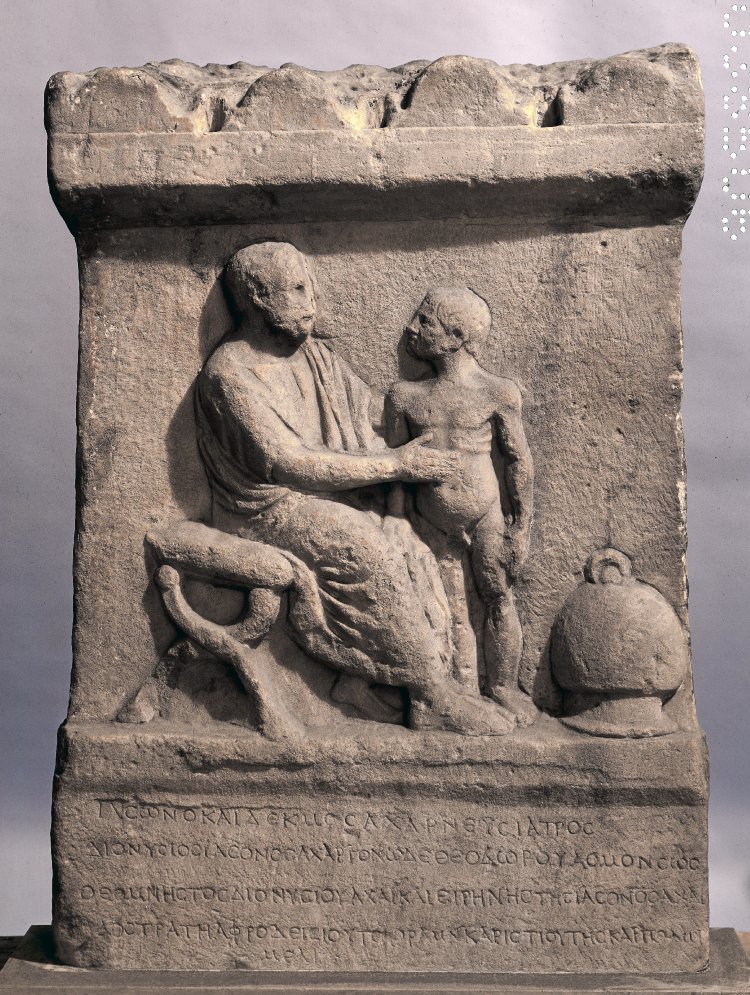
Marble Tombstone of an Athenian Physician Named Jason. Roman Imperial period, 2nd century CE. Marble. Reg. No. 1865,0103.3. London: The British Museum.
Description of Disease & Etiology
While the exact cause of the child’s swollen abdomen in this relief is unknown, several conditions are plausible given the geographic and historical context. For example, malnutrition-related ascites due to severe protein deficiency, schistosomiasis, or a Wilms tumor (nephroblastoma). For the purposes of this interpretation, the focus will be on schistosomiasis as a likely and historically-relevant explanation.
Schistosomiasis is a tropical and subtropical disease and is one of the most prevalent parasitic diseases globally, caused by blood flukes of the genus Schistosoma. It affects millions of people worldwide in over 75 countries, particularly in regions with limited access to clean water and sanitation.1 Young children in endemic areas have especially high exposure rates, with children in high-transmission areas having nearly 100% exposure to infectious stages of Schistosoma by age one.2 Several species are responsible for human disease, most notably S. haematobium, S. mansoni, and S. japonicum.1
The parasite’s life cycle starts with the excretion of eggs in urine or feces into freshwater, where they hatch into free-swimming miracidia.1 These miracidia infect snail hosts and, once inside this host, undergo asexual reproduction and development into their cercariae stage.1 These cercariae penetrate the skin of individuals during contact with contaminated water.1 Once inside the host, the parasites mature and develop into adult worms, after migrating through the venous system to their target sites.1 Depending on the species, adults can be found in the bladder and ureters (S. haematobium), small intestine (S. japonicum), or large intestine (S. mansoni).1 When these eggs become trapped in tissues, they provoke an immune response that leads to inflammation and organ damage, manifesting in the clinical features of schistosomiasis.3
Signs/Signifiers of Illness
The clinical presentation of schistosomiasis varies depending on the species involved and the duration of exposure.4 In its early phase, known as acute schistosomiasis, symptoms can include fever, chills, abdominal discomfort, and a dermatitis caused by cercarial penetration, often referred to as ‘swimmer’s itch’.4 These are more common in individuals without prior exposure, such as travelers or first-time hosts, and are often self-limiting.4
As the infection becomes chronic, the body mounts an immune response to parasite eggs trapped in tissues, which leads to inflammation and organ-specific complications. In intestinal schistosomiasis (typically caused by S. mansoni and S. japonicum) common symptoms include diarrhea, abdominal pain, hepatomegaly, and weight loss.4 In more advanced cases, granulomatous inflammation in the presinusoidal periportal spaces of the liver can lead to hepatosplenomegaly, as depicted in this artwork.4
Pathology
In acute schistosomiasis, pathology is largely driven by immune activation and mild inflammation across affected tissues.4 As the infection becomes chronic, a prolonged immune response to Schistosoma eggs trapped in tissues such as the liver, intestines, and bladder develops.4 These immune responses lead to granuloma formation, which over time progress into fibrotic lesions due to collagen deposition.4
In hepatic schistosomiasis, particularly caused by S. mansoni and S. japonicum, this fibrosis impairs normal blood flow through the liver, resulting in portal hypertension, hepatosplenomegaly, and eventually ascites.4 The magnitude of pathology related to schistosomiasis is largely driven by how many and which type of parasite is causing the condition, and as such, a thorough review is beyond the scope of this write up. However, for interested readers, I recommend Carbonell et al., 2021.
Treatment
The first-line treatment for schistosomiasis is the drug praziquantel.1 Although the exact mechanisms of action of the drug are still unknown, current evidence points to the drug increasing calcium permeability in schistosome cells, resulting in an influx of calcium into parasite cells and ultimately causing paralysis in adult worms.5 Preventative strategies for this condition include improved sanitation and safe water supplies, snail control, health education about transmission and symptoms, and annual or biannual mass drug administration of praziquantel in high-risk groups, such as schools.1,3
Social Determinants of Illness
The most significant social determinant of schistosomiasis is a lack of access to clean, safe water and adequate sanitation infrastructure.3 Other contributing factors include limited availability of diagnostic facilities, poor access to praziquantel, and limited coverage of mass drug administration programs.6 Additionally, restricted healthcare access and low disease awareness in both affected populations and some healthcare systems exacerbate the disease burden.3,6
Author(s): Victoria Rhodes
Citations:
1. Nelwan, M. L. Schistosomiasis: Life Cycle, Diagnosis, and Control. ''Curr. Ther. Res.'' 91, 5–9 (2019).
2. Osakunor, D. N. M., Woolhouse, M. E. J. & Mutapi, F. Paediatric schistosomiasis: What we know and what we need to know. ''PLoS Negl. Trop. Dis.'' 12, e0006144 (2018).
3. Verjee, M. A. Schistosomiasis: Still a Cause of Significant Morbidity and Mortality. ''Res. Rep. Trop. Med.'' 10, 153–163 (2019).
4. Carbonell, C. et al. Clinical Spectrum of Schistosomiasis: An Update. ''J. Clin. Med.'' 10, 5521 (2021).
5. Abou-El-Naga, I. F. Calcium/calmodulin-dependent protein kinase II in Schistosoma: Relation to praziquantel action and resistance. ''Mol. Biochem. Parasitol.'' 263, 111686 (2025).
6. Isaiah, P. M. et al. Contextual factors influencing schistosomiasis treatment and identification of delivery platforms for arpraziquantel in hard-to-reach areas and populations in Homa Bay County, Kenya. ''PLOS Glob. Public Health'' 4, e0004035 (2024).