(Influenza)
Artist/ Title/ Date
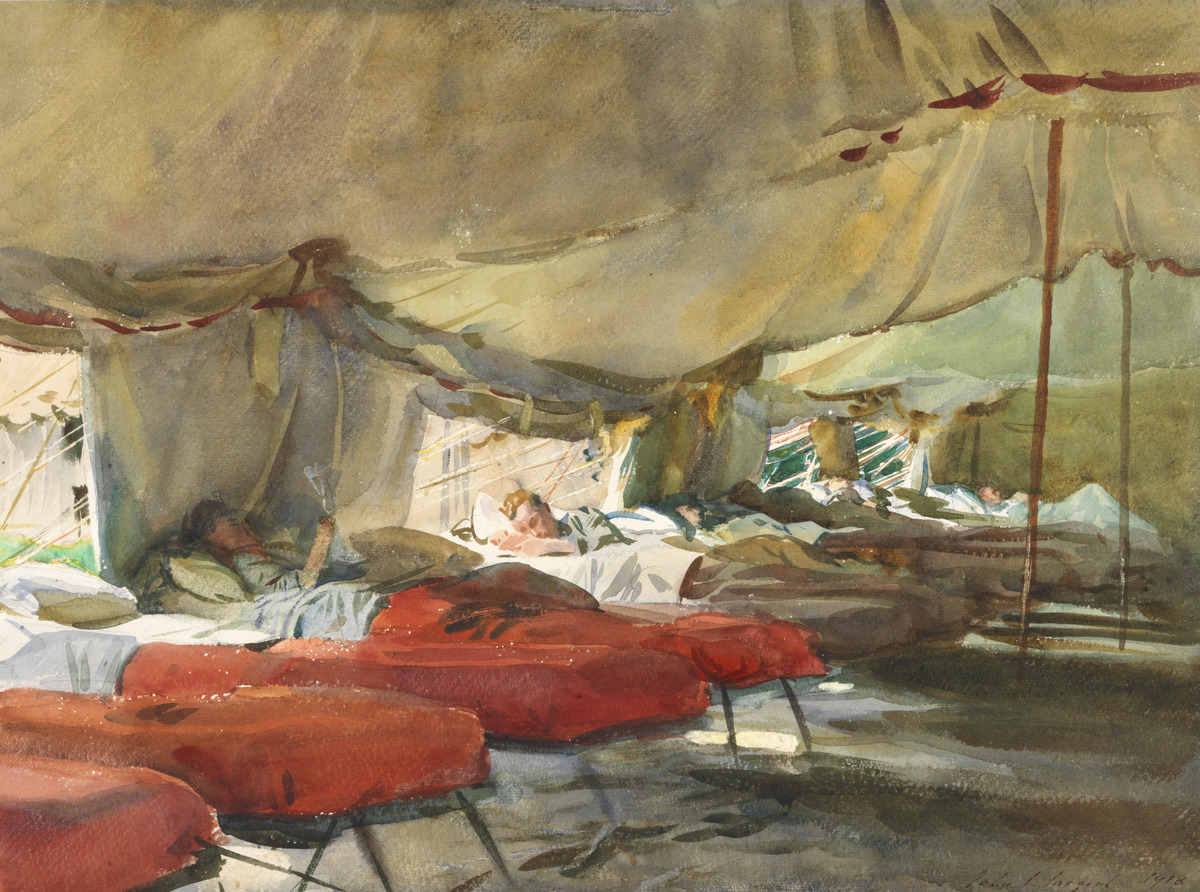
John Singer Sargent. Interior of a Hospital Tent. 1918. Watercolor on paper. Imperial War Museums, London.
Description of Disease & Etiology
Influenza is a disease caused by members of influenza virus groups A, B, C, and D. Among humans, type A and B influenza viruses are the most clinically significant. Due to the multipartite nature of their RNA genomes, these viruses can mutate through both antigenic drift and antigenic shift. Antigenic drift occurs when genomes gradually accumulate mutations via replication errors, while antigenic shift happens when multipartite genomes mix during the simultaneous infection of one cell with two strains, allowing for RNA reassortment and the creation of a novel viral strain. It is important to note that antigenic shift is a characteristic of type A influenza viruses, which explains why pandemic, novel strains of influenza are typically type A.
During infection, these viruses primarily affect the respiratory epithelium, but other cell types, such as immune cells, can also be affected. Transmitted via respiratory secretions and aerosols, the most common consequences of illness result from lung inflammation, while more severe outcomes include systemic inflammatory misregulation, such as multiorgan failure.1 In this image, a hospital tent that would have been common during the Spanish Influenza pandemic of 1918 is depicted. This pandemic, caused by an H1N1 strain of type A influenza virus, is estimated to have resulted in 50-100 million deaths.2
Signs/Signifiers of Illness
Signs and symptoms of mild influenza can include myalgia, malaise, lethargy, headache, cough, sore throat, and congestion. Gastrointestinal symptoms such as diarrhea, abdominal pain, nausea, and vomiting are more common in children. The most consistent hallmark signs of influenza include a fever greater than 38°C with a dry cough.
In the case of more severe presentations, additional signs and symptoms may include multiple organ dysfunction, primary or secondary pneumonia, seizures, and more, as systemic inflammation worsens and pulmonary function declines.3
Pathology
The pathology of influenza is driven by two key factors: the extent to which the virus infects and kills respiratory epithelial cells in the upper and lower respiratory tracts, and the degree of alveolar macrophage activation, inflammatory cytokine production, and other immunological responses.
In milder cases, the tissue primarily affected includes the pseudostratified columnar epithelium of the trachea and bronchi. In more severe cases, the alveolar epithelial cells of the lower respiratory tract are more involved, secondary bacterial pneumonias can be common, and cytokine dysregulation leading to cytokine storm outcomes may be observed.
Histologically, areas of capillary thrombosis, focal necrosis, and desquamation of the alveolar lining may be observed. Hemorrhage into the alveolar air spaces can occur as the result of necrosis and desquamation. The combination of edema and hemorrhage can have fatal consequences for some patients. Under significant inflammatory stress, the lungs may become unable to perform their primary function of gas exchange, potentially leads to more severe pathology such as hemorrhagic bronchitis, pneumonia, multiorgan failure.4
Treatment
Treatment of seasonal influenza in otherwise healthy individuals includes antipyretics and analgesics, hydration, and the use of neuraminidase inhibitors such as oseltamivir, which block a neuraminidase enzyme utilized by influenza to release from infected cells. More severe infections are managed based on clinical presentation and may require hospitalization to administer corrective treatments for pneumonia or systemic inflammation.3
Social Determinants of Illness
Income, education, occupation, social class, sex, and race/ethnicity have all been implicated in influenza health outcomes. Access to health care services and vaccination are essential preventative measures. However, barriers to these effective measures can worsen outcomes.
For example, the inability to isolate at home due to financial constraints or job insecurity may promote influenza outbreaks. Additionally, housing densities and occupational exposure can predispose specific social groups to higher transmission risk. Negative opinions about vaccination, distrust in the health care system, and lack of access to trusted health information may all contribute to decreased vaccination rates in marginalized communities.5, 6 Author: Victoria Rhodes Citations: * 1) Kalil, A. C., & Thomas, P. G. (2019). Influenza virus-related critical illness: Pathophysiology and epidemiology. Critical Care, 23(1), 258. https://doi.org/10.1186/s13054-019-2539-x * 2) Berche, P. (2022). The Spanish flu. La Presse Médicale, 51(3), 104127. https://doi.org/10.1016/j.lpm.2022.104127 * 3) Tyrrell, C. SB., Allen, J. L. Y., & Gkrania-Klotsas, E. (2021). Influenza: Epidemiology and hospital management. Medicine, 49(12), 797–804. https://doi.org/10.1016/j.mpmed.2021.09.015 * 4) Taubenberger, J. K., & Morens, D. M. (2008). The Pathology of Influenza Virus Infections. Annual Review of Pathology: Mechanisms of Disease, 3(Volume 3, 2008), 499–522. https://doi.org/10.1146/annurev.pathmechdis.3.121806.154316 * 5) Cordoba, E., & Aiello, A. E. (2016). Social Determinants of Influenza Illness and Outbreaks in the United States. North Carolina Medical Journal, 77(5), 341–345. https://doi.org/10.18043/ncm.77.5.341 * 6) Mayoral, J. M., Alonso, J., Garín, O., Herrador, Z., Astray, J., Baricot, M., Castilla, J., Cantón, R., Castro, A., Delgado-Rodríguez, M., Ferri, A., Godoy, P., Gónzález-Candelas, F., Martín, V., Pumarola, T., Quintana, J. M., Soldevila, N., Tamames, S., Domínguez, Á., & and the CIBERESP Cases and Controls in Pandemic Influenza Working Group, Spain. (2013). Social factors related to the clinical severity of influenza cases in Spain during the A (H1N1) 2009 virus pandemic. BMC Public Health, 13(1), 118. https://doi.org/10.1186/1471-2458-13-118