Artist/ Group/Tribe, etc.
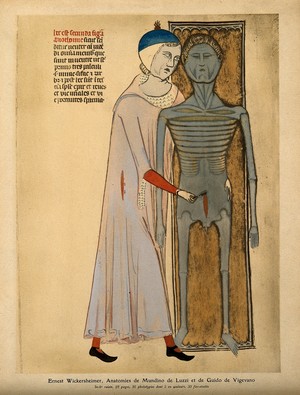
The dissection of an emaciated, grey cadaver by an anatomist who is making an abdominal incision with a scalpel with his right hand while his left hand is placed on the cadaver's hip. Colour process print, 1926, after a manuscript illustration, 1345. Guido de Vigevano (Lombard) Wellcome Collection
Medium, time frame
This image: 1 print: collotype, printed in colour; image 29.2 x 21.4 cm The image in the Wellcome collection is a facsimile from Guido de Vigevano's manuscript, the "Liber notabilium", of 1345 in the Musée Condé, Chantilly, no. 334 (ex. 569). The figures are described in fols 257-273v in a section entitled: "Hec est anothomia Philipi septimi [sic], Francorum regis, designata per figuras per Guidonem, medicum suprascripti regis"
Symbolism, iconography
This facsimile of an illustrated folio from the manuscript depicts two human figures, one represented as a physician and the other as a cadaver. The physician is dressed in traditional, western European medieval garb and holds a scalpel, while his left hand is placed on the hip of the cadaver, holding it steadily. The emaciated cadaver is represented with a sallow and grey complexion. His eyes are closed and face gaunt. The anatomist slices into the abdomen of the cadaver with the scalpel, revealing red flesh beneath. The contents of the incision are suggested by the description to the left:
This is the second anatomy figure depicting the belly split open, showing the vital abdominal organs: first there are three tissue layers of the mirach, siphac and the zirbus, and after this the intestines, the spleen, the kidneys, the urinary tract, and the passages that carry sperm.
Historical context
Guido de Vigevano de Papia was a Lombard and was a renowned physician for European monarchs, such as Emperor Henry VII of Germany and Queen Jeanne de Borgogne. He most likely trained as a physician in Bologna or his home town of Papia, however he fled to France under political asylum in the early 1320s after being in service to the Emperor Henry VII. Guido came from an Italian tradition of anatomical drawing and his style was greatly influenced by the teachings of Mondino de’Luzzi, whose seminal text Anathomia corporis humani, in 1316, codified methods of dissection for the purpose of studying anatomy. Despite this, in 1299, Pope Boniface VIII had instigated a papal ban on the dissection and dismemberment of cadavers, and it was a punishable crime in the first half of the 14th century. However, as dissections became more and more frequent, the Church in Rome extended greater leniency towards the practice, and instead of prohibiting the act completely, they allowed dissections to operate under authorised scrutiny.
Socio-cultural context and influences
<span id="in-liber-there-is-a-presence-of-cultural-hybridity-relating-to-illustration-traditions.-in-the-italian-tradition-it-was-common-to-represent-anatomy-using-a-living-figure-to-suggest-the-vitality-of-the-body-and-all-its-parts.-however-in-the-french-tradition-a-style-known-as-macabre-emerged-representing-the-dead-as-actually-being-distinctly-dead-with-a-veneer-of-decay.-this-iconography-was-derived-from-the-circulation-of-devotional-stories-that-were-in-possession-of-the-elite-such-as-the-three-living-and-the-three-dead.-in-this-story-three-living-nobles-on-a-courtly-hunt-are-confronted-with-three-dead-ones-who-are-in-various-states-of-decay-and-they-terrify-and-disgust-their-living-counterparts-urging-them-to-remember-that-they-can-never-escape-their-mortality-despite-material-wealth-and-prestige-in-the-living-world.-guidos-complete-book-functions-as-a-memento-mori-exemplified-by-the-dedication-of-the-book-to-philippe-vii.-anatomy-particularly-thoracic-and-abdominal-dissection-had-a-very-real-significance-for-a-ruling-monarch.-this-was-because-after-death-bodily-division-was-practiced-where-parts-of-the-monarchs-body-were-removed-and-dispersed-to-holy-sites-and-family-graves-as-relics-of-political-and-religious-significance."> In Liber, there is a presence of cultural hybridity relating to illustration traditions. In the Italian tradition, it was common to represent anatomy using a living figure to suggest the vitality of the body and all its parts. However, in the French tradition, a style known as macabre emerged, representing the dead as actually being distinctly dead with a veneer of decay. This iconography was derived from the circulation of devotional stories that were in possession of the elite, such as “the three living and the three dead.” In this story, three living nobles on a courtly hunt are confronted with three dead ones who are in various states of decay, and they terrify and disgust their living counterparts, urging them to remember that they can never escape their mortality despite material wealth and prestige in the living world. Guido’s complete book functions as a memento mori, exemplified by the dedication of the book to Philippe VII. Anatomy, particularly thoracic and abdominal dissection, had a very real significance for a ruling monarch. This was because after death, “bodily division” was practiced, where parts of the monarch’s body were removed and dispersed to holy sites and family graves as relics of political and religious significance.
Significance (elements of art/ principles of design)
The image represents the importance of both the cadaver and the anatomist. The anatomist is portrayed as being respectable, indicated by his university garb lined with ermine, a prestigious material that indicates his advanced social standing, reinforced by his greying hair, suggesting expertise and experience. Nonetheless, creative liberties have been taken with the image. Firstly, the representation of the cadaver, which has been abstracted to stand parallel to the anatomist, commands equal visual significance. Moreover, the viewer is enabled to look upon the pages at length, and can gradually and progressively undertake dissection through the book. Through studying the pages they are invited to wield the tool, however this differs greatly from the reality. As such, the closeness of anatomist and cadaver overcomes the physical limitations of dissection. Normally anatomists had to work quickly due to “the stench”. Here, the abstracted cadaver displays a level of dignity through his straight posture, and the anatomist no disgust. There is an interesting kinship between the two, reiterated by the appearance of the anatomist’s red chemise, which imitates the shape of his incision. The way the anatomist meets the cadaver’s gaze, though eyes are closed, and the tenderness and closeness of the hold, is redolent of the obligation of non-maleficence in the Hippocratic oath: to do no harm, not even to the dead.
Author(s): Christina Olszewski
Citations:
Bovenmyer, Peter. “Chapter 10 Dissecting for the King: Guido da Vigevano and the Anatomy of Death.” In Picturing Death, 1200-1600, eds. Steven Perkinson and Noa Turel. Brill, 2021.
Fohnan, A. Arabic and Latin Medical Terminology, Chiefly from the Middle Ages. Videnskappsselskapet, 1921. accessed online via: https://ia803205.us.archive.org/2/items/arabiclatinanat00fona/arabiclatinanat00fona.pdf
Wickersheimer, Er. “L’Anatomie” de Guido de Vigevano, médecin de la reine Jeanne de Borgogne (1345).”Archiv für Geschichte der Medizin, vol. 7'', 1 (1913): 1-25. JSTOR. https://www.jstor.org/stable/20773023
Wellcome Collection. " The dissection of an emaciated, grey cadaver by an anatomist who is making an abdominal incision with a scalpel with his right hand while his left hand is placed on the cadaver's hip. Colour process print, 1926, after a manuscript illustration, 1345. " Wellcome Collection Catalogue. Accessed 28/06/2025. https://wellcomecollection.org/works/xwqcpd4w ""