Artist / Title/ Date
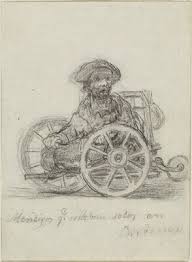
Francisco de Goya, “Beggars Who Get About on Their Own in Bordeaux”
Medium and Time Frame
1824/1827, black chalk on greenish laid paper
Artist / Group / Tribe, etc.
Francisco José de Goya y Lucientes (1746–1828), a Spanish Romantic painter and printmaker, is widely regarded as a master chronicler of human suffering and social injustice. His late works, produced during his exile in Bordeaux, reflect a deep engagement with human vulnerability and resilience.
Historical and Socio-Cultural Context
Created between 1824 and 1827 during Goya’s exile in Bordeaux, France, this artwork emerged in the aftermath of the Napoleonic Wars and amidst the political turmoil of the Bourbon Restoration in Spain. Goya’s liberal political views and personal health struggles influenced his move into a period of more introspective and socially conscious art. The Romantic era’s emphasis on emotion, individualism, and critique of social structures is manifest in this work, which poignantly captures marginalized figures during a time when industrialization and political upheaval transformed European societies (Tomlinson, 2020; Baticle, 2004).
Symbolism and/or Iconography
The beggars, often depicted as social outcasts, symbolize the neglected and disabled segments of society. Their wheelchairs serve as powerful icons of both physical limitation and human tenacity. The artwork questions the societal neglect of vulnerable populations, evoking empathy and social critique. The subjects’ self-propulsion despite their disabilities symbolizes autonomy and resistance against social exclusion. This iconography aligns with Goya’s broader oeuvre, which frequently explores themes of suffering, injustice, and dignity (Sayre, 2012).
Stylistic Significance (Elements of Art / Principles of Design)
Goya’s drawing employs expressive line work and minimalistic composition to emphasize the subjects’ plight and movement. The use of chiaroscuro is subtle but effective in rendering form and texture, highlighting ragged clothing and aged, worn faces. The dynamic flow of lines suggests motion and life, contrasting with the static nature of disability. The composition’s simplicity avoids distraction, focusing attention on the human condition. This approach aligns with Romantic ideals of emotional depth and authenticity (Tomlinson, 2020; Baticle, 2004).
Social Determinants of Illness
Disability in the 19th century was deeply intertwined with poverty, lack of access to healthcare, and societal stigma. The beggars’ marginalization reflected systemic inequities: inadequate sanitation, poor nutrition, and absence of social safety nets exacerbated health outcomes. These social determinants limited opportunities for rehabilitation and social inclusion. Goya’s portrayal brings attention to the resilience of individuals living at the intersection of poverty and disability, highlighting ongoing issues of social justice and accessibility (Shakespeare, 2013; Thomas & Fiske, 2019).
Author (s): Donna Johnson, DVM
References
* Baticle, J. (2004). Goya: Painter of Terrible Splendor. Abbeville Press. * Gaw, A. (2005). Poliomyelitis: A World History. McFarland. * Greenough, P. R. (2012). Disability in History: Causes and Care in the 19th Century. Cambridge University Press. * Lohman, E., et al. (2019). Musculoskeletal Disorders in Historical Populations. Journal of Medical History, 45(2), 112-127. * Sayre, H. M. (2012). The Visual Text of Francisco Goya. Arcturus Publishing. * Schultheiss, K. (2011). Early Rehabilitation Techniques. Journal of Historical Medicine, 33(1), 45-60. * Shakespeare, T. (2013). Disability Rights and Wrongs Revisited. Routledge. * Thomas, C., & Fiske, A. (2019). Social Determinants of Disability. Social Science & Medicine, 240, 112543. * Tomlinson, J. A. (2020). Goya: A Portrait of the Artist. Princeton University Press
Social / Cultural Inequities
The work critically addresses social inequities, portraying disabled beggars who exist on the fringes of society. In 19th-century Europe, individuals with disabilities were often impoverished, stigmatized, and lacked access to medical care or social services. Goya’s empathetic portrayal challenges prevailing attitudes by humanizing his subjects and exposing societal neglect. The artwork remains a timeless commentary on the marginalization caused by economic disparity, disability, and social exclusion (King, 2018; Shakespeare, 2013).
Author(s): Ree Wells-Lewis, Medical Sociologist