Title
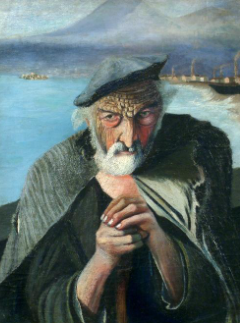
Old Fisherman, Tivadar Csontváry Kosztka (Hungarian, 1853–1919)
Medium and time frame
Oil on canvas, c. early 20th century
Artist / Group / Tribe
Tivadar Csontváry Kosztka was a Hungarian painter associated with late Symbolism and proto-Expressionism. Largely self-taught, he rejected academic conventions in favor of a highly personal visual language emphasizing spiritual vision, psychological intensity, and corporeal presence. Although marginalized during his lifetime, Csontváry is now recognized as a key figure in Central European modernism whose work anticipates Expressionist concerns with the vulnerable and destabilized body.
Historical and Socio-Cultural Context
Painted during the early twentieth century, Old Fisherman emerges from a period of economic and social transformation within the Austro-Hungarian Empire. Industrialization and modernization destabilized traditional rural and maritime livelihoods, intensifying class divisions and economic precarity. Fishermen, long emblematic of subsistence labor, occupied increasingly marginalized positions within these shifting social structures.
Concurrently, medical and scientific discourse surrounding pathology, degeneration, and chronic illness entered broader cultural awareness. Within Symbolist and early modernist contexts, the body became a site through which anxieties about labor, aging, and decline were visually articulated. Csontváry’s emphasis on bodily surface aligns with this cultural moment, situating physical difference as both a social and existential condition.
Symbolism and / or Iconography
The fisherman’s aged body operates as a symbol of endurance shaped by prolonged environmental exposure. His skin—rendered with pronounced texture, irregular coloration, and scale-like patterning—draws attention to the body as a site of visible alteration. From a medical humanities perspective, these features are suggestive of ichthyosis or chronic dermatologic disease, conditions characterized by thickened, scaly skin often exacerbated by harsh environmental conditions.
Symbolically, the skin functions as an archive of lived experience, bearing the cumulative effects of labor, climate, and time. Rather than concealing physical difference, Csontváry foregrounds it, transforming dermatologic abnormality into a visual marker of resilience, vulnerability, and social marginality.
Stylistic Significance (Elements of Art / Principles of Design)
Csontváry employs expressive line, dense surface texture, and heightened contrast to emphasize corporeality. Thick paint application and irregular brushwork produce a tactile quality that draws the viewer’s attention to the materiality of the skin. The restrained but forceful color palette heightens the sense of exposure and fatigue.
The frontal composition isolates the figure, compelling direct visual engagement and resisting sentimentalization. Distortions of proportion and emphasis on surface detail align the work with proto-Expressionist strategies, using formal disruption to communicate psychological and physical intensity.
Medical Cross-References (AMDx Taxonomy)
* Primary Classification: Dermatology * Suspected Condition: Ichthyosis (acquired or congenital), chronic hyperkeratosis * Body System: Integumentary * Related Conditions: Psoriasis, eczema, occupational dermatoses * Visual Indicators: Scaly texture, thickened epidermis, discoloration * Environmental Factors: Salt exposure, UV exposure, wind, cold
AMDx Thematic Tags
Aging • Labor • Occupational Health • Chronic Disease • Skin as Archive • Environmental Exposure • Disability Representation
Selected References (APA)
Birnbaum, D. (2013). Csontváry Kosztka Tivadar: The lonely genius. Budapest, Hungary: Hungarian National Gallery.
Gilman, S. L. (1988). Disease and representation: Images of illness from madness to AIDS. Ithaca, NY: Cornell University Press.
Hungarian National Gallery. (n.d.). Tivadar Csontváry Kosztka collection. Budapest, Hungary.
Sontag, S. (1978). Illness as metaphor. New York, NY: Farrar, Straus and Giroux.
Wellcome Collection. (2020). Skin, disease, and representation in visual culture. London, UK: Wellcome Trust.
Social / Cultural Inequities
The fisherman’s visibly marked body reflects inequities tied to labor, class, and access to medical care. Chronic dermatologic conditions disproportionately affect individuals exposed to environmental stressors and limited healthcare—conditions historically associated with maritime and rural labor. By centering a body marked by disease and age, Csontváry challenges artistic traditions that privilege youth and idealized health, foregrounding how illness and disability intersect with economic marginalization.