Artist/ Group/Tribe, etc.
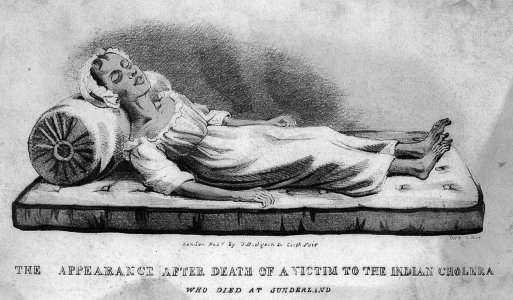
A dead victim of cholera at Sunderland in 1832, John William Gear (1806-1866) English
Medium, time frame
1832, Coloured lithograph attributed to J.W. Gear.
Symbolism, iconography
This image depicts a young woman who has succumbed to cholera, lying on a mattress with a bolster. Her body is weak, listless and emaciated. The text on the image says, “The appearance after death of a victim to the Indian Cholera who died at Sunderland.”
Historical context
John William Gear (1806-1866) was an English-born artist who specialised in theatrical portraits and miniatures, working in the mediums of watercolour and lithography. He is best known for his series of portraits depicting theatre audiences, known as “Portraits of the Public Being Heads of Audiences.” While outside of his usual subject matter, his interest in public matters resonates through this depiction of cholera. This illness devastated European society through Britain in the 1830s and claimed the lives of many inhabitants over the next fifty years. Sunderland, the site of the image, was the first town in Britain to officially record deaths by the “Indian cholera,” and by January, 1832, cholera had claimed the lives of 215 inhabitants from Sunderland alone. Scandal abounded at Sutherland, as medical practitioners were accused of withholding their identification of the disease and the significance of its contagion from the public, advancing its rapid spread.
Socio-cultural context and influences
19th century British values of empire and ‘othering’ are elicited in this lithograph, with disease metaphorical for the moral shortcomings of society. Most notably, the commonest way to depict the victims of cholera or cholera’s embodiment as a monstrous force, was to colour the skin blue. Blue skin was part of a distinctive visual vernacular that made the disease recognisable to the public of the time. A connection to cholera, the blue disease, was made with India’s other ‘blue’ export, indigo, a highly coveted material at the time. The print itself promotes visibility of the disease in its first recorded place within Britain, and reasserts its perceived origins of India, rendering its effects and its gravity much more tangible.
Significance (elements of art/ principles of design)
The image represents, with clarity and detail, the ravaging effects of cholera on the body. The colour version of this image uses a restrained palette of blue and red. A reddish brown is used for the hair, the only element of the woman that has not lost its lustre. Her sunken eyes and open mouth are lined with twinges of mauve, indicating lifelessness. Attention is given to her skeletal hands and feet. Notably, behind her there is a smudge of darkness that is filled with the same pallid blue that covers her skin, creating the effect of a ‘cloud’ emanating from her body. This illustrates the public opinion of the time that cholera was transmitted by miasma, defined by Jankovic as “malodorous mists… which tended to occur during sultry weather and in the vicinity of decaying organic matter.” The “cholera cloud” became emblematic of the disease, and wherever the cloud could be seen, imminent loss of life would follow close behind.
Author (s): Christina Olszewski
Citations:
Barnett, Richard. “Cholera.” In The Sick Rose, or, Disease and the Art of Medical Illustration, edited by Richard Barnett, 130-145. London: Thames & Hudson, 2014.
Clanny, W. Reid. “The Cholera in Sunderland,” The Lancet. 17, no. 442, (1832), 731-732. DOI: https://doi.org/10.1016/S0140-6736(02)83352-9
Mukharji, Projit Bihari. “The “Cholera Cloud” in the Nineteenth-Century “British World”.” Bulletin in the History of Medicine,'' 86, no. 3 (2012): 303-332. JSTOR https://www.jstor.org/stable/26305866''
Sciampacone, Amanda. “The ‘Scourge of Modern Times’: Cholera, Race and Empire in Early Nineteenth Century British Illustrated Print Culture.” Journal of Victorian Culture, 27, no. 2 (2022): 356-369. DOI: https://doi.org/10.1093/jvcult/vcac020