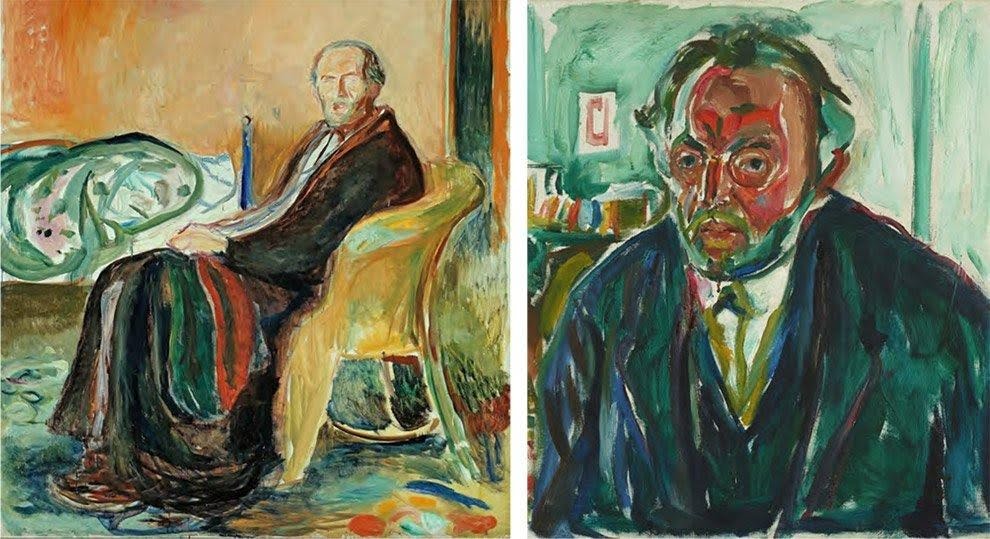
Munch’s Two Spanish Flu Self-Portraits
(A) Self-Portrait With the Spanish Flu. 1919. Oil on canvas. 59 x 52 in. National Gallery, Oslo. © 2020 Artists Rights Society (ARS), New York.
(B) Self-Portrait After the Spanish Flu. 1919-20. Oil on Canvas. 23 x 29 in. Munch Museum, Oslo. © 2020 Artists Rights Society (ARS), New York.
Artist/ Group/Tribe, etc.
Edvard Munch, (Norwegian, Løten 1863–1944 Ekely)
Medium, time frame
1919, Oil on Canvas.
Symbolism, iconography
Both of these images represent self portraits of the artist: one image shows him seated in a chair, recognisable by the light brush strokes that trace his features, and the other a close up of his own face. In these paintings Munch is around the age of 56 years old.
Historical context
As an artist, Munch was preoccupied with the themes of death and illness, and ill health was part of his reality: a sickly child growing up, he witnessed the death of his mother at the age of 5 and sister at the age of 14 to tuberculosis, and his older brother to pneumonia in his thirties. These traumatising losses haunted him for the rest of his life, manifesting as anxiety that fuelled his prolific output. It is not certain that Munch truly had the Spanish flu at the time of these paintings, however the influenza pandemic of 1918-1919, known colloquially as the Spanish Flu, infected a fifth of the world’s population at the time and claimed the lives of over 20 million people. It was the most deadly for people between the age of 20 and 40, so it is probable that Munch was cognizant of the threat of this illness, driving him to preserve his own state of feverish frenzy in a painting. Historically, Munch is best known for images representing angst and anguished emotion, and this set of works places himself as the subject of his own misery, relating to illness and fear.
Socio-cultural context and influences
Edvard Munch is considered to be an important contributor to the movement of Modernism. His work combines values from Symbolism, a movement which privileged imaginative and symbolic forms and subject matter, with the striking, abstract brushwork of Expressionism from the 1900s onwards. In the aftermath of WW1, the artistic climate was driven by angst and disillusion, a sentiment explored by many artists of the time. Munch travelled extensively and was influenced by his contemporaries in France, Italy and Germany, particularly by artists like Henri Toulouse-Lautrec, Vincent van Gogh and Paul Gauguin. He also studied psychoanalysis and was inspired by the playwright Henrik Ibsen, and the deep mysteries of the psyche resound in his work.
Significance (elements of art/ principles of design)
Rather than choosing to represent life faithfully, Munch privileges colour, shape and form to suggest ideas and evoke a dreamlike animation in his work, with wavy, distorted compositions heightening this hallucinatory quality. This can be seen in the full length portrait, through the blanket draped over his knees, the coverlet of the bed crumpled and the curve of the chair he is sitting in. They add movement to an otherwise static composition. The handling of the paint in both pieces is thin, loose and liquid, dripping in places with strokes quivering in others, alluding to a febrile immediacy in Munch’s painting style. In the portrait depicting himself at bust level, many areas of the canvas have been left without paint, creating contrast and a sense of transparency to the figure and the interior that is suggested by thick blocks of colour. In this portrait, attention has been given to the contours of the face which are concentrated with warm tones, red brush strokes and glazed eyes. In these paintings we bear witness to the isolation, the fear and despair of a patient who knows sickness too well.
Author (s): Christina Olszewski
Citations:
Barry, John M. "The Site of the Influenza Pandemic of 1918–1919." The Influenza Pandemic of 1918–1919. Accessed January 15, 2025. https://virus.stanford.edu/uda/.
Morens, David M., Jeffery K. Taubenberger, and Anthony S. Fauci. "The Persistent Legacy of the 1918 Influenza Virus." New England Journal of Medicine 361, no. 3 (2009): 225–229. Accessed January 15, 2025. https://pmc.ncbi.nlm.nih.gov/articles/PMC2958553/
Potter, P. "Edvard Munch (1863–1944). Self-Portrait After the Spanish Flu (1919–20) [About the Cover]." Emerging Infectious Diseases [serial on the Internet]. March 2003. Accessed January 15, 2025. http://www.cdc.gov/ncidod/EID/vol9no3/aboutcover.htm.
Shradda Nair, "Exploring Artist Edvard Munch’s Iconic Works Developed During the Spanish
Flu." Stir World, published July 17, 2020. https://www.stirworld.com/see-features-exploring-artist-edvard-munch-s-iconic-works-developed-during-the-spanish-flu2.