Artist/ Group/Tribe, etc.
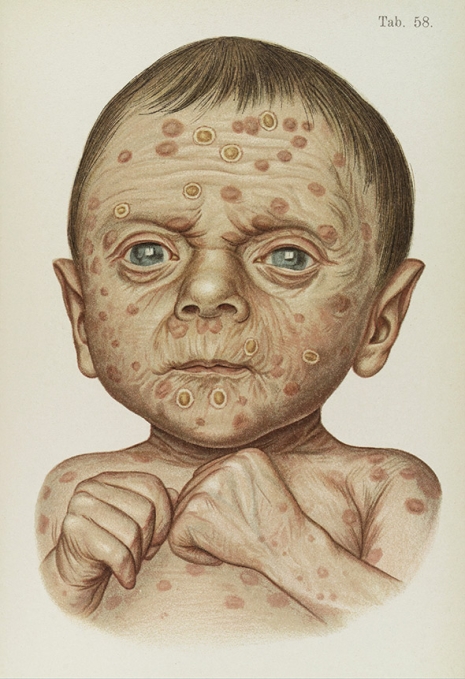
Artist unknown, published in “A manual of syphilis and the venereal diseases written by James Nevins Hyde and Frank Hugh Montgomery, p.238 Currently within the Wellcome Collection, London
Medium, time frame
1900, lithograph on paper
Symbolism, iconography
The image represents an infant afflicted by syphilis, as discernable from the sores and texture of the child’s skin and in the cloudy appearance of their eyes. The image represents a close up of the child’s bust to capture the subtle details of their skin and colouring. The expression of the child is strained, and his hands gripped tight into fists, as the portrait mode of representation has been borrowed for the benefit of scientific illustration.
Historical context
From the 18th century onwards in Europe, the notion of ‘heredity,’ or the phenomenon of diseases being inherited within a certain family, and certain medical conditions being passed down over generations had not always been widely accepted as truth. This image appeared during a time when the legitimacy of hereditary diseases and acquired characteristics was widely debated, until later in the early 20th century when the evidence of gene mutation and evolutionary change became much more significant, and hereditary diseases much more self-evident.
Socio-cultural context and influences
Syphilis was of great public concern from the early 16th century, where the disease was epidemic in western Europe and known as “the French sickness.” Women affected with syphilis gave birth to syphilitic children, recorded in 1527 by Jacques de Bethencourt who wrote, “sick parents give birth only to sick children. In consequence, there is nothing astonishing in that children can receive this evil as a heritage from their ascendants.” The tone of this quote is significant, as for a long time venereal disease was associated with moral depravity, and the Enlightenment thinkers of the 18th century strongly believed that the rampancy of this disease would lead to the degeneracy of society. “Moral hygiene” became a new way of managing the disease, with an emphasis on sexual temperance and familial values, targeted at high risk groups, typically identified as fashionable women.
Significance (elements of art/ principles of design)
While the work itself is simple, the infant’s fixed gaze is deeply evocative of pathos, as one looks over a face that is riddled with wrinkles and puckered skin that is covered in sores. It is an image of corrupted innocence: the cherubic glow of the infant has been robbed and replaced with the sin of their kin. Even though the image is scientific in nature, the creased brow of the child and the tightness of the child’s fists convey a subtle intensity to the image, paired with the arresting and troubled gaze. It is important to consider the historical origins of the piece, as at this time there were wide debates about eugenics and the ‘worthiness’ of a human life like this one, stemming back to Enlightenment ideas of a declining population leading to the destruction of the body politic. This idea persisted until the end of the 19th century. The physician Arabella Kenealy wrote of a child like this one in 1895, describing it as “a maimed thing defrauded of its child right of health and joyousness, of its human right of brain integrity, a thing which Nature, abhorrent, was striving to cast off.”
Author (s): Christina Olszewski
Citations:
Barnett, Richard. “Syphilis.” In The Sick Rose, or, Disease and the Art of Medical Illustration, edited by Richard Barnett, 181-214. London: Thames & Hudson, 2014.
Kenealy, Arabella. “A Question of Conscience,” BMJ, 1895; 2 : 682. doi: 10.1136/bmj.2.1811.682
Lomax, Elizabeth. “Infantile Syphilis as an Example of Nineteenth Century Belief in the Inheritance of Acquired Characteristics.” Journal of the History of Medicine and Allied Sciences, no. 1 (34), 1979, Pages 23–39.
Meehan, Ciara. "Such mental suffering and such misery’: Reproductive complications resulting from syphilis and gonorrhoea, 1880-1914,” Perceptions of Pregnancy: Researchers’ Network. Published 01 September 2014,https://perceptionsofpregnancy.com/2014/09/01/reproductive-complications-syphilis-gonorrhoea/
Quinlan, Sean S. “Inheriting Vice, Acquiring Virtue: Hereditary Disease and Moral Hygiene in Eighteenth-Century France.” Bulletin of the History of Medicine. 2006, no. 4 (80). 649-676. JSTOR https://www.jstor.org/stable/44449590