Artist/ Group/Tribe, etc.
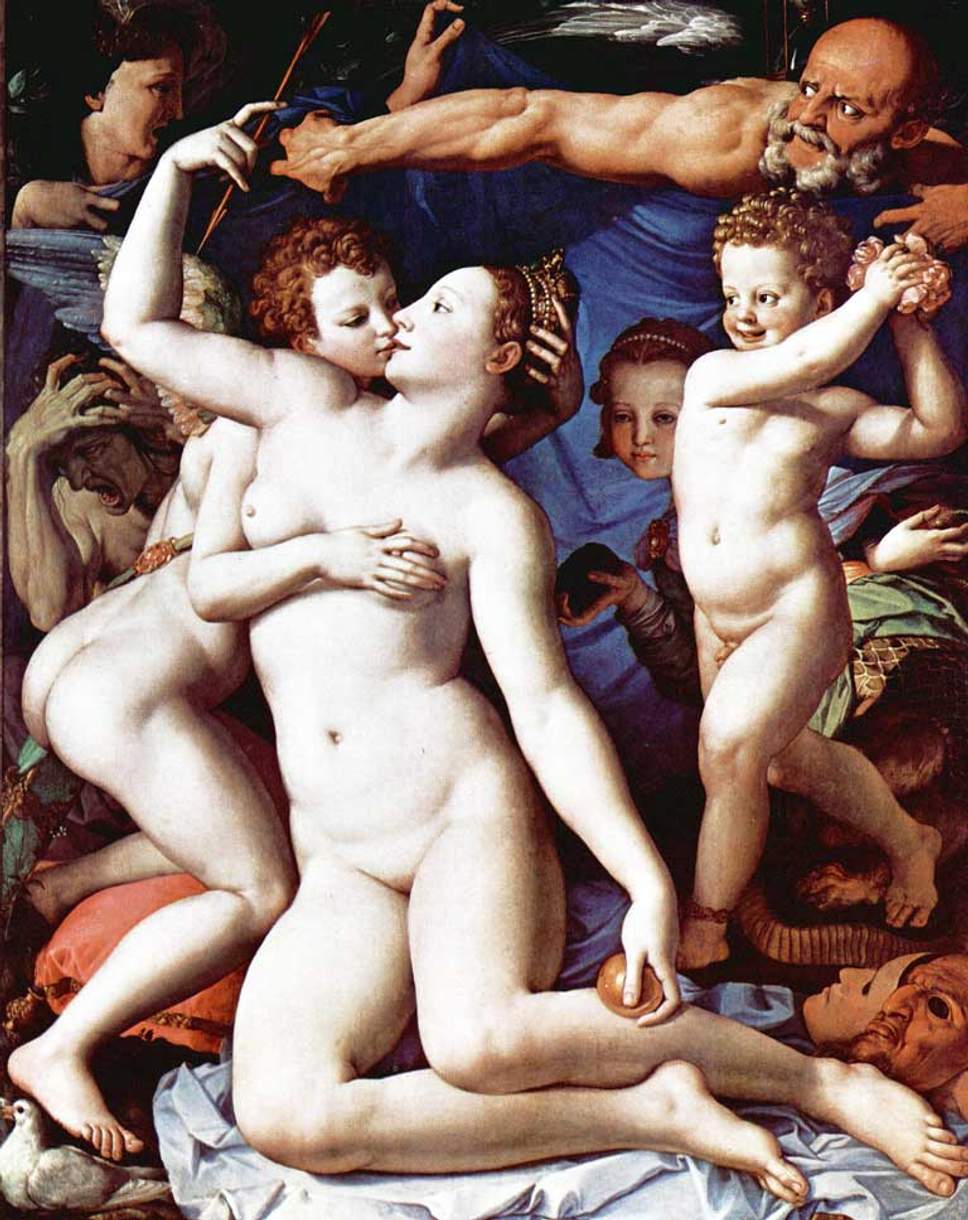
Agnolo Bronzino (Agnolo di Cosimo) (1503-1572), Florentine “An Allegory of Venus and Cupid.”
Medium, time frame
1545, Oil on wood (141.1cm x 116.2 cm), National Gallery London
Symbolism, iconography
The ample yet cryptic symbolism in Bronzino’s painting is drawn directly from classical Greek mythology and allegory. At its centre we see Venus, the goddess of love, embracing her son Cupid. All the characters within the painting thus serve as an allegory describing the transmission and contraction of Syphilis, a venereal disease.
Historical context
Agnolo Bronzino was a very successful Florentine painter whose most influential patron was Cosimo I de Medici, the Duke of Tuscany. The Medicis were the ruling family of parts of Italy in the 15th and 16th centuries. Bronzino’s work is an example of Mannerism: an art movement characterised by elegant, long-limbed classical figures, artificially tempered beauty and the bright, rich colours of the paintings that was a popular style during the high Renaissance. The painting itself, depicting mythological figures, contained familiar messages and symbols for the cultural elite of Bronzino’s time.
Socio-cultural context and influences
Syphilis proved to be a significant public health concern, rampant amongst the noble and elite class. It became the subject of tractates and writings of significant philosophers, physicians and poets during the Early-Modern period and a subject of refined literature of the time. It is probable that Bronzino would have been familiar with the literary tropes of the disease, thus informing his iconography and the legibility of his painting. Bronzino’s mannerist style attributes a courtly elegance to the disease, making it more palatable for its intended audience, without compromising an awareness of the imminent danger and suffering of its contraction that was all too well known at the time.
Significance (elements of art/ principles of design)
The left hand figure can be interpreted as representative of Syphilis, known as il morbo gallico, displaying the stigmata of the disease itself. The libidinous embrace between Venus and Cupid suggests that this kind of embrace is driven by vice and can only result in suffering, and also suggests the modes of transmission: through intercourse, kissing and breastfeeding. Fraud reinforces this, pretending sweetness but holding the sting in her tail, while the spell of Folly’s rose petals is broken, unmindful of the thorn in his foot. Father Time grapples with Oblivion on the far left, who, lacking eyes and the back of her head, attempts to cover the scene with the blue cloth. The tortured man in the background is contorted in pain, reinforcing the unwittingly fatal consequences of lust and pleasure.
Author(s): Christina Olszewski
Citations:
Cook, Christopher. “An allegory with Venus and Cupid: a story of syphilis.” Journal of the Royal Society of Medicine vol. 103,11 (2010): 458-60. doi:10.1258/jrsm.2010.100201
Conway, J. F. “Syphilis and Bronzino’s London Allegory.” Journal of the Warburg and Courtauld Institutes 49 (1986): 250–55.
https://doi.org/10.2307/751305.
Healy, Margaret. “Bronzino’s London ‘Allegory’ and the Art of Syphilis.” Oxford Art Journal 20, no. 1 (1997): 3–11.http://www.jstor.org/stable/1360711.
"Mannerism," National Gallery of Art, Accessed 16th December 2024. URL: https://www.nga.gov/features/slideshows/mannerism.html#slide_1