(Spanish Flu)
ART CASE STUDY KEY
Artist/ Group/Tribe, etc.
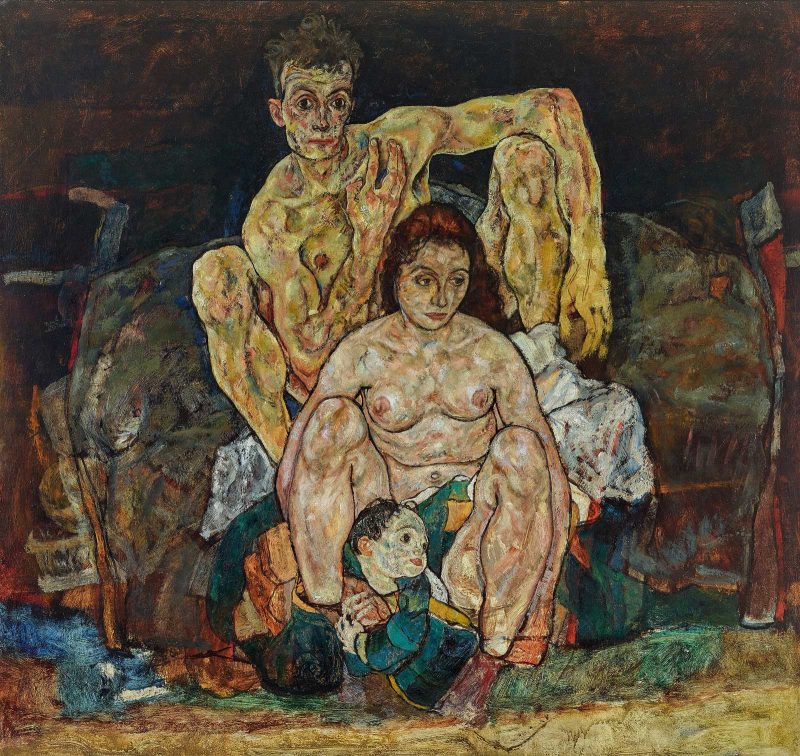
Egon Schiele (Austrian), Portrait with Family, 1918
Medium, time frame
oil on canvas, 152.5 cm x 162.5cm 1918
Symbolism, iconography
Also entitled “Crouching Couple,” the painting depicts three key figures : a man, a woman and a small child. The figures are thought to be Egon Schiele himself, his wife, Edith Schiele or his lover Wally Niezel who would have served as a model for the woman, and his nephew Toni, who served as a model for the baby. The background is obscured, however the figures are seated on a couch. Characteristic of Schiele’s style, the figures are represented in an illustrative manner, the nude bodies of the man and woman cast into relief through copious rendering and colour, while the child was added as an afterthought, as originally there was a bouquet of flowers between the woman’s legs. The baby looks to the left of the canvas, as the mother looks downwards: it is only Schiele’s gaze which meets ours, forcing us into dialogue.
Historical context
This painting was completed in the last year of Schiele’s life, and the balanced composition is representative of his mature style. In 1918, Schiele’s wife Edith was expecting her first child, however at 6 months pregnant she and the baby did not survive the infection of the Spanish flu. Merely three days later, Schiele died at the age of 28, after contracting the disease from his wife.
Socio-cultural context and influences
Egon Schiele’s talent was recognised as a youth, and he fell under the tutelage of the painter Karl Ludwig Strauch, and the artist Max Kahrer. At sixteen, on his first attempt, he was admitted into the general art class at the Academy of Visual Arts in Vienna. He exited the academy due to its conservative nature, and found himself under the influence of Vienna’s most famous artist, Gustav Klimt (1862-1918). Schiele belonged to the movement of Expressionism and had his roots in the “Jugendstil” (the German version of Art Nouveau movement), lending an illustrative quality to his work with a focus on form and draftsmanship. Privileging expression over decorative quality, his work is preoccupied with sexual scenes as well as death and discovery, rendered in a grotesque style.
Significance (elements of art/ principles of design)
The domestic setting in the painting is clearly represented, while all the figures in the painting hold consistent visual significance. Some elements remain incomplete, such as the father’s left hand and that of the baby, the movement of which has been fleetingly sketched. In comparison to other paintings, the figures are corporeal, colour tones and daubs of paint rendering volume in the musculature. The piece is remarkable in Schiele’s oeuvre because of its realism. The mother, father and baby are all looking in different directions, which alludes to a lack of connection between the figures, perhaps suggesting the final separation that all three will encounter. The muted colours and the heavy posturing of the bodies depicted lend austerity to the work, the expressions on the faces slightly wan and empty. The painting, through its monumentality and subject matter, lends a hopeful, idealistic and unified quality to the work, but the details betray hopelessness, with the realisation that loss and life are finite.
Author (s): Christina Olszewski
Citations:
Schiele, Egon, and Delphi Classics. Delphi Complete Works of Egon Schiele Illustrated. 2023. Reprint, Delphi Publishing Ltd, 2023. https://www.perlego.com/book/4280222. Zwingenberger, Jeanette, and Esther Selsdon. Egon Schiele and Artworks. [Edition unavailable]. 2023. Reprint, Parkstone International, 2023. https://www.perlego.com/book/4304114.