Artist/ Group/Tribe, etc.
Hans Folz (c.1435-1513) Nuremberg
Medium, time frame
Woodcut print on paper, 1482
Symbolism, iconography
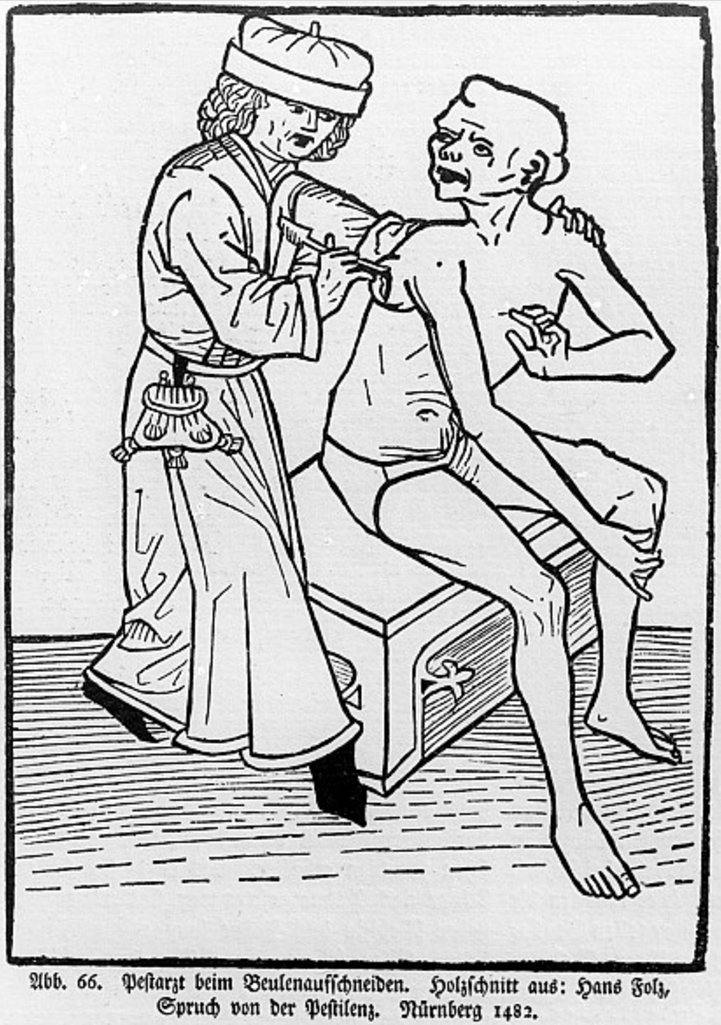
The image depicts a man who is a physician on the left side, lancing a boil from a man’s back. The man is seated on a bench that is designed ornately. The physician bears an expression of deep focus. His patient looks towards him, an arm raised in exclamation, with worry and pain directed towards the physician. There are no background details, and a sense of space is conveyed by the use of line. The text beneath reads, “Plague doctor cutting out lumps: Woodcut from Hans Folz, Spruch von de Pestilenz. Nuremberg, 1482.”
Historical context
Hans Folz was a barber-surgeon, Meistersinger (a writer of German poetry known as Meisterleider in the early modern period), printer, playwright and author of Reimpaarspr ü che (rhyme-pair stories.) In Germany, he was the first to self-publish his own work. At the time, the profession of barber-surgeon was not highly regarded in comparison to educated physicians and religious healers. A strong undercurrent of Christianity permeates his artistic output, intended for consumption by his Nuremberg public in a contemporary and vernacular style. The physical body as a key theme was explored assiduously in all that he did, and he maintained the interconnectedness of Christian salvation and social, physical and spiritual health. There is a moralistic aspect to his work that serves to inform the public of treatments for health, correct and incorrect behaviour, and the dynamics of control and order. Folz was also a strong believer in anti-Jewishness, an opinion that held popular ground at the time, and this bias can be perceived in many of his works.
Socio-cultural context and influences
The subject matter of the piece represents the Bubonic Plague, also known as the Black Death which swept across Europe in the 14th century, from 1348-9. At the time, the plague was considered to be a punishment from God, but in actual fact transmission was due to bacteria being carried by rats and fleas. Against such a widespread threat, medicine of this time was useless, and many people sought divine forgiveness in acts of self-punishment and flagellation. This woodcut print was created over 130 years after the original Bubonic plague epidemic, and thus serves as a moralistic lesson, and a reminder of the consequences of sin.
Significance (elements of art/ principles of design)
In this piece, the body is a site of suffering and a harmonious whole. On the left side, equipped with a purse that holds his instruments, the physician is clothed in heavy robes. The drapery is represented through jagged and undulating lines, providing a stark contrast to the near-naked body beside him. He is the picture of health in comparison, with a full face and head of hair.
The man on the right is represented semi-naked, his body emaciated and face gaunt, brow furrowed with worry and suffering. Folz has paid careful attention to anatomical details through creases in the patient’s belly, the tendons in his knees and the proportions of fingers, toes and limbs. Buboes cover him from head to toe, indicated by very subtle bumps in an otherwise economical use of line. The state of the patient’s body, though sick and aged, is whole, suggesting that his morality too, is intact, and there may be a chance that he could be saved.
Author (s): Christina Olszewski
Citations:
Griffiths, Antony. Prints and Printmaking: An Introduction to the History and Techniques. Berkeley: University of California Press, 1996. Huey, Caroline. Hans Folz and Print Culture in Late Medieval Germany. London: Routledge, 2016. Linsboth, Christina. "Mortalitas magna’ - The Great Death - The Plague Epidemic of 1348-9." The World of the Habsburgs. Accessed 16th January 2025. https://www.habsburger.net/en/chapter/mortalitas-magna-great-death-plague-epidemic-1348-9