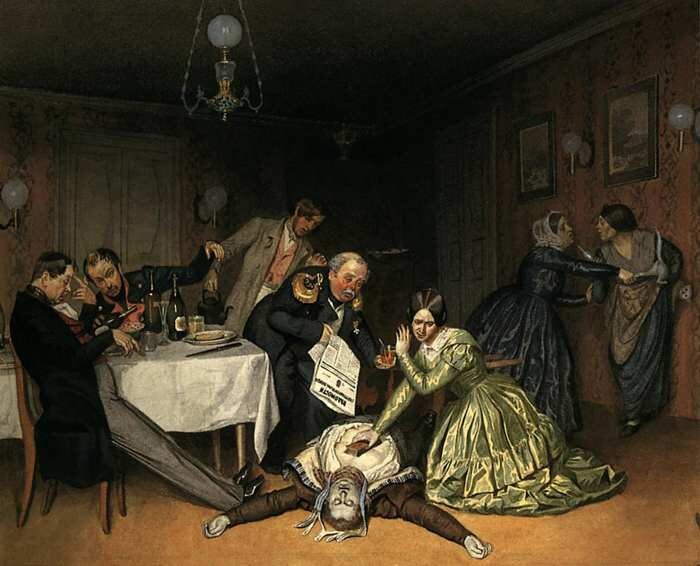
Cholera
Description of Disease & Etiology
The gram-negative bacterium Vibrio cholerae is the causative agent of the diarrheal condition cholera.1 There are more than 200 serogroups of this bacterium have been identified, but chief among them are strains belonging to serogroups O1 and O139, which produce cholera toxin (CTX).1 Strains of V. cholerae without this toxin may cause small gastrointestinal outbreaks, bacteremia, and wound infections, but lack the ability to cause the condition cholera, which is estimated to effect nearly 4 million individuals each year, causing 143,000 deaths, predominantly in areas of sub-Saharan Africa and south Asia.1–3
Signs/Signifiers of Illness
The primary significance of this condition is the rapid and aggressive fluid loss. As a result, signs and signifiers of this condition in severely affected individuals often relate back to the loss of fluid and electrolytes. Symptoms such as sunken eyes, dry mouth, severe thirst, lethargy, and a rapid heart rate can all accompany the severe fluid losses.2 Due to the water loss within the blood, signs of hypovolemic shock, such as rapid heart rate and rapid breathing, can be evident. 2 In these severe cases, kidney failure, shock, and death can occur within hours if left untreated.2
Pathology
Vibrio cholerae establishes in the small intestine after transport through the stomach.1 A high infectious dose is characteristic of this microbe (108 bacteria), as it is poorly acclimated to low pH.1 Uptake of CTX by endocytosis occurs, and this internalized CTX impairs cAMP signaling in intestinal epithelial cells.1 This disruption of cAMP signaling results in a massive release of electrolytes and water into the intestinal lumen, leading to the pronounced diarrhea.”1 90-95% of infected individuals remain asymptomatic, but the remaining 5-10% develop severe and profuse watery diarrhea that is pale, milky white, and often described as “rice-water stool”.1 An abundant net fluid loss (up to 1 liter per hour) from the intestine can lead to hypovolemic shock.2
Treatment
Without proper clinical management, the fatality rate of cholera can approach 50%, but with adequate access to medical treatment, this drops to less than 1%.2 Fluid replacement is a critical aspect of treating symptomatic cases of cholera. Depending on the severity, oral rehydration solutions can be utilized, with I.V. fluid replacement needed for more severe cases. The WHO recommends Ringer’s lactate solution over normal saline, as it has a higher amount of potassium and bicarbonate. The International Centre for Diarrhoeal Disease Research recommends Dhaka solution, which contains glucose as well as additional potassium and bicarbonate.2 In addition to fluid replacement, antibiotic use is recommended for severe cases, with several usable and common options available, such as tetracycline, fluoroquinolones, doxycycline, and azithromycin.2
Social Determinants of Illness
Access to medical care is one of the most common variables attributed to outcomes for cholera patients, as fluid replacement therapy has a pronounced impact on survival.3 Health-seeking behavior, particular as it relates to delays in seeking care from medical professionals, can also have an effect on the risks of negative health outcomes of cholera.3 Cholera outbreaks usually occur in areas with poor sanitation which result in the contamination of food and water supplies. These outbreaks are more often seen in underdeveloped countries or in periods after flooding disasters.3 However, it still represents a global public health hazard and awareness about the modes of transmission, diagnosis and treatment of cholera is needed.2
Author(s): Victoria Rhodes
1. Montero, D. et al. Vibrio cholerae, classification, pathogenesis, immune response, and trends in vaccine development. ''Front. Med.'' 10, (2023).
2. Chowdhury, F., Ross, A., Islam, M. T., McMillan, N. & Qadri, F. Diagnosis, Management, and Future Control of Cholera. ''Clin. Microbiol. Rev.'' 35, e00211-21 (2022).
3. Pampaka, D., Alberti, K., Olson, D., Ciglenecki, I. & Barboza, P. Risk factors for cholera mortality: A scoping review. ''Trop. Med. Int. Health'' 30, 332–350 (2025).