Artist/Group/Tribe
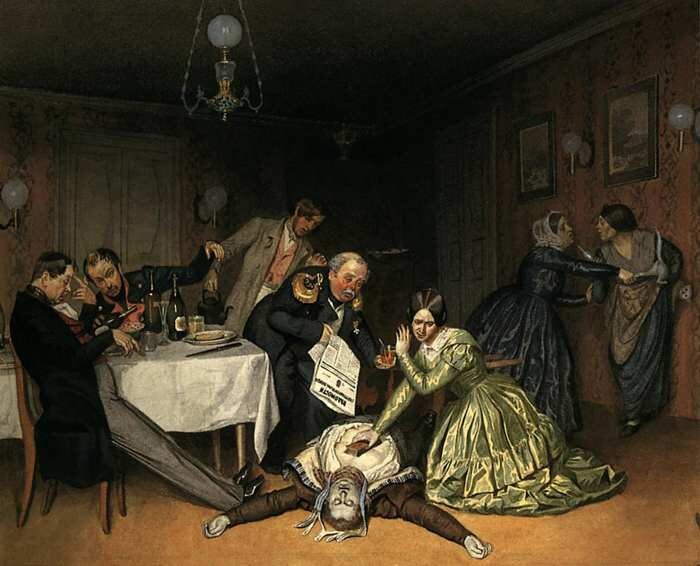
It is Cholera to Blame, Pavel Fedotov, Russian (4th July 1815 - 26 November 1852)
Medium, time frame
Watercolor on Paper, 1848, 32.8 x 38.2cm
Symbolism, iconography
Fedotov has made an everyday meal the subject of his painting, indicated by bread and wine at the table. While biblically connotative, the menacing direction of the knife pointed towards one of the men alludes to his ‘last supper.’ Realistic historical details are included in the image: the fair-headed man in the shadows holds an iron kettle filled with boiled water, alluding to safety precautions taken during the outbreak, while the flushed-faced man in an imperial outfit futilely proffers a glass of mint tea, common used to treat cholera. The newspaper, held by this man, announces the widespread public concern of the outbreak.
Historical context
19th century Russia was a time marked by stark class distinctions in an autocratic, feudal system of power. The title of the text alludes to the return of cholera in Russia after more than ten years, the last outbreak being in 1837. However, the outbreaks of 1848 proved to be the most difficult for the country, compounded by poverty, poor sanitary infrastructure, crowded living conditions and trade and migration relying on river transport. The cholera outbreak also provoked discontent that made government officials, military and physicians the target of violent assault, inciting widespread dissent amongst the masses as aggression was quelled through military force.
Socio-cultural context and influences
Since Pavel Fedotov served in the Moscow army for the first half of his life, his proximity to experiences of the people within the autocratic, militaristic rule of Russia provided him with rich source material to paint from. Though not formally trained as a painter, his art critiqued the system in a time of strict censorship laws. Pavel Fedotov admired the Dutch masters from the 16th and 17th centuries and was especially influenced by the 18th century English artist William Hogarth. He represented the everyday person in interior spaces, otherwise known as “genre” paintings, instead of depicting idealised subjects from history and mythology, with his own humoristic, satirical twist.
Significance (elements of art/ principles of design)
<span id="the-juxtaposition-of-gestures-and-expressions-attribute-a-theatrical-quality-to-the-piece-the-figures-assembled-as-if-they-are-on-stage.-this-creates-a-suspenseful-spectacle-of-the-death-that-has-just-occurred-the-interior-with-no-windows-and-closed-doors-alluding-to-a-sense-of-no-escape.-likewise-the-composition-echoes-the-crowded-social-conditions-of-the-time-that-allowed-for-the-proliferation-of-cholera.-the-knives-signify-the-blame-that-was-shafted-onto-the-noble-class-by-the-lower-classes-and-the-military-coercion-that-was-used-to-quell-the-discontent-of-the-masses.-the-man-who-is-dead-lies-with-his-shirt-unbuttoned-and-his-neck-kerchief-splayed-about-his-ears-his-dress-suggesting-his-low-social-standing."> The juxtaposition of gestures and expressions attribute a theatrical quality to the piece, the figures assembled as if they are on stage. This creates a suspenseful spectacle of the death that has just occurred, the interior with no windows and closed doors alluding to a sense of no escape. Likewise, the composition echoes the crowded social conditions of the time that allowed for the proliferation of cholera. The knives signify the blame that was shafted onto the noble class by the lower classes and the military coercion that was used to quell the discontent of the masses. The man who is dead lies with his shirt unbuttoned and his neck-kerchief splayed about his ears, his dress suggesting his low social standing.
Author(s): Christina Olszewski
Citations:
Cross, Samuel H. “Nineteenth Century Russian Painting.” The American Slavic and Eastern European Review, vol. 4, no. 3/4, 1945, pp. 35-53. JSTOR, http://www.jstor.org/stable/2491760.
Jackson, David. The Wanderers and Critical Realism in 19th Century Russian Painting. Manchester: Manchester University Press, 2006.
Patterson K. D. (1994). Cholera diffusion in Russia, 1823-1923. Social science & medicine (1982), 38(9), 1171–1191. https://doi.org/10.1016/0277-9536(94)90183-x
Rice, Tamara Talbot. “Some Reflections on Nineteenth-Century Russian Painting.” The Burlington Magazine, vol. 101, no. 671, 1959, pp. 53–57. JSTOR, http://www.jstor.org/stable/87270716