Artist/ Group/Tribe, etc.
'''Captain Charles Gold (Illustrator) George Kirtland (Engraver). '''
Medium, time frame
– Watercolour on paper, 1802.
Symbolism, iconography
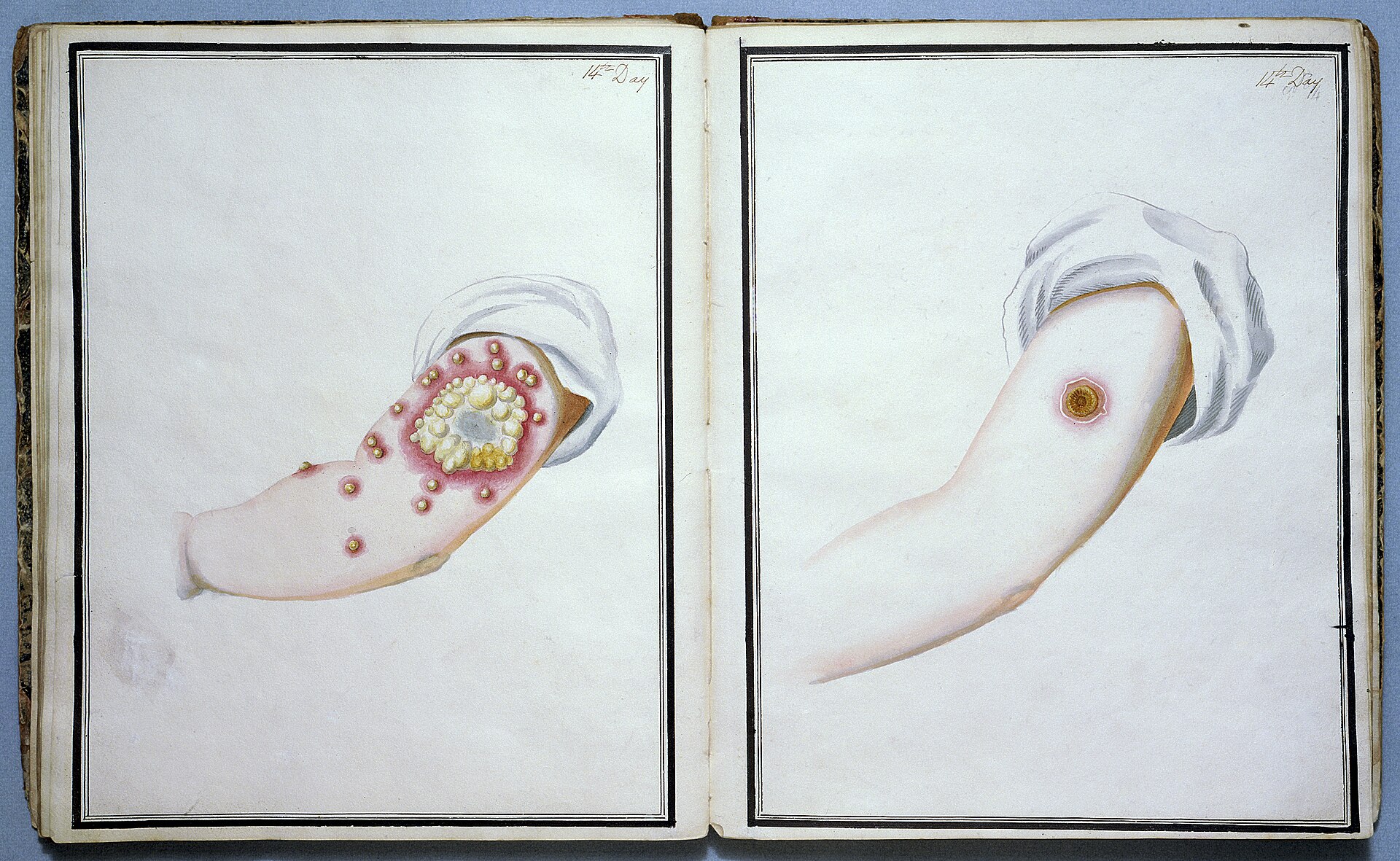
The images here are represented side by side: the first represents variolation of smallpox, and the second represents vaccination with cowpox. Both diseases are illustrated clearly on the skin of the patients, whose fair complexions are lightly rendered in comparison to the deep red that characterises the virulence of the disease. These images represent the 14th day after infection, where the smallpox scar and cowpox scar begin to cicatrize, with the smallpox patch much more expansive and progressed than the milder cowpox beside it.
Historical context
Edward Jenner, a well known physician in the 18th century, pioneered vaccination in the Western world. He is best known for his publication known as “An Inquiry into the Causes and Effects of the Variolae Vacinae,” published in 1798. In his lifetime and earlier, smallpox was ravaging Europe at alarming rates. Smallpox infection was widespread, and with a 20-60% mortality rate and the permanent disfigurement of survivors, a cure to the disease was sought after. A common treatment at the time was variolation, or exposing an individual to smallpox at a very minimal scale. Variolation caused a mild infection that then granted immunity upon recovery, however these procedures were not always successful. Edward Jenner discovered that the smooth-skinned milkmaids who had contracted cowpox were immune to smallpox after recovering from their trade disease, and he began the project of vaccination in England using cowpox to protect against smallpox. There was major public opposition to vaccination with moral qualms and apprehension about the introduction of an animal illness into the bodies of human beings. Moreover, there was a greater risk of blood-borne transmission of diseases like syphilis through inoculation. Despite the clear benefits of vaccination, Jenner endured criticism and ridicule in relation to this endeavour until the end of his life.
Socio-cultural context and influences
These paintings belong to a series of thirty watercolours that represent the development of both smallpox sores (left) and cowpox inoculation (right). While others had preceded Jenner in making these discoveries, it was the campaign that he led which enabled him to reach public acknowledgement. These images, and several others like them, were presented to Parliament as part of a petition in relation to vaccination. Jenner received a payment of ten thousand pounds from Parliament to increase access to vaccination across England. This pair of images, akin to the others presented to Parliament in Jenner’s campaign, is distinct from quotidian representations of cowpox vaccination that circulated in the 18th century. Satirical works such as James Gillray’s cartoons depicting the freakish results of cowpox inoculation were widely disseminated, reflecting the climate of fear surrounding this new process.
Significance (elements of art/ principles of design)
In Edward Jenner’s project, Captain Charles Gold’s paintings, later reproduced in engraving form by George Kirtland, are distinct for their refinement and scientific nature. A didactic approach has been used to show precisely how the diseases progress over a sixteen day period. Colour has been used sparingly in the piece, however flesh tones are brought to life through subtle nuances of red that surround the pock marks, and elicit a sense of pain associated with the image, attributing vitality to these otherwise flat and static images. Another notable fact is that both of these figures represented are children. The one affected by smallpox is a very young child, which can be perceived by the rounded form of the arm and the emergence of a pudgy wrist where the drawing ends towards the bottom left hand side. The cowpox patient is also still a child, but a little older. The choice of children as subjects is significant, symbolising innocence, hope and future aspirations, and perhaps even a sacrifice and a degree of fragility. It is known that Jenner inoculated on his own son as a baby, so fully did he believe in the future of this treatment that he treated his own precious future in kind.
Author (s): Christina Olszewski
Citations:
Barnett, Richard. “Smallpox.” In The Sick Rose, or, Disease and the Art of Medical Illustration, edited
by Richard Barnett, 95-110. London: Thames & Hudson, 2014.
Biss, Eula. Immunité, translated by Sophie Langlais, Paris: Éditions Les Arènes, 2018. via Perlego:
https://ereader.perlego.com/1/book/3470527/2
Lakhani, S. “Early clinical pathologists: Edward Jenner (1749-1823).” Journal of Clinical Pathology. 45, no. 9 (1992). 756-758. DOI doi:10.1136/jcp.45.9.756
Riedel S. “Edward Jenner and the history of smallpox and vaccination.” ''Proceedings (Baylor
University. Medical Center)'', 18 no.1 (2005). 21–25.
DOI: https://doi.org/10.1080/08998280.2005.11928028