Artist/ Group/Tribe, etc.
Andrew Wyeth, (American) MoMA (New York)
Medium, time frame
Tempera on gessoed Masonite board, 1948
Symbolism, iconography
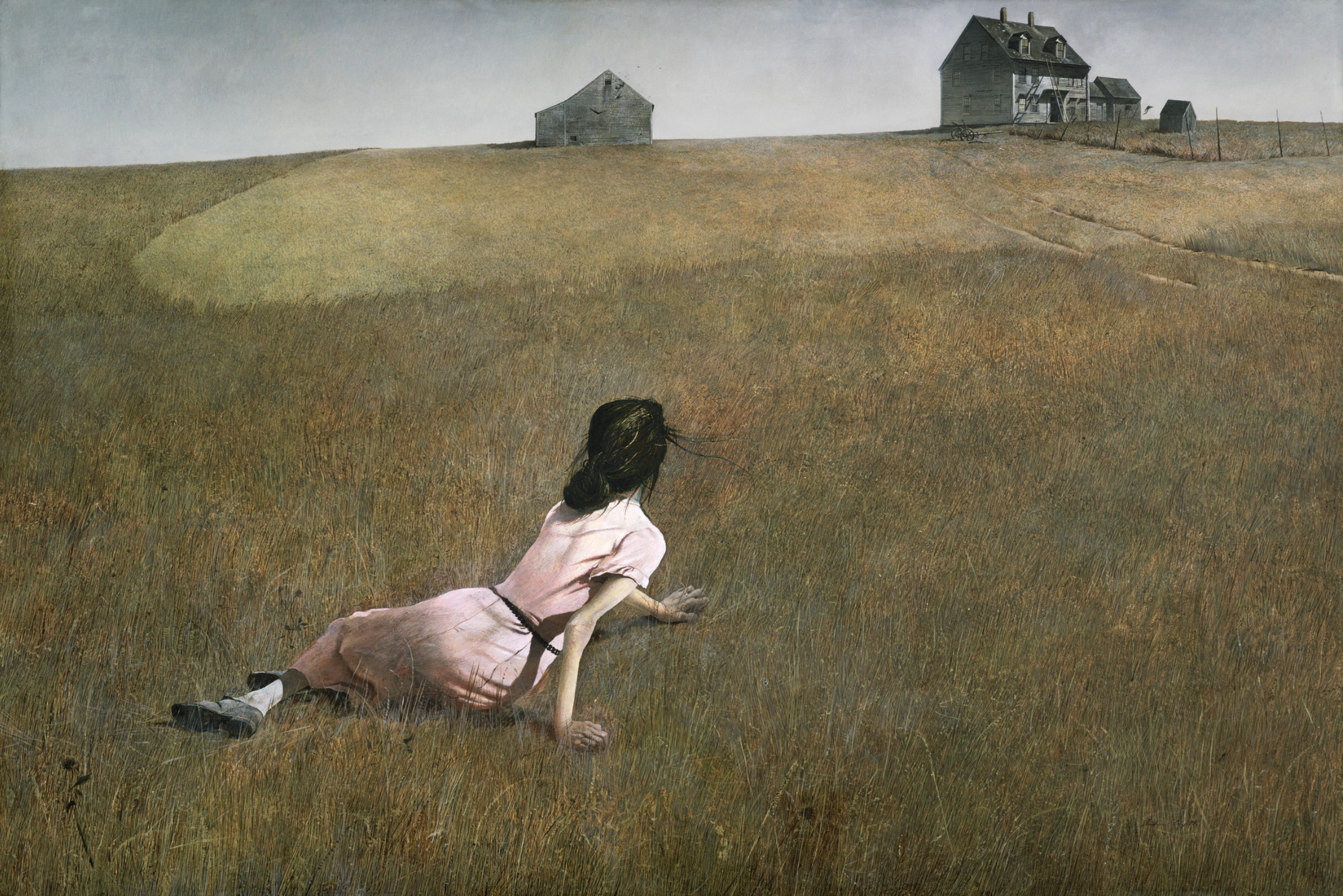
Christina’s World (1948) by Andrew Wyeth depicts a large, open field stretching toward a distant farmhouse and outbuildings. In the foreground, the figure of a young woman is distinguished in the lower third of the painting, clothed in a pale pink dress with long dark brown hair tied in a bun. In comparison to her youthful body, the arms appear emaciated, elbow swollen with gnarled hands. Her body is angled diagonally across the mown grass, and these arms support her upper body as she looks toward the buildings in the distance, reaching for them with her left hand.
The field occupies most of the composition and is painted in dry, muted tones of beige, tan, and light brown. The curved slope of the hill meets the horizon. To the right, a narrow track runs through the grass toward the cluster of buildings. On the hill, a farmhouse, barn, and smaller structures sit against an overcast sky. The high horizon exemplifies the field’s expanse, and the buildings’ distance from the figure. The landscape depicts Maine, which Wyeth describes as a place that feels “almost like going to the surface of the moon. . . Up in Maine I feel it’s all dry bones and dessicated [sic] sinews.”
Historical context
Andrew Wyeth was the son of the esteemed artist and illustrator, N.C Wyeth, and belonged to the movement of American Realism with a career that spanned the 20th century. Wyeth’s medium of choice was egg tempera, an ancient painting material that dated from the Medieval era, which he was taught to use by Peter Hurd, his brother-in-law. Through this medium, he used brushes that were sometimes only a few hairs in size to paint tiny strokes and superfine detail. This painting is considered to be one of his most iconic works, and its acquisition by the MoMA in New York for $1,800 heralded Wyeth’s subsequent success as America’s most popular artist. While the painting depicts the figure of Anna Christina Olson, a disabled woman who would be a close friend and muse for the rest of her life, Wyeth crafts his image based on the experience of his time. The painting’s completion in 1948 comes after the end of World War II, and is preceded by the aftermath of the Great Depression from 1929-1940, and the Dust Bowl of the 1930s. Through its desolation, this painting draws on the living memory of millions of Americans who were collectively displaced and subject to misfortune in that time. Moreover, the influx of returned war veterans and the societal fear of polio resulted in an increasing visibility and fear of disablement.
Socio-cultural context and influences
Christina’s World became so famous and widely reproduced that it was internalised as a cliché in the American spirit. Wyeth’s iconic composition was parodied widely in marketing campaigns, selling everything from air conditioners and alcohol to a burgeoning, consumeristic middle class. Nonetheless, despite elements of idealism, Wyeth based his painting on observation of his time. The expansive, desolate field with its spare farmhouse and barn captures premodern New England through a rustically wistful dream. Wyeth was also deeply inspired by Anna Christina Olson’s character, whose mind was described as “bright, curious and hungry,” who could do anything in her youth despite her disability, including “row a boat, climb a tree, harness a horse, and drive a carriage.” However, by the time she was 26, Christina was unable to walk beyond a few paces, and her hands had become deformed, forcing her to use her wrists, elbows and knees to complete manual tasks. At this age, she visited doctors in Boston City Hospital to get a diagnosis, but after a week of tests and observation, they had no answer, and she was told to “go on living as she had always done.” Assistance was always firmly, but gently declined throughout her life, despite being profoundly handicapped. With reluctance, at the age of 74 she finally accepted the use of a wheelchair, but she died shortly afterwards.
Significance (elements of art/ principles of design)
This earthly perspective was inspired by Wyeth’s observation of Christina climbing a hill, dragging herself with her upper body, after harvesting produce from the family vegetable patch. Wyeth’s composition provides a worm’s eye view, which situates us within the grass alongside her to share in her arduous labour. The lost profile view of Christina conceals her identity and interiority, inviting speculation on her experience and motive for being out in the field. The sea of grass, finely rendered in hundreds of tiny strokes, creates distance, while the diagonal line between figure and house emphasises the expanse of the field. This suggests not only precarity and struggle, but also a sense of vulnerability combined with tenacity. Few visual elements illustrate Christina’s disability, and in fact, Wyeth’s decision to represent her from a lost profile disappointed her upon first sight of the image, although it allowed a viewer to project their impressions, feelings and experiences on the painting’s subject. However, he faithfully rendered subtle details, such as the emaciated arms and knobby fingers on her disfigured hands, as well as her pink dress which was her favourite. Wyeth grappled mentally with the struggle of realistically representing all of Christina’s disability, opting instead to temper the harsh reality by beautifying the form of the body in his painting. The figure’s form is modelled on the artist’s 26 year old wife with the motive to represent Christina in her youth, depicting her struggle as a long one. This figure also serves as an allegory of farming culture wasting away, as many farms were abandoned in Maine at the time. Despite these details, the painting brims with possibility and the largeness of life’s potential. Christina wrote, “Andy put me where he knew I wanted to be. Now that I can’t be there anymore, all I do is think of that picture and I’m there.”
Author(s): Christina Olszewski
Citations:
Griffin, Randall C. “Andrew Wyeth’s Christina’s World: Normalizing the Abnormal Body.” American Art 24, no. 2 (Summer 2010): 30–49. https://doi.org/10.1086/656458.
Hoptman, Laura. “Andrew Wyeth’s Christina’s World.” MoMA Magazine. Published March 2, 2023. https://www.moma.org/magazine/articles/895.
Patterson, Marc C., Thomas B. Cole, Eliot Siegel, and Philip A. Mackowiak. “A Patient as Art: Andrew Wyeth’s Portrayal of Christina Olson’s Neurologic Disorder in Christina’s World.” Journal of Child Neurology 32, no. 7 (June 2017): 647–649. https://doi.org/10.1177/0883073817700603.
Smeltz, L. “Seeing Christina’s World.” Journal of General Internal Medicine 37, no. 14 (2022): 3755–56. https://doi.org/10.1007/s11606-022-07762-4."Footnotes:"