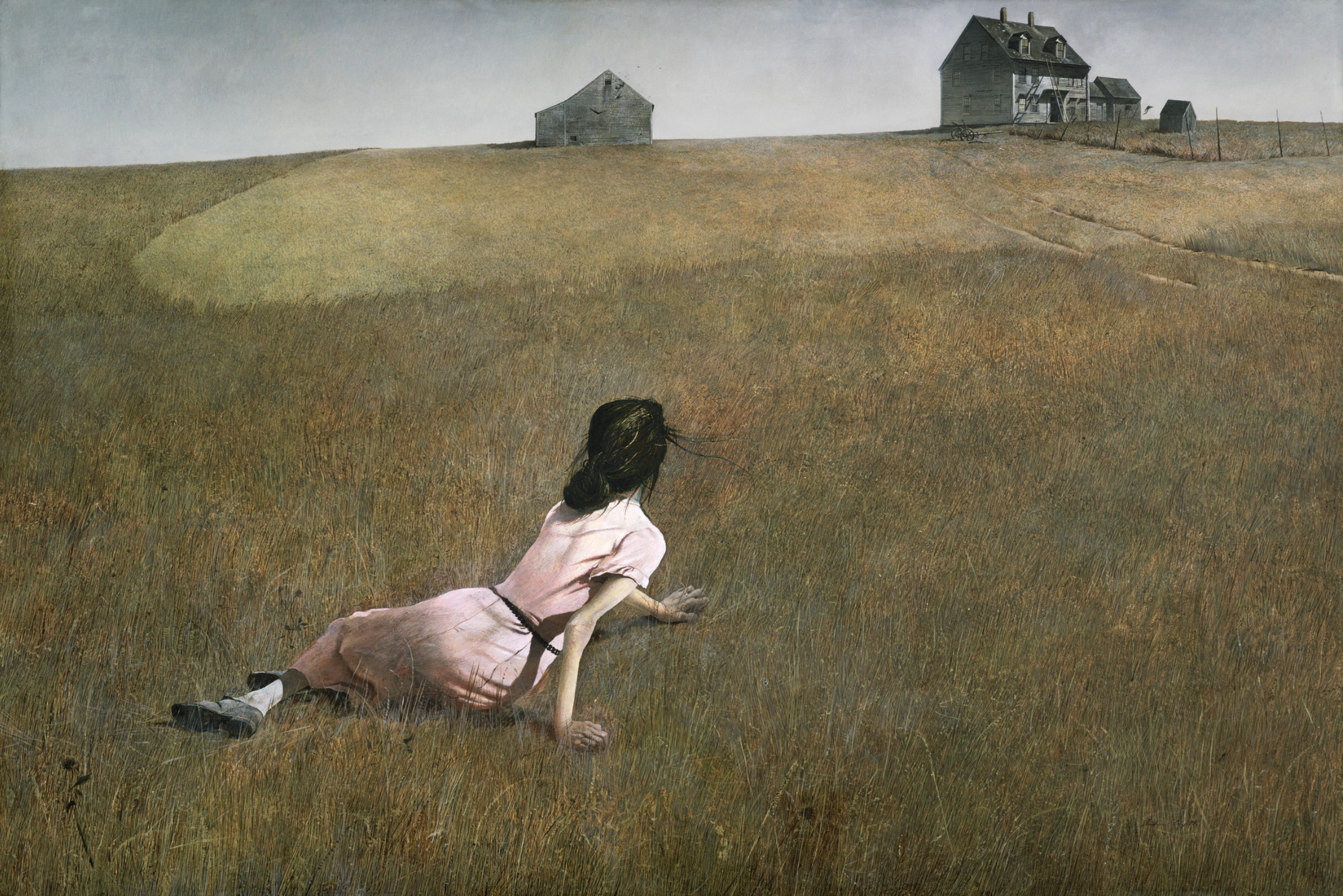
Artist, Title, Date
Andrew Wyeth, Christina’s World, 1948. Egg tempera on gessoed panel. Museum of Modern Art, New York City, New York.
Description of Disease & Etiology
Charcot–Marie–Tooth disease (CMT) is a group of inherited peripheral neuropathies characterized by slowly progressive distal weakness, atrophy, sensory loss, and foot deformities. CMT most commonly involves abnormal myelin production from Schwann cells with additional axonal structural or functional damage resulting in impaired nerve conduction and subsequent denervation. This results in motor and sensory deficits of peripheral nerves, while autonomic involvement is usually minor. It is among one of the most common genetic neurologic disorders, seen in roughly 1 in 2,500 people. Symptom onset usually occurs within the first two decades of life, frequently before age twenty, and frequently before the first decade in many demyelinating cases; however, the range is wide, spanning severe infantile disease to mild forms that only appear in mid-adulthood. Most subtypes, including the common CMT1A, affect males and females roughly equally; the exception is CMTX1, the X-linked form, in which hemizygous males are usually affected earlier and more severely. Progression is usually slow, taking years or decades, and the majority of patients are ambulatory throughout life.
Pathology
The disease involves numerous different genetic etiologies leading to various phenotypes. In CMT1, the most common variant, there is segmental demyelination and subsequent remyelination resulting in characteristic “onion bulb” formations, leading to markedly slowed nerve conduction. CMT2 primarily involves axonal damage with relatively preserved myelin. CMTX1 predominates in males and is often more severe, and there exist intermediate forms of CMT which involve characteristics of multiple different forms. Critically, genotype determines severity, and the breadth of phenotypes reflects the gene involved and the nature of the mutation. In CMT1A, progression is usually uniform and slow, resulting in mild to moderate disease in most patients. In contrast, certain point mutations (PMP22, MPX, etc.) can yield far more severe, early-onset disease. For instance, MPZ and certain PMP22 mutations underlie the severe infantile phenotypes like Dejerine-Sottas disease and congenital hypomyelinating neuropathy. Alternatively, X-linked CMTX1, due to GJB1 (connexin-32) mutations, occupies an intermediate electrophysiologic range and, as noted, is expressed more severely in hemizygous males. Therefore, the same diagnostic label encompasses a spectrum, from barely perceptible deficits to wheelchair dependence. Forecasting an individual patient’s trajectory increasingly depends on identifying the specific causative variant rather than the clinical syndrome alone.
Signs / Signifiers of Illness
CMT is an insidious, length-dependent demyelinating disease with signs and symptoms related to distal weakness and atrophy. Sensory loss is common, including loss of vibratory sense and proprioception, while loss of pain and temperature is less common. Areflexia of knees and ankles is also seen. People with CMT often develop pes cavus, or “hammertoes”, due to progressive foot denervation, as well as Achilles tightness and a steppage gait with foot drop. Some forms of CMT (Roussy-Levy) may even involve tremor, hearing impairment, and (rarely) phrenic and/or diaphragmatic involvement. Red flags for alternative diagnoses or severe disease include rapid progression of symptoms, asymmetric symptomology, proximal weakness more prominent than distal weakness, rashes, weight loss, or other systemic features. Diagnosis is often done through Electromyography, showing demyelinating or axonal patterns, and genetic testing.
Wyeth’s painting itself supplies a striking record of the disease’s outward signifiers. Christina is rendered prone in an open field, propping her upper body on conspicuously thin, wasted arms; the elbow forms a prominent bony knob, and the hands appear clawed and gnarled as they grip the grass. This distal-predominant wasting of the upper limbs with intrinsic hand atrophy producing a claw-like posture is precisely the pattern expected in a length-dependent peripheral neuropathy such as CMT. Her lower limbs are largely concealed beneath her body and skirt, so the foot deformities and calf wasting characteristic of the disease are not directly visible; their absence from view, however, does not argue against them. Notably, she is depicted on the ground with no wheelchair, cane, walker, or other ambulatory aid anywhere in the frame, her gaze fixed on a farmhouse set atop a distant rise.
Approached as if she were a patient encountered in clinic, the scene permits a cautious clinical reading. Her posture and the conspicuous absence of any assistive device suggest that she cannot reach the house on foot and is instead navigating her world by crawling, a degree of disability that implies profound, predominantly lower-limb involvement. This is not merely hypothetical: the painting’s real subject, Anna Christina Olson, was in her fifties and had been symptomatic for decades, and her disorder was long attributed to poliomyelitis before a retrospective neurologic analysis argued that a form of Charcot–Marie–Tooth disease was the more likely cause. The natural next steps in clinic would be electrodiagnostic studies and genetic testing, to localize the lesion to peripheral nerve and to subtype the disease. The setting is equally informative: an isolated, rural farmstead implies meaningful distance from neuromuscular specialty care, probable dependence on another person or a vehicle for transport, and a home environment poorly adapted to limited mobility. Her solitude in the frame, with no caregiver or companion in view, raises the practical clinical questions of who assists her at home, how she accomplishes activities of daily living, and what her risk is for falls, pressure injury, and social isolation.
Treatment
There remains no established therapy for CMT. However, there are emerging trials for small-molecule therapies, gene-targeted strategies, and myelin or axonal support medications which may prove useful in the future. Currently, the best treatment options include supportive care through physical and occupational therapy, orthotics to increase mobility, surgical options for severe deformities, pain management, and genetic counseling.
Social Determinants of Illness
While there is no primary therapy for CMT, supportive care involves numerous aspects of the healthcare system, which in turn require proper coordination and thus proper access to healthcare. Insurance coverage for orthotics, physical and occupational therapy, and other aspects of care remains a hurdle for many, while geographic factors may limit access to various neuromuscular clinics, geneticists, and surgeons. Additionally, accommodations in school and at various places of work are needed to allow proper societal participation for individuals with CMT. There remains a large burden of stigma in society around visible deformities, gait changes, and the need for assistive devices/orthotics, which can in turn lead to decreased social participation and anxiety or depression for individuals suffering from CMT. Support groups may prove helpful for many individuals. Beyond access barriers, progressive disability carries substantial economic consequences: declining motor function can erode earning capacity and threaten long-term financial stability, even as out-of-pocket costs for orthotics, therapy, and assistive devices accumulate. The burden also extends to families, as partners, parents, or siblings frequently assume demanding caregiving roles, a reality embodied in the rural isolation of Wyeth’s scene, where reaching care may depend on another person and a vehicle and where the physical and emotional toll on caregivers can be considerable. Attending to caregiver support, transportation, and economic security is therefore as much a part of comprehensive CMT care as the medical and surgical management itself.
Author(s): Michael Motoc
Citations:
Bird, Thomas D. “Charcot-Marie-Tooth Hereditary Neuropathy Overview.” GeneReviews® [Internet]., U.S. National Library of Medicine, 23 Jan. 2025, www.ncbi.nlm.nih.gov/books/NBK1358/.
Laurá, Matilde et al. “Charcot-Marie-Tooth disease and related disorders: an evolving landscape.” Current opinion in neurology vol. 32,5 (2019): 641-650. doi:10.1097/WCO.0000000000000735
Chakravorty, S., Logan, R., Elson, M.J. et al. Expanding the genotype–phenotype correlation of childhood sensory polyneuropathy of genetic origin. Sci Rep 10, 16184 (2020). https://doi.org/10.1038/s41598-020-73219-5
England, J. D., et al. “Practice parameter: Evaluation of distal symmetric polyneuropathy: Role of laboratory and genetic testing (an evidence-based review).” Neurology, vol. 72, no. 2, 13 Jan. 2009, pp. 185–192, https://doi.org/10.1212/01.wnl.0000336370.51010.a1.
Hattori, Naoki et al. “Demyelinating and axonal features of Charcot-Marie-Tooth disease with mutations of myelin-related proteins (PMP22, MPZ and Cx32): a clinicopathological study of 205 Japanese patients.” Brain: a journal of neurology vol. 126, Pt 1 (2003): 134-51. doi:10.1093/brain/awg012
Griffin, Randall C. “Andrew Wyeth’s Christina’s World: Normalizing the Abnormal Body.” American Art, vol. 24, no. 2, 2010, pp. 30–49. doi:10.1086/656458
Patterson, Marc C., et al. “A Patient as Art: Andrew Wyeth’s Portrayal of Christina Olson’s Neurologic Disorder in Christina’s World.” Journal of Child Neurology, vol. 32, no. 7, 2017, pp. 647–649. doi:10.1177/0883073817700603