Artist, Title, Date
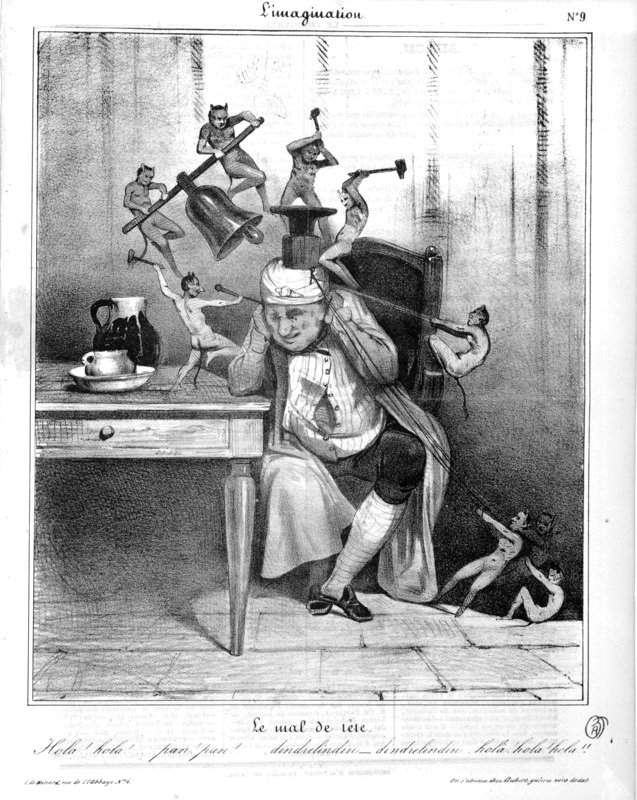
“Le mal de tête,” or "The Headache," for L’Imagination. Honoré Daumier. Lithograph. 1833.
Description of Disease & Etiology
Migraine is a common, disabling primary headache disorder characterized by recurrent attacks of moderate to severe head pain often accompanied by nausea, photophobia, phonophobia, and, in many patients, transient visual-neurologic symptoms known as aura. In “Le mal de tête”, Honoré Daumier depicts a solitary figure hunched forward, hands pressed firmly against the head, seemingly agonized by the constant torturous racket made by a group of fiendish figures. Although the lithograph predates modern neurology, it captures the phenomenology of migraine, including its associated pain, throbbing quality, and agonizing nuisance with striking clinical accuracy.
Migraine is now understood as a complex neurobiological disorder with strong genetic underpinnings. Genome-wide association studies have identified multiple loci involved in neuronal excitability, synaptic transmission, and vascular regulation. Environmental triggers such as stress, sleep disruption, hormonal fluctuations, and dietary factors interact with this genetic susceptibility to precipitate attacks. Daumier’s work reflects a period when migraine was poorly differentiated from moral weakness, nervous exhaustion, or psychosomatic illness, particularly in urban, industrializing societies. Moreover, he draws both a moralizing and playful quality to his work, highlighting the socio-religious impact migraine may have on one’s life.
Pathology
Contemporary models describe migraine as a disorder of brain network excitability rather than a purely vascular phenomenon. Central to migraine with aura is cortical spreading depression, a slowly propagating wave of neuronal and glial depolarization followed by suppression of cortical activity. This phenomenon is closely linked to transient neurologic symptoms and may initiate downstream activation of the trigeminovascular system, leading to headache pain felt in one specific location.<span id="during-the-headache-phase-trigeminal-afferents-innervating-the-meninges-release-neuropeptides-such-as-calcitonin-gene-related-peptide-cgrp-substance-p-and-neurokinin-a-resulting-in-neurogenic-inflammation-and-central-sensitization.-functional-neuroimaging-has-demonstrated-altered-activity-in-the-brainstem-hypothalamus-and-cortical-pain-networks-both-during-and-even-between-attacks-supporting-the-concept-of-migraine-as-a-chronic-brain-disorder-rather-than-an-episodic-vascular-event."> During the headache phase, trigeminal afferents innervating the meninges release neuropeptides such as calcitonin gene-related peptide (CGRP), substance P, and neurokinin A, resulting in neurogenic inflammation and central sensitization. Functional neuroimaging has demonstrated altered activity in the brainstem, hypothalamus, and cortical pain networks both during and even between attacks, supporting the concept of migraine as a chronic brain disorder rather than an episodic vascular event.
Signs/Signifiers of Illness
Clinically, migraine presents with unilateral or bilateral pulsating head pain that worsens with physical activity and is frequently accompanied by nausea, vomiting, photophobia, and phonophobia. Aura symptoms, when present, typically evolve gradually over minutes and resolve within an hour. Daumier’s visual depiction of an individual with compressed posture, exaggerated facial tension, and withdrawal from social interaction serves as a signifier of the invisible but overwhelming nature of migraine pain. The lithograph also reflects the cognitive and affective dimensions of migraine. Patients often report difficulty concentrating, irritability, and a desire for isolation during attacks. These features, though non-specific, are essential to understanding migraine as a disorder that disrupts not only sensory processing but also emotional regulation and social functioning.
Treatment
Modern migraine management is multifaceted and includes both acute and preventive strategies. Acute treatments aim to abort attacks and include nonsteroidal anti-inflammatory drugs, triptans, gepants, and ditans. Preventive therapies are indicated for patients with frequent or disabling attacks and may include beta-blockers, antiepileptic drugs, antidepressants, and monoclonal antibodies targeting CGRP or its receptor. Non-pharmacologic approaches remain essential and include sleep regulation, stress management, cognitive behavioral therapy, and identification of individual triggers. The contrast between these evidence-based interventions and the therapeutic nihilism of Daumier’s era underscores the profound advances in neuroscience and headache medicine over the past century.
Social Determinants of Illness
Migraine disproportionately affects women and individuals of working age, contributing to substantial personal and societal burden. Access to healthcare, socioeconomic status, occupational demands, and cultural attitudes toward pain significantly influence diagnosis and treatment. Historically, migraine sufferers, particularly women, were often dismissed as hysterical or overly sensitive, a bias that delayed scientific understanding and effective care. Daumier’s lithograph, produced in a context of rapid urbanization and social stratification, reflects the intersection of neurologic illness and social stress. Even today, stigma and under-recognition persist, highlighting the importance of integrating biomedical advances with social awareness to fully address the impact of migraine.
Author (s): Michael Motoc
Citations: * 1) Goadsby PJ, Holland PR, Martins-Oliveira M, Hoffmann J, Schankin C, Akerman S. Pathophysiology of Migraine: A Disorder of Sensory Processing. Physiol Rev. 2017;97(2):553-622. doi:10.1152/physrev.00034.2015 * 2) Charles A. The pathophysiology of migraine: implications for clinical management. Lancet Neurol. 2018;17(2):174-182. doi:10.1016/S1474-4422(17)30435-0 * 3) Wattiez, Anne-Sophie et al. “Calcitonin gene-related peptide (CGRP): role in migraine pathophysiology and therapeutic targeting.” Expert opinion on therapeutic targets vol. 24,2 (2020): 91-100. doi:10.1080/14728222.2020.1724285 * 4) Lauritzen M. Pathophysiology of the migraine aura. The spreading depression theory. Brain. 1994;117 ( Pt 1):199-210. doi:10.1093/brain/117.1.199 * 5) Olesen J, Burstein R, Ashina M, Tfelt-Hansen P. Origin of pain in migraine: evidence for peripheral sensitisation. Lancet Neurol. 2009;8(7):679-690. doi:10.1016/S1474-4422(09)70090-0 * 6) Dodick DW, Silberstein SD. Migraine prevention. Pract Neurol. 2007;7(6):383-393. doi:10.1136/jnnp.2007.134023