Artist/ Group/Tribe, etc.
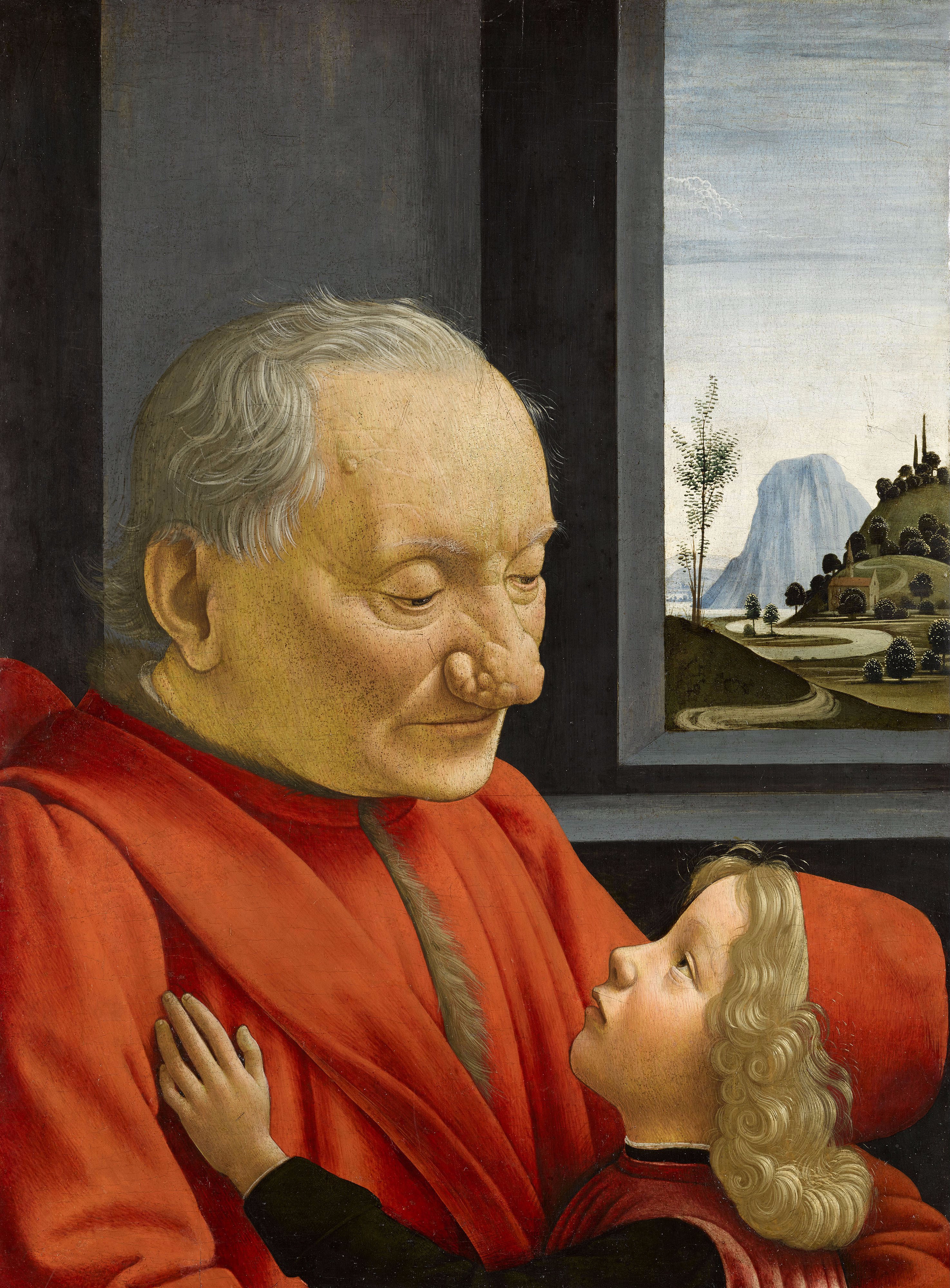
Old Man with a Child, Domenico Ghirlandaio 1449-1494 (Italian)
Medium, time frame
Egg tempera on poplar panel, 1480 (quattrocento / Italian Renaissance )
Symbolism, iconography
The composition centers on the intimate representation of an old man, characterized by the visible effects of rhinophyma, and a young boy. The elder is depicted as a well-to-do figure, attired in bright, fur-lined red robes known as a lucco, with a cappuccio headdress draped over his shoulder. Beside him, the little boy looks upward, his head crowned by soft golden curls and a red cap that matches his doublet. Their eyes are locked in a profound mutual gaze, emphasized by the boy’s small hand reaching out to rest tenderly upon the old man’s chest. In the background, a window displays a mountainous landscape featuring a body of water rendered with atmospheric perspective, offset by the presence of a plain stone wall.
Historical context
Born into a family of craftsmen and shopkeepers, Domenico Ghirlandaio was apprenticed to a goldsmith at fifteen, considered an elite profession, although he eventually turned his talents toward painting. Before the Quattrocento, portraits of an individualistic nature were largely unknown. This work emerged from the rise of humanism and a renewed interest in the individual human being and its representation, making this particular portrait especially unique. The biographer Vasari described Ghirlandaio as “the greatest delight of the period,” noting his primary fame as a fresco painter. This background is evident in his technique here: the simplified composition, precise drawing, and flat decoration with hard colors are hallmarks of his style, as is the characteristic landscape. There is a distinct emphasis on physiognomy, reflecting a Renaissance tension between the representation of the physical body and the more abstract qualities of the mind.
Socio-cultural context and influences
Ghirlandaio’s painting style was significantly affected by Netherlandish influences, particularly in the adoption of oil painting techniques and a heightened realism. While Florentine artists were already renowned for their mastery of portraiture, this work makes an important statement about the significance of family during this era, capturing the emotions and mutual regard that served as the bedrock of society. Furthermore, the practice of physiognomy, that is, the study of facial features to determine character, was common at the time, as evidenced by the later writings of figures like Giovanni Battista della Porta and Ciro Spontone.
Significance (elements of art/ principles of design)
In this composition, the man’s head is slightly inclined to minimize the visual impact of his deformity. The work explores two paradigms of aging: physical and mental decline as an unredeemable loss, versus a mixture of decline tempered by opportunities for growth. This sentiment is echoed in the idea that “a good man widens for himself his age's span; he lives twice who can find delight in life bygone.”
The landscape, with its peaceful, meandering river, represents the flow of time and generational continuity. This reinforces the theme of intergenerational bonding and exchange; without the child, the old man might be dismissed for his unsightly nose and pigmented skin. However, the child does not see these flaws, instead perceiving the man’s personhood and an inner grace. While the figures remain unknown, the child may be included as a narrative device to increase the man’s perceived beneficence, at odds with the physiognomic norms of the time. Their tender conversation takes place at a window, which symbolizes a point of transition, proving that “there is nothing more beautiful in this world than a healthy wise elderly person... talking in a soothing voice about life as one who knows it.”
Author(s): Christina Olszewski
Citations:
Cadogan, Jean. Domenico Ghirlandaio. Reprint, London: Reaktion Books, 2025. https://www.perlego.com/book/5279634.
Kauppinen, Heta, and Patrick McKee. "Old Age, Painting, and Gerontology." The Journal of Aesthetic Education 22, no. 2 (Summer 1988): 87–100. JSTOR https://www.jstor.org/stable/3333125
Loh, Maria H. "Renaissance Faciality." Oxford Art Journal 32, no. 3 (2009): 341, 343–63. JSTOR https://www.jstor.org/stable/25650874
Valentiner, W. R. "PORTRAIT OF AN OLD MAN BY DOMENICO GHIRLANDAIO." Bulletin of the Detroit Institute of Arts of the City of Detroit 13, no. 1 (October 1931): 5–7. JSTOR https://www.jstor.org/stable/41501484
Zöllner, Frank. "The 'Motions of the Mind' in Renaissance Portraits: The Spiritual Dimension of Portraiture." Zeitschrift für Kunstgeschichte 68, no. 1 (2005): 23–40. JSTOR https://www.jstor.org/stable/20474