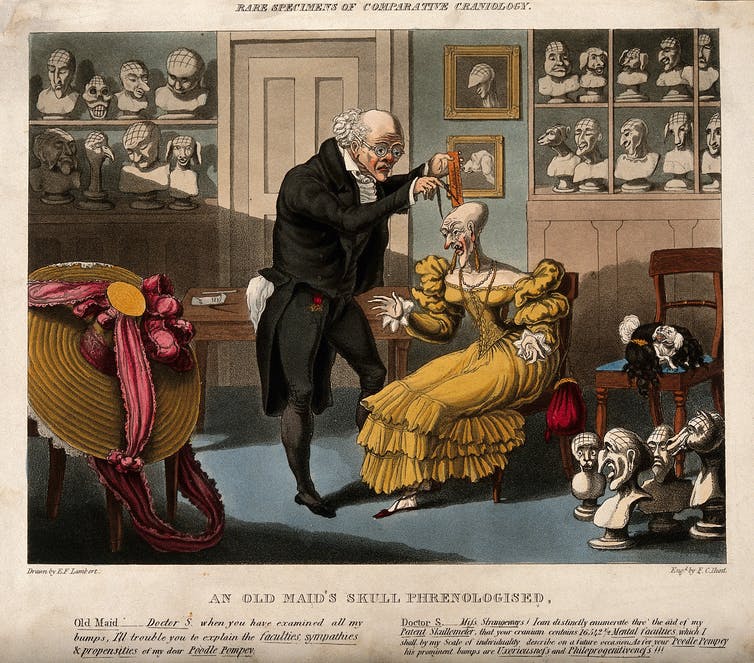
Old Maids Skull
Phrenology emerged in the late 18th and early 19th centuries as a purportedly scientific study of the relationship between the shape of the skull and mental faculties. Founded by the German physician Franz Joseph Gall (1758–1828), phrenology was based upon the notion that the brain and its mental faculties—such as behavior, intelligence, or even violence—were localized in specific regions of the cerebral cortex. While this was not a faulty assumption, Gall and his followers, particularly Johann Spurzheim, derived increasingly flawed relationships between the size and contour of these brain regions. For instance they believed that the measurement of the skull’s surface would enable scientists and physicians to make wider conclusions and assessments of a person’s character, intelligence, and moral tendencies (Gall, 1835).
Phrenology initially held appeal within medical and scientific circles. At the time, neurology and psychiatry were in their infancy, and phrenology appeared to offer a rigorous, methodical approach to understanding the mind-body connection. The discipline’s emphasis on brain localization contributed, in a limited way, to the later development of neuroscience, as it encouraged researchers to consider that specific brain areas might serve distinct functions (Finger, 1994). Moreover, its understanding of the brain as a “geometric” organ, in the sense that both its arrangement and size could impact function or the lack-thereof. However, phrenology’s methods—including palpating skulls to infer psychological traits—were based on faulty premises without concrete medical evidence for its validity. The assumption that cranial contours reflected underlying brain structure was anatomically incorrect; skull thickness and shape bear little consistent relationship to cortical topography.
Despite its scientific shortcomings, phrenology gained immense popularity in Europe and the United States during the 19th century. Its appeal lay partly in its promise of self-knowledge and social order—it suggested that moral and intellectual capacity could be objectively measured. However, this objectivity was illusory and arrived during a period of increasing scientific progress in which societal excitement allowed many sensational-yet-flawed scientific ideas to disseminate without proper scrutiny. Phrenology quickly became intertwined with social hierarchies and emerging racial theories. Practitioners used phrenological charts to “prove” the intellectual superiority of Europeans and the inferiority of other races, providing a seemingly rigorous, legitimate, and objective veneer to racism, colonialism, and eugenic ideologies (Stepan, 1982). The “scientific” ranking of skulls and faculties mirrored and reinforced existing social biases, promoting the idea that moral virtue and intelligence were biologically predetermined and unequally distributed among populations.
By the late 19th century, advances in experimental psychology and neuroanatomy had discredited phrenology as a science. Researchers such as Pierre Flourens demonstrated through lesion studies that while different regions of the brain contributed to different functions, complex behaviors themselves could not be localized to discrete brain “organs” as Gall proposed (Flourens, 1842). Yet the legacy of phrenology persisted—its emphasis on quantifying human worth through biological traits influenced later pseudosciences like craniometry and physiognomy, both of which underpinned eugenic movements in the early 20th century. These movements were used to justify racial discrimination, sterilization, and restrictive immigration laws under the guise of biological improvement (Gould, 1981), and became important underpinnings of numerous global conflicts and atrocities, subsequently shaping the development of the modern world.
Phrenology thus occupies a paradoxical place in medical and scientific history. While it encouraged the anatomical study of the brain and contributed an important geometric and geographic study of the brain, it also exemplified the dangers of conflating empirical observation with social prejudice. Its history underscores a crucial lesson for modern medical science: that claims of biological determinism, when uncritically accepted or socially motivated, can lead to the misuse of medicine and science to rationalize inequality.
'''References '''
* Gall, F. J. (1835). On the Functions of the Brain and of Each of Its Parts. Boston: Marsh, Capen & Lyon.
* Finger, S. (1994). Origins of Neuroscience: A History of Explorations into Brain Function. Oxford University Press.
* Flourens, P. (1842). Recherches Expérimentales sur les Propriétés et les Fonctions du Système Nerveux. Paris: Baillière.
* Stepan, N. L. (1982). The Idea of Race in Science: Great Britain 1800–1960. Macmillan.
* Gould, S. J. (1981). The Mismeasure of Man. W. W. Norton & Company.